In 2024, a new American biotech made a decision that would give it very little room to hide. Navigator Medicines licensed an antibody from South Korea's IMBiologics, called it NAV-240, and raised $100 million to find out whether its neat biological theory could survive contact with a complicated human disease. The theory: if inflammation runs along more than one route, perhaps one drug should close more than one route at a time.
That sounds obvious until you remember how medicine works. A plausible mechanism can produce a persuasive diagram, encouraging early blood tests, even a handsome financing round. None of those things can tell a person with hidradenitis suppurativa, or HS, whether the next flare will be less painful. Navigator has reached the part of its story where the diagram must answer to the patient.
- Navigator develops investigational antibodies for inflammatory and autoimmune disease; neither candidate is an approved medicine.
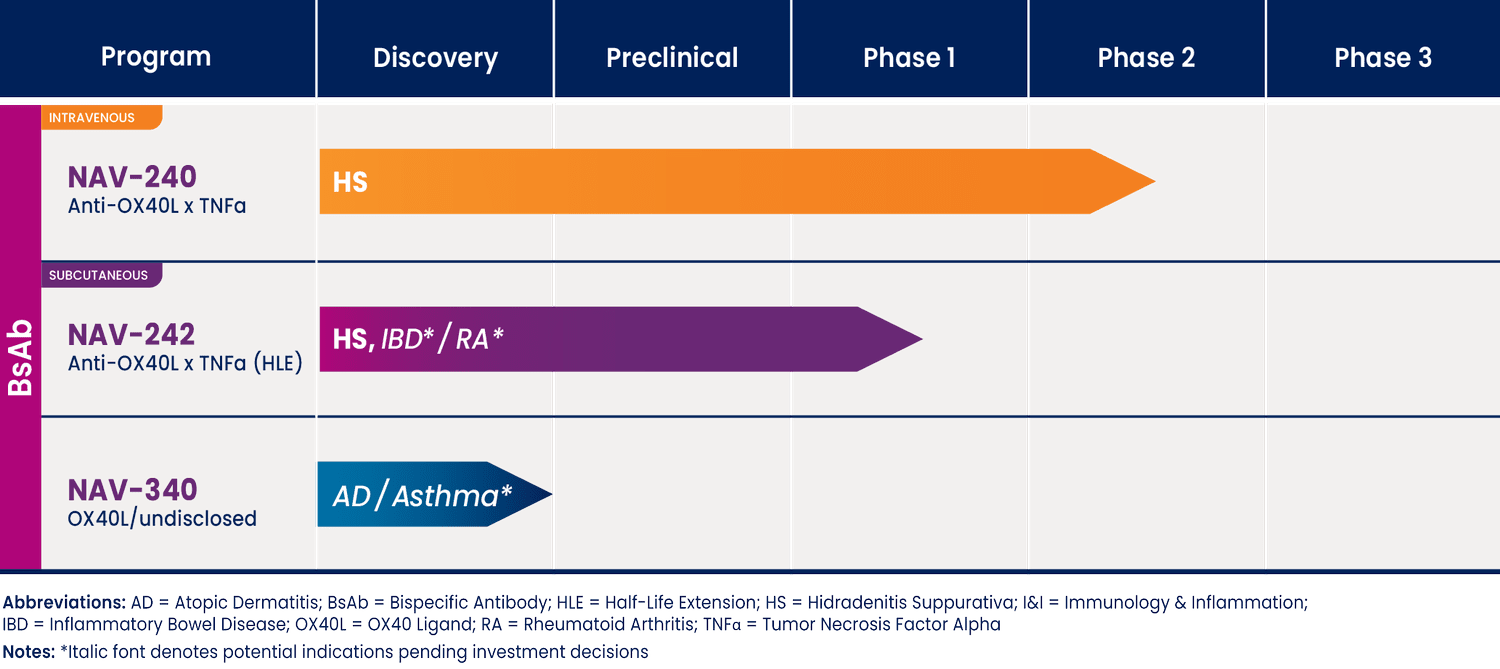
- NAV-240 blocks OX40L and TNFα and is in a Phase 2a trial for moderate to severe HS.
- NAV-242 uses the same two-target approach and is designed for a longer interval between subcutaneous doses.
- Its announced financing is a $100 million Series A, co-led by RA Capital Management and Forbion.
A disease with more than one culprit
HS causes recurrent, painful lumps, abscesses and draining tunnels, often where skin rubs together. Its effect reaches beyond skin: sitting, moving, intimacy and work can all become negotiations with a condition that returns. Existing care includes antibiotics, surgery and biologic drugs aimed at individual inflammatory pathways. For some patients, those treatments help. For many, the relief is incomplete.
Navigator's answer is a bispecific antibody, a single engineered molecule with two targets. One is TNFα, a familiar signal in inflammatory medicine. The other is OX40L, involved in communication that sustains immune responses. By inhibiting both, the company hopes to improve on what either target might achieve alone. It is an argument about the complexity of disease, not yet a demonstrated advantage over an approved therapy.
A company built around an asset
Navigator was formed in 2024 as a subsidiary of Sera Medicines, the biologics-focused accelerator led by co-founder Stephen Thomas. It did not begin by announcing a vast discovery platform and waiting for a molecule to emerge. It licensed a clinical-stage program already known as IMB101 from IMBiologics, renamed it NAV-240, and assembled capital and development talent around it. The August 2024 Series A gave the company $100 million to advance that candidate and a broader OX40L-focused portfolio. That figure is funding raised, not a disclosed price for the license; the license's financial terms have not been made public.
This arrangement reveals the company's business model. Navigator is a venture-backed drug developer, spending capital on clinical evidence now in the hope of a future approved medicine or commercial partnership. There is no pharmacy shelf, subscription plan or paying patient base to point to. Its immediate audience includes trial participants, investigators, regulators and investors. Its intended eventual users are people living with difficult inflammatory disease, starting with adults with moderate to severe HS.

The team reflects that development job. Tausif “Tosh” Butt became CEO in February 2025 after leadership roles at Idorsia and ChemoCentryx. Dana McClintock joined as chief medical officer when the license and financing were announced. Chief scientific officer Kristie Grebe leads research and development. These are appointments aimed at taking a molecule through trials, where the expensive surprises tend to arrive.
The first evidence, and its limit
Navigator's Phase 1a study gave NAV-240 to 40 healthy volunteers in single ascending doses. The company reported no serious adverse events and no treatment-emergent adverse events that caused a participant to leave. Drug concentration rose with dose; a blood marker called TARC fell with higher exposure. A later multiple-dose study involved 24 healthy volunteers and, according to results presented in March 2026, showed a favorable safety and tolerability profile with predictable pharmacokinetics and low immunogenicity.
These findings mattered because they supported moving forward. They did not establish that NAV-240 reduces HS lesions. Healthy volunteers do not have the disease being treated; a biomarker is not a draining tunnel that stops draining. That distinction is where many otherwise promising drug stories lose their plot.
“Results of the Phase 1b study presented at AAD provide a strong foundation for NAV-240.”Dana McClintock, chief medical officer, March 2026
The pivotal next scene is MAINSAIL, Navigator's randomized, double-blind, placebo-controlled Phase 2a study. The company announced the first patient dosed in March 2026. The trial asks whether NAV-240 helps adults with moderate to severe HS, tracking abscesses, nodules, draining tunnels and quality of life. Its primary response measure looks for a substantial reduction in inflammatory lesions at week 16 without an increase in abscesses or draining tunnels. Navigator expects results in the second half of 2027.
The second candidate is about time
NAV-242 is Navigator's follow-on antibody, again aimed at OX40L and TNFα. Its distinctive feature is an engineered longer half-life and subcutaneous delivery. In animal work, the company reported improved stability and exposure compared with NAV-240, suggesting the possibility of dosing every other month or perhaps quarterly. “Possibility” is the important word: clinical trials must establish whether that schedule is safe, effective and practical in people.
Navigator announced the first Phase 1 participant dosed in March 2026, after Australian ethics approval. The study starts with safety and drug behavior, then includes people with HS. Having two clinical candidates creates options, but it also ties them to the same underlying bet. If the dual-target idea disappoints, longer intervals alone will not rescue it.
The test worth watching
There is a useful lesson in Navigator's design. It chose an existing clinical asset, raised enough to put it through a meaningful study, and selected endpoints patients could recognize in their own lives. The licensing route can shorten the walk from company formation to trial, provided the asset is available, the rights are clear, investors will fund the risk, and a team can run the study. It does not make the biology more forgiving.
The company stands in a crowded immunology market with established single-target biologics and other experimental approaches. Its difference is sharply stated: inhibit OX40L and TNFα in the same molecule, and perhaps deliver broader control with a tolerable schedule. The phrase “perhaps” does a great deal of work here. If MAINSAIL delivers convincing improvements in symptoms and quality of life, it becomes a different kind of company. Until then, Navigator is what the best young biotechs really are: a disciplined question with a budget.