Imagine hiring a courier who knows a precise street address but cannot get through the front door. Genetic medicine has lived with a version of that predicament for years. Researchers can design molecules that change what a cell makes, or edit a stretch of DNA. Getting enough of those molecules into the right tissue, and then into the useful part of its cells, is another trade entirely. Evercrisp Biosciences was formed around that less glamorous trade: the journey.
- Evercrisp designs small proteins meant to carry RNA medicines and gene editors to selected cells.
- Its work is preclinical. A promising binder or a conference presentation is not a treatment.
- An investor funding dispute interrupted research; a court record says staffing fell from 19 to four.
- The decisive next tests concern tissue distribution, biological activity, and reliable delivery inside cells.
Founded in 2021 by Jennifer Doudna, Tanja Kortemme and Spiros Liras, the company has a plausible division of labor. Doudna helped establish CRISPR as a programmable editing tool. Kortemme works in computational protein design. Liras brought drug development and venture experience. Evercrisp’s current website lists Meenu Chhabra Karson as CEO and describes an office in South San Francisco, even as its Berkeley origins remain part of its identity.
The courier is the product
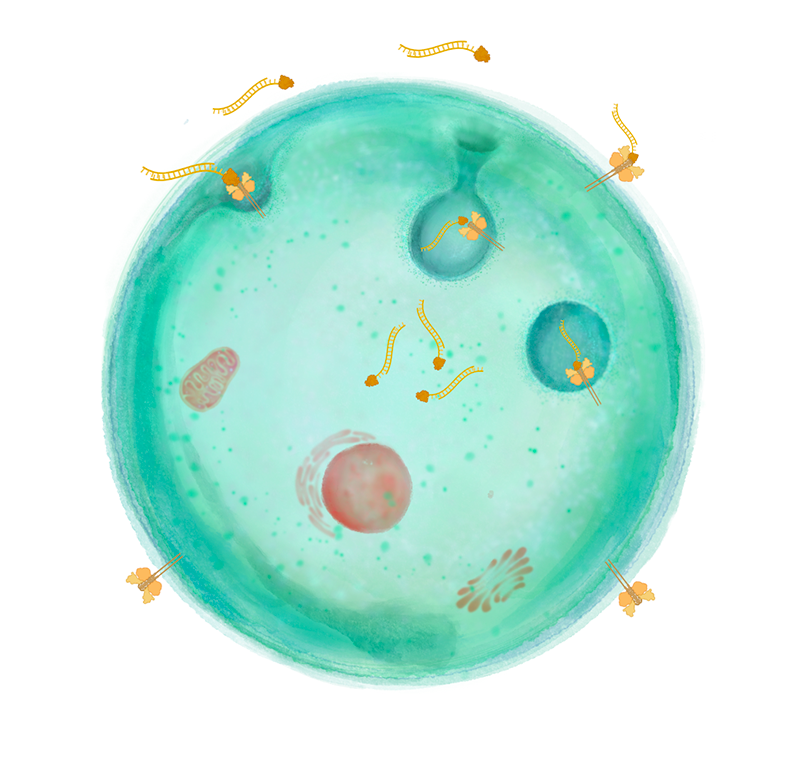
Evercrisp’s proposed courier is a miniprotein, engineered to recognize a receptor on a cell’s surface. The company says it uses machine learning to design these proteins, then attaches therapeutic cargo: an antisense oligonucleotide, a small interfering RNA, or a CRISPR protein complex. The receptor acts like a doorbell. Binding can trigger uptake into the cell. Other engineered elements are meant to help the cargo escape the endosome, the membrane-bound compartment that often traps incoming material.
Mechanism shown as Evercrisp proposes it; a useful therapy requires more evidence at every step.
This is distinct from sending a genetic payload inside a viral vector or a lipid nanoparticle. Those approaches have achieved real clinical progress, but a new delivery method might reach tissues they serve poorly or permit a different dosing pattern. Evercrisp names brain, kidney and muscle as ambitions. The word “might” matters here. Better cell entry in a laboratory does not automatically mean selective distribution through a living body, a safe repeat dose, or a durable clinical benefit.
A sixfold clue, and the missing experiment
The company publicly discussed two preclinical projects at the 2025 meeting of the American Society of Gene & Cell Therapy. One presentation concerned cell-surface receptor targeting for oligonucleotides. The other addressed designed miniproteins for delivery of gene editors to challenging tissues. These are research presentations, not evidence of an approved medicine or a human trial. They also show a broader public emphasis: UC Berkeley describes the company around self-delivering CRISPR editors, while the 2025 program gave oligonucleotide delivery an oral presentation of its own. The public record does not establish why the mix changed.
A later investor report offered a more specific clue. Evercrisp had identified a miniprotein that bound nephrin, a kidney-associated protein, with more than six times the binding of its previous best binder. It also reported selecting ApoL1 siRNA sequences and working on muscle delivery of siRNA cargo for Duchenne muscular dystrophy. Binding strength is one component of a medicine. It does not tell us how much reaches the kidney, which other tissues receive it, or whether the RNA produces the intended effect in vivo. The report said those constructs still needed animal evaluation before candidate selection.
The same platform could be useful to several kinds of drug developer. An RNA company may want targeted uptake at a lower dose. A genome-editing company may want to send a CRISPR ribonucleoprotein into a tissue without the usual delivery vehicle. Evercrisp appears to pursue both its own therapeutic programs and potential business development agreements with other biotechs. It has invited prospective partners to contact it. No named paying customer, license deal or commercial product is public.

When the cash stopped moving
In experimental biotech, the distinction between a plan and a result often has an invoice attached. An Apple Tree Partners investor report put its investment in Evercrisp at $26 million by mid-2025. That figure is cumulative investor spending, not a single funding round and not the cost of one product. A company database records an initial $3.5 million Series A financing in August 2021. The two numbers describe different moments.
The investor report also said a dispute over funding had reduced Evercrisp’s workforce from 19 people to four. Work on a revised delivery approach, guide chemistry and other programs stopped. Evercrisp entered a Chapter 11 case in January 2026 as part of a group of Apple Tree-related companies. A bankruptcy court order later authorized approximately $1.45 million in portfolio funding for Evercrisp. Authorization is not proof that all of that money reached the lab.
A receptor can admit a molecule. It cannot pay a contract research organization.What the court filings make painfully concrete
A February court filing lists the services Evercrisp hoped to restore: in vivo studies at CRADL, protein production at Biometas, tissue analysis at Histobridge, chemistry work at ChemPartner, and library access at Tango Biosciences. The purpose was to produce biodistribution, selectivity and stability data for candidate selection and potential partners. These are the ordinary measurements that decide whether a delivery idea survives contact with an animal. Their suspension was not an abstract corporate setback; it halted the evidence-making machinery.
By August 2026, a filing said Evercrisp planned to produce in vivo biodistribution and muscle knockdown or functional data by the fourth quarter, while resolving endosomal escape and conjugation work. That was a plan as of the filing, not a reported result. It describes the next sensible question with unusual clarity: did the intended payload reach the intended tissue and do something useful there?
What the experiment can teach
For a researcher or founder, the reusable lesson is less romantic than “design a better protein.” Pick a receptor with a plausible tissue address. Measure binding, then distribution, then functional payload activity. Put endosomal escape on the same scorecard as cell entry. Compare against the delivery methods a partner actually uses. And budget for the outside studies that make each answer credible before declaring the platform versatile.
The approach would struggle if the receptor appears widely in healthy tissue, if the protein binds beautifully but releases little cargo, if immune reactions or repeat dosing spoil the advantage, or if manufacturing cannot be scaled at a tolerable cost. Evercrisp’s own filings show another condition: even strong preclinical designs can stall when the next experiment cannot be financed. It is a company with an interesting courier, a list of destinations, and a very exacting route map. The arrival notice is still to come.