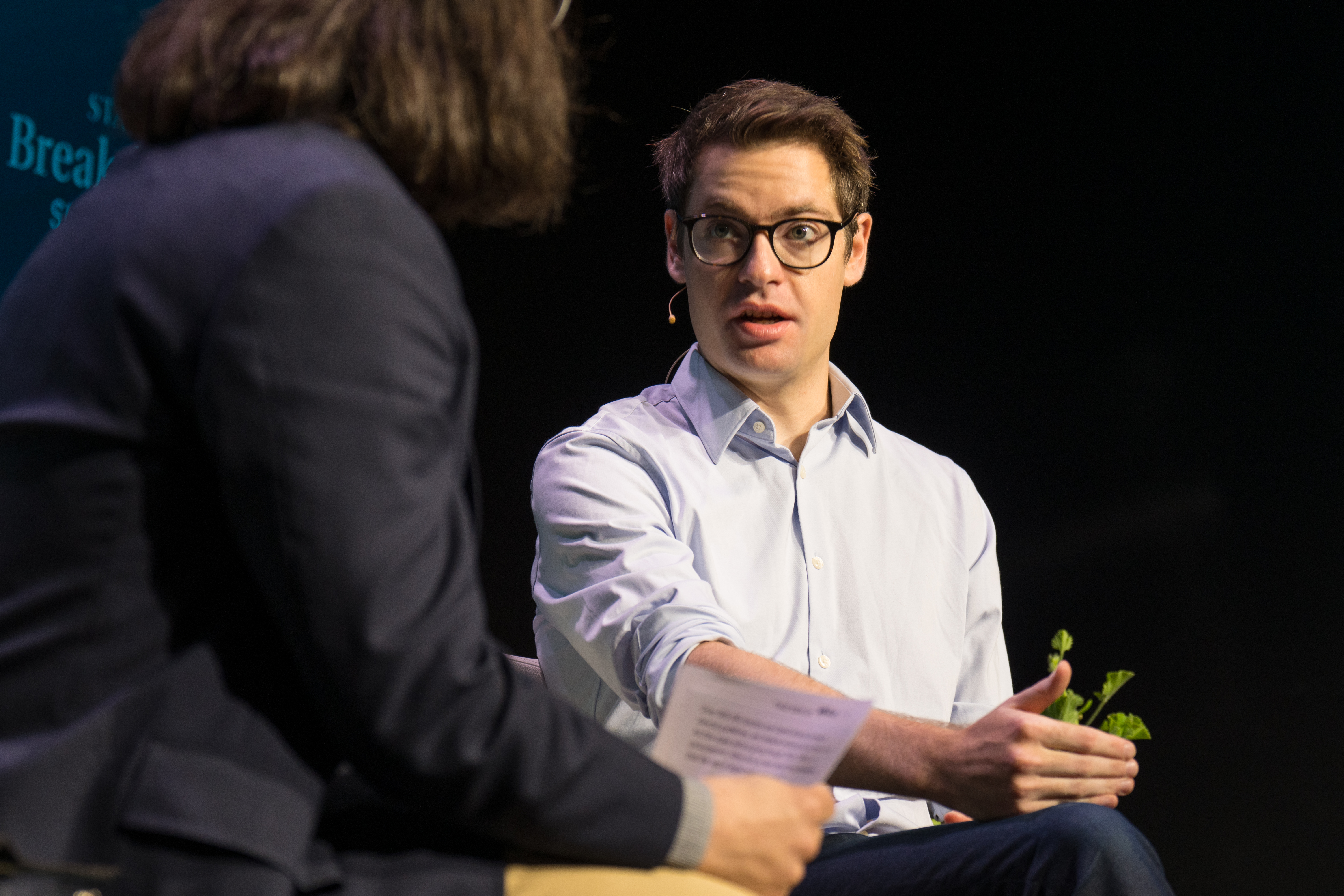
At an event for AI builders, Zachary Ziegler offered a piece of founder advice that was nearly rude in its simplicity. Start with the hardest part. Ignore the tempting little errands around it. Then ask, over and over, whether the result is actually good. The question his early team kept putting to itself was shorter still: “Is this awesome?” It sounds like something a child might ask after seeing a magic trick. In Ziegler’s telling, it was a demanding test, and the answer required several rounds of uncomfortable revision.
The person asking it had taken a winding route to a founder’s stage. At Cornell, Ziegler studied engineering physics. A university account from 2016 put him in a nanotechnology lab and recorded ambitions to earn a doctorate in applied physics, teach, and research nanoscale materials. By 2019, his published work concerned the behavior of language models. A few years later, he was co-founder and chief technology officer of OpenEvidence, a company building a search and answer product for clinicians. The subject matter changed sharply. The habit of asking what a system can actually do stayed with him.
Ziegler tends to explain the company in terms of use. He has said that making useful things is what motivates him. For a scientist, that sentence can carry an entire career change. There is satisfaction in a model that works on paper. A product adds another set of witnesses: people with little time, their own vocabulary, and no reason to applaud a clever system that does not help them finish a task.
The physics student with a different future in mind
In 2015, before the founder title, Ziegler was a Cornell undergraduate working in Jiwoong Park’s research group. Cornell listed him as a contributor to a paper on atomically thin films in Nature Nanotechnology. The next year, he won a Barry Goldwater Scholarship, a distinction for students headed toward research in science, mathematics and engineering. He had also received a campus research grant and the Arthur “Cully” Bryant Scholarship. The university’s brief sketch of him is unusually specific: a student from Wellesley, Massachusetts, planning on applied physics, teaching and nanotechnology.
Plans made at 20 are allowed to age. His later research moved toward text rather than thin films, but the transition was less capricious than it appears on a résumé. In both fields, a researcher works with a structure that is easy to observe and hard to explain. The material changes; the patient effort to find the rules does not. At Harvard, Ziegler joined Alexander Rush’s natural language processing research circle and received a National Science Foundation Graduate Research Fellowship. His public bios describe PhD studies in machine learning. The record establishes the research and the fellowship; it does not need an invented degree ceremony to make the chapter count.
One of his 2019 papers, written with Yuntian Deng and Rush, explored neural linguistic steganography: using a language model to tuck a hidden message into generated text that still reads like ordinary prose. Another examined ways to model sequences of words. These are not obvious first drafts of a clinician search product. They are, however, close studies of how language models generate and organize text, questions that would soon become startlingly practical.
“Ultimately what motivates me is just making useful stuff.”Zachary Ziegler, in a 2025 interview
A product built around the answer’s footnotes
OpenEvidence was founded with Daniel Nadler as large language models were becoming products that anyone could talk to. Ziegler had studied such models before their conversational interfaces became familiar. His account of the company’s early idea is candid: the founders considered a consumer information product, then focused quickly on professionals whose questions called for access to a vast published record. Their challenge was less to make a machine sound fluent than to make a large body of knowledge navigable in a working day.
That is why Ziegler returns to citations. In a podcast conversation, he summarized the philosophy as “trust, but verify.” A response, in his view, needs a trail back to the material that supports it. The user should be able to inspect the path and disagree. The underlying design makes search central: retrieve relevant material, assemble an answer, and keep the references close enough to check. It gives a professional an aid to judgment, not a reason to set judgment aside.
There is a nice irony in that career arc. The researcher who helped study how to hide information in plausible sentences now works on a system that is supposed to show its working. It would be too tidy to claim one project caused the other. What the two projects share is a fascination with the gap between fluent language and the information underneath it. One investigated whether text could conceal a signal. The later product tries to make its signal findable.
At GV’s AI Builders event, Ziegler described the earlier product as a sequence of hard corrections. The team found that a narrow reliance on one class of studies did not answer the variety of questions users brought to it. It broadened the material it searched, adding other forms of published guidance and synthesis. Ziegler recalled at least eight changes of direction. That number is more revealing than a clean launch date: each revision was a decision to let the actual task outrank an elegant first idea.
The cost of a very short question
“Is this awesome?” can sound flippant until it is used as a veto. Ziegler has described an early company discipline of setting aside attractive peripheral work and returning to what he called the crux of the problem. A pleasant interface, a long feature list or a smart presentation could wait. The engine of the product had to handle the difficult query. It is the sort of priority that offers very little instant gratification and makes for a duller weekly update. It can also keep a team from mistaking activity for progress.
By 2025, the company was reporting wide adoption among U.S. physicians. Ziegler described growth of 30 to 40 percent month over month in a November interview and said tens of thousands of clinicians were joining each month. Those are company figures, and they belong to a particular moment. They do show why his early question kept mattering after the first users arrived. At that scale, every rough edge is repeated often. Every useful detail is repeated often too.
He has also defended the company’s choice to reach professionals directly. In his telling, a tool earns its place when someone can reach for it during an ordinary day and get a useful, inspectable answer quickly. Institution-wide integrations may have a role, but he has spoken about the immediate value of being able to open a phone and ask a question. The adoption story, then, is partly a story about access: fewer steps between an individual and the work they want to do.
What a CTO keeps in the frame
A title such as chief technology officer can suggest a person hidden behind architecture diagrams. Ziegler has spent some of his public time talking instead about the people who use the architecture. He says the purpose of the system is to support professionals and preserve their judgment. In one interview, he noted that intuition and experience are things current models cannot simply reproduce. At a 2026 STAT event, he compared OpenEvidence more to a searchable resource than to an autonomous practitioner. The distinction matters to his description of the work, even as the product and its reach continue to change.
He is interested in stronger reasoning models and in bringing information into daily workflows. He has also talked about knowledge held in practitioners’ experience, beyond the published record. Those are ambitions, not finished features. What is visible today is a person trained in research trying to maintain a researcher’s habit inside a company: make a claim, show the basis, invite a closer look. It is a temperament that suits someone who once investigated the machinery beneath ordinary-looking sentences.
There is no neat final chapter to this profile. The young physicist’s nanotechnology plan led somewhere else. The language model researcher became a founder. The founder keeps returning to the same blunt product question, even after the audience has grown. That may be the most human thing in the story: knowing a clever system can still disappoint, and asking whether it has earned another day of someone’s attention.
The public record also shows a founder willing to explain the less photogenic parts of the work. He talks about what the team left out, about expanding the material the tool can search, and about resisting attractive side projects. Those choices seldom become the headline in a funding announcement. They shape what happens when somebody opens a product for the second time. Ziegler’s career does not run in a straight line from one breakthrough to another; it runs through labs, papers, experiments and revisions. The question at the center is therefore more demanding than its cheerful phrasing suggests. “Is this awesome?” asks a team to look at the thing it made as a stranger would. If the honest answer is no, there is more work to do.