The first thing Yvonne Chen offered when she announced her arrival at Benchling was not a slogan. It was an equation with a gloomy answer: $2 billion and 10 years. Those are the familiar estimates attached to bringing a single medicine to market. For a chief marketing officer, it is an unusually stubborn brief. No clever campaign can hurry an experiment or repair scattered laboratory data. The job begins further upstream, where software, scientists and institutional memory keep failing to meet.
Chen had just welcomed her second child. Her criteria for work, she wrote, had become exacting. When Benchling cofounder and chief executive Sajith Wickramasekara called, the proposition survived that test: help make scientific work move faster by putting usable AI inside the systems where research is designed, recorded and interpreted. “We need more life-saving treatments, faster,” she wrote. The line is clean. The machinery underneath it is gloriously untidy.
A career built around the moment before adoption
Chen’s résumé looks like a compact history of what Silicon Valley wanted people to do next. At AT&T, she worked in sales and managed a business call center as a sales coach. At Google, from 2006 to 2008, she handled partner relationships and operations. At Facebook, she moved through monetization and advertising operations, then product marketing for Pages and Ads. She also rebuilt a business-to-business sales training program. Each role sat near the awkward border between a product existing and people actually changing their behavior to use it.
That border became her territory. After earning an MBA at Harvard Business School, Chen joined Localytics, the mobile analytics company, to lead product marketing and strategy. Then came Udemy in 2016. The assignment shifted from explaining advertising and app data to persuading employers that learning belonged in the flow of work. Her argument at the time was blunt: “Learning is not a luxury, it’s a necessity.” She compared the hesitation around workplace learning to companies wondering, a few years earlier, whether they needed social media. Delay did not preserve the old world. It merely created a larger bill for catching up.
Udemy for Business grew from $1 million to more than $100 million in annual recurring revenue during its first five years. That company milestone belonged to a broad team, not one executive, but Chen was part of the marketing leadership that made a new enterprise category understandable while it scaled. Udemy went public in 2021. Her next chapter at Calm added responsibility across marketing and revenue operations. The products changed; the organizational question remained: What has to be true before a useful technology becomes an ordinary habit?
Three educations in one résumé
Chen’s formal education has the neat symmetry of two California-to-Cambridge business degrees: a BS in business administration from UC Berkeley’s Haas School, completed in 2005, and an MBA from Harvard Business School, completed in 2014. The practical education between and after them is less tidy and probably more revealing. Sales taught her that value has to survive a conversation. Operations taught her that a promise eventually becomes a process. Product marketing taught her that neither the customer nor the engineer should need a dictionary to understand the other.
She has kept learning in public. Her Udemy-era articles moved from employee engagement to the return on learning and the effect of automation on creativity. The pieces were written for business readers, but their recurring subject was adaptation. People do not become ready for a changing workplace because an executive declares them ready. They need time, a usable system and a reason to apply a new skill immediately. Years later, Chen’s language around AI in science follows the same grammar. A model becomes consequential when it sits near the task, understands the available context and helps a person do better work now.
Her experience also extends beyond operating roles. Public profiles describe her advising Series A, B and C startups on go-to-market strategy and revenue operations. She has served as an adviser to Pay’N’Park and invested in the leadership-development company Sounding Board. Those are small entries beside the large company names, yet they sharpen the portrait. Chen’s interest is not limited to announcing products after the machinery is built. It reaches into the early questions about who a product is for, how revenue work should be organized and which claims a young company has earned the right to make.
“The opportunity to build and market a product that accelerates science is incredibly meaningful.”Yvonne Chen, on joining Benchling
The laboratory has no patience for theater
Biotechnology makes the adoption question less forgiving. An advertisement can be measured in a click. Scientific work collects meaning slowly, across protocols, samples, instruments, notebook entries and decisions that may matter years later. A language model parachuted on top of that sprawl can produce a pleasant paragraph while missing the experiment. Benchling’s pitch is that AI needs a structured data foundation and a place inside the researcher’s daily workflow. Chen’s marketing task is to make the distinction vivid without pretending the work is simple.
Her public description of a “true AI Scientist” has four parts. It should select useful predictive models and language models for a task. It should connect with manual and automated wet-lab work. It should turn each result into knowledge that can be found and used again. And it should keep experiments moving without waiting for a fresh prompt at every turn. This is not AI as a visiting oracle. It is closer to a very industrious colleague who remembers where the data lives and does not resent the paperwork.
The company’s early evidence gives Chen something more substantial than futurism to discuss. Benchling said in February 2026 that its AI tools had been used across 500 biotech companies before general availability. The examples were deliberately workmanlike: pulling experimental details for reports, making scientific prediction models accessible inside the platform, cleaning instrument exports and turning old notebook entries into searchable, structured records. The marketing is strongest when the magic trick is the removal of an annoying Tuesday afternoon.
This emphasis places a useful constraint on the story Chen can tell. The broad AI market rewards spectacle, while laboratories reward provenance. A result must remain connected to the experiment, sample, protocol and decision that produced it. Benchling’s opportunity is to present its existing record of scientific work as the ground beneath new models and agents. Chen therefore has to market two speeds at once: the quickening pace of AI and the deliberate habits by which research earns confidence. The tension is not a nuisance to edit out. It is the product category.
The team appears in the sentence
Chen’s own posts reveal the operator behind the positioning. After two Benchtalk events in Boston and London drew 1,100 people over two weeks, she did not claim a marketing triumph and move on. She named product and engineering for giving people something worth seeing. She thanked sales, customer experience and field teams for the conversations. She credited the marketing and communications people who shaped the moment. Then, after the dutiful roll call, she invited anyone not yet talking to Benchling to do so, adding “wink, wink.”
The sequence is characteristic: substance, distribution, credit, sale, joke. It also echoes how former colleagues describe her. One Udemy colleague recalled a manager who gave him autonomy while keeping the highest-leverage goals clear. He said Chen built credibility across the organization and treated him as a person before treating him as a direct report. Another called her collaborative, hardworking and results-focused. Recommendations are ceremonial by nature, but the repeated emphasis on cross-functional trust fits Chen’s own standard for hiring product marketers. She has said that reference checks should establish whether a candidate was trusted beyond marketing by people in product, sales and engineering.
That is a revealing demand. Product marketing is often mistaken for the art of polishing nouns. Chen treats it as a test of whether a person can carry meaning between groups that have different incentives and dialects. In biotech, those dialects multiply: bench scientists, computational researchers, data teams, executives and regulators do not experience the same software in the same way. A credible story has to cross all of them without becoming mush.
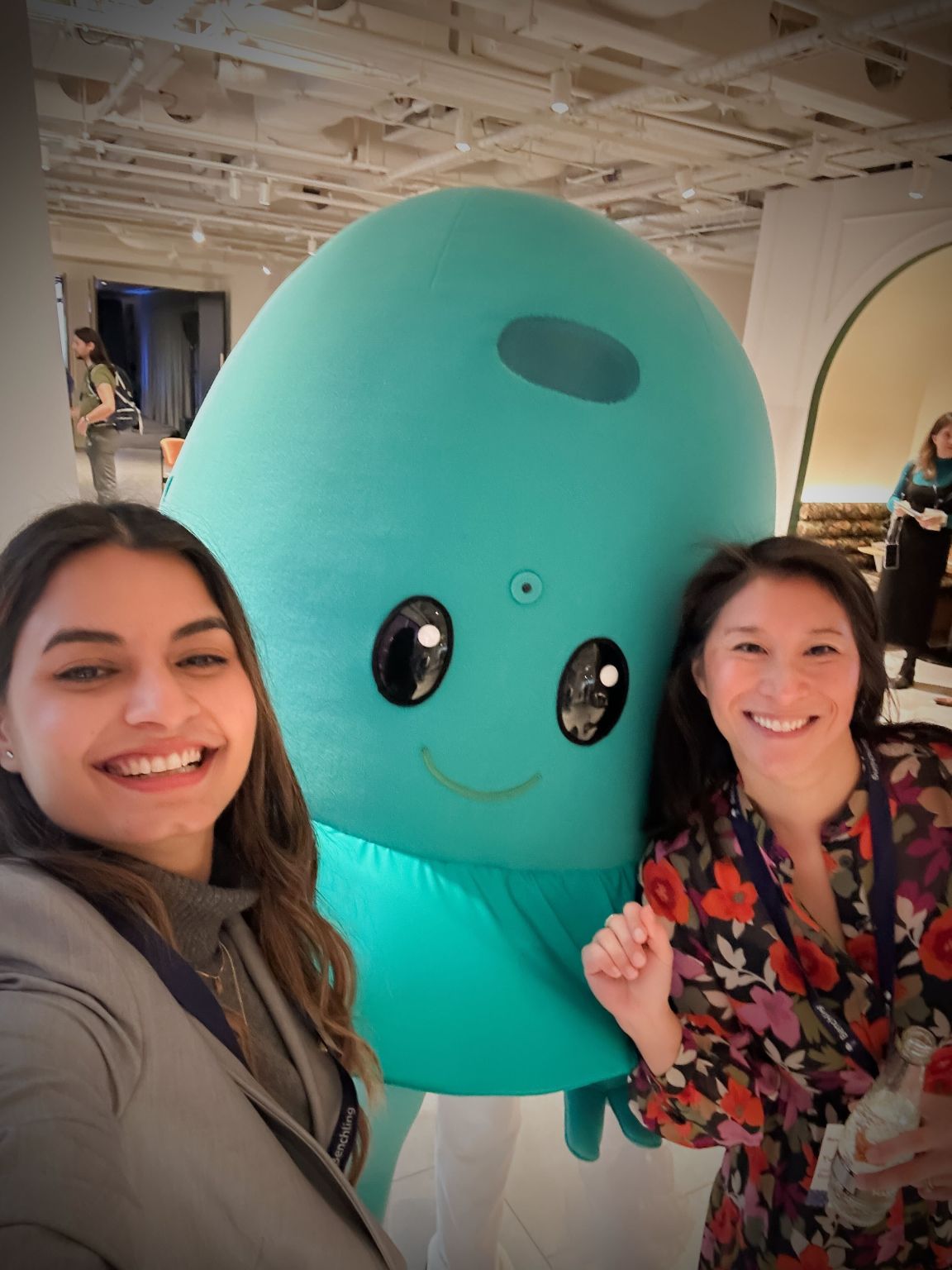
Her own style mixes an executive’s appetite for a clean framework with a salesperson’s refusal to leave the ask implicit. She can praise a launch, identify the teams behind it and invite a prospect into the conversation in the same short post. She can also loosen the collar. The occasional “heyo,” the wink and the cheerful appearances with JeffyP, Benchling’s bulbous turquoise mascot, keep a technical subject from acquiring the manners of a tax seminar. Serious buyers do not require a company to be joyless. They require it to be accurate.
A market moment is not owned by marketing. It is assembled across a company.
Teaching the market, again
There is a satisfying rhyme between Chen’s Udemy period and her present job. A decade ago, she was arguing that companies could not treat learning as a perk because technology kept rewriting jobs. Today, she argues that biotechnology cannot treat AI as a side experiment because useful models must be integrated with how research already happens. Both claims ask institutions to learn while operating. Both are easier to applaud than to implement.
Benchling’s partnerships with Anthropic and NVIDIA help furnish the technology. Its events help build the audience. During the 2026 J.P. Morgan week in San Francisco, Chen’s teams held an AI panel at company headquarters, hosted a breakfast with Lux Capital and put copies of a biotech AI report into people’s hands on the street. There is something pleasingly analog about distributing paper to explain artificial intelligence. Even the future occasionally needs a passerby.
By spring, Chen was taking the argument to an AWS life-sciences gathering in New York: the industry needed to move from pilots to AI embedded in actual R&D. The distinction is the heart of her brief. A pilot proves that software can perform. Adoption proves that an organization can change. Her career has been an education in the large distance between the two.
Chen does not arrive at Benchling as a scientist, and she does not pose as one. Her craft is translation. She knows how a call-center worker hears a sales goal, how a product team describes a feature, how a buyer evaluates a new category and how a colleague decides whether a leader can be trusted. In the laboratory, that craft meets a field where imprecision is expensive and useful context is everywhere. The role is less about making AI sound intelligent than making its place in the work intelligible.
The $2 billion and 10-year equation still sits at the top of the page. Chen cannot solve it with language. But language can clarify the system that has to change, gather the people required to change it and keep the promise attached to something observable. For a marketer who has spent two decades around the moment before adoption, it is a formidable next lesson. The jellyfish, mercifully, keeps the room from becoming too solemn.