A student at Youngrok Kim’s school wanted to know who should apologize when a robot makes a mistake. Kim could not produce an immediate answer. He later put the question into an essay about Korea’s startup policies. It was a small classroom exchange with a large reach: responsibility, technology, the freedom to get something wrong. For someone who runs an accelerator, writes about entrepreneurs and has spent years developing education programs, it was also a useful interruption. The teacher had been given homework.
Kim’s career has involved several changes of professional scenery. Architecture came first. Talent development and university teaching followed. In 2019 he established Next Challenge Foundation. In March 2025, Next Challenge School opened. The recurring interest is how people acquire the ability, and the opportunity, to make something happen. His work has given that question several addresses.
A different kind of floor plan
Before the startup programs, Kim spent ten years in urban architecture and space design. His work included freeform buildings and minimalist interiors. The transition into entrepreneurship therefore involved a change in what he was trying to arrange: people’s opportunities to learn and collaborate joined the physical spaces around them.
There is a temptation to make this sound like a perfectly drawn blueprint. The actual route included an invitation. While working on a government talent-development project, Kim met a Hanyang University professor who recommended him for a special appointment. His ensuing university work involved entrepreneurship teaching, industry collaboration and curriculum development.
He had already established the multidisciplinary talent academy known as TECHRIDER in 2011. He mentored there over eight years, with approximately 460 participants completing the program. That early project places education well before the foundation in his career. Helping founders was an extension of an existing interest in developing people.
Kim’s own studies crossed business and technology: business administration at Handong University, a master’s in management of technology at Sogang, and doctoral coursework in management consulting at Hanyang. He served at Hanyang’s Global Entrepreneurship Center from 2012 to 2018. By the time he established an accelerator, he had spent years thinking about what could be taught before a venture began.
A place to begin, on Jeju
Next Challenge Foundation was established in January 2019. That June, Seogwipo city, the foundation and Jeju Free International City Development Center opened Startup Bay. Its stated purposes were youth entrepreneurship, job creation and a stronger local economy. The choice of setting gives Kim’s story a particular geography: a startup institution taking root in Seogwipo, away from the country’s familiar concentration of entrepreneurial attention.
Startup Bay offered an identifiable beginning. Prospective and early founders could find workspaces and training, with support adapted to their stage of development. In a 2022 interview, Kim explained that selection needed to consider a founder’s capability and values, rather than simply favoring applicants who already had a record of revenue or investment. A program designed to help people start has to leave room for people who are starting.
The physical space was part of a larger arrangement involving public bodies and private expertise. An accelerator can supply training, introduce collaborators and help a company prepare for investment. The local question is whether those activities become connected enough to make a viable community. Kim’s work repeatedly returns to that relationship between a founder’s next step and a city’s longer future.
The same concern appears in his thinking about Incheon, where he has said he lives. He wants young people to have reasons to remain, including better jobs and stronger connections among universities, companies and startup institutions. In March 2026 his appointment as chairman of the Incheon Center for Creative Economy and Innovation added another institutional responsibility to that interest in place.
The wolves get a reading list
Kim’s books give his educational work a less domesticated vocabulary. Three titles feature wolves: 변종의 늑대, 진격의 늑대 and 미지의 늑대. They explore startups, adaptation and unfamiliar markets. A reading list with this much wildlife is unlikely to promise that every business problem comes with a tidy answer key.
At a May 2023 gathering of business leaders in Seoul, Kim discussed the startup ecosystem and the importance of finding new business through ideas. The subjects moved from entrepreneurial change to collaboration between established companies and younger ventures. His speaking work brings the thinking in the books into rooms where people are already responsible for making decisions.
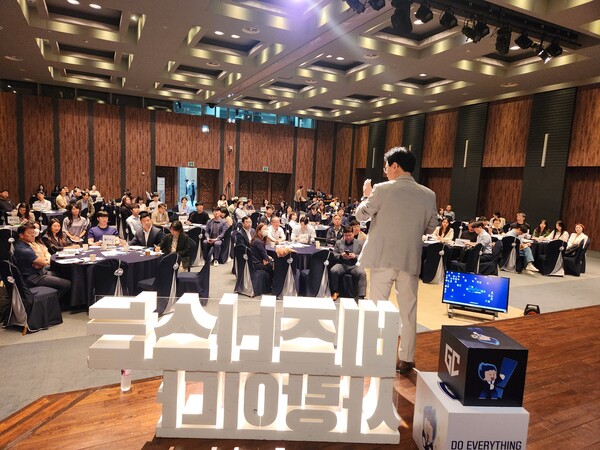
He also took that discussion to an Incheon industrial-complex CEO academy in June 2023, addressing challenge, failure and business change. The audience matters. Entrepreneurship education, in his working life, reaches beyond students preparing to enter a profession. It includes people whose businesses already have employees, habits and something to lose.
In October 2026 he coauthored 탈패턴 인재는 어떻게 만들어지는가 with Choi Hyein. The book examines questioning through ten technology leaders. On LinkedIn, where he uses the name Rocky KIM, he described it as his tenth book. The movement from wolves to questions fits his widening attention to how people prepare for technological change.
The distance between an introduction and a business
International work has given Kim’s ideas a practical test. In a January 2024 column, he wrote about his experience establishing local entities and joint ventures in Thailand, Singapore, Vietnam and Malaysia. Getting a business incorporated and getting it to revenue were separated by substantial obstacles. Different rules and institutions required close attention.
That is a useful correction to the ease with which a presentation can acquire a world map. A connection abroad begins a process. Customers, operating arrangements and reliable local relationships still have to follow. Kim’s argument emphasized the detailed knowledge needed to help founders through those steps.
The foundation’s corporate collaboration programs provide one concrete example of how it organizes connections. In 2025 it ran four Around X tracks for 125 startups: 100 with Google Play’s Changgu, ten with Intel, ten with Thales and five with L’Oréal. The program included preparation for technical collaboration, proof-of-concept work and overseas market entry.
THE COLLABORATION ROSTER / 2025
Participants by track, not investment amounts or business outcomes.
Those figures describe a program’s intake. They do not settle what the participating companies will achieve. Their value here is more specific: they show an educator and accelerator operator arranging different kinds of access for different businesses. The next work belongs to the relationships, experiments and decisions that follow.
Moving the question into school
Next Challenge School brought Kim’s interest in learning to younger students. Opened in March 2025 after five years of preparation, the alternative school combines startup practice, technology education and international experiences. Kim serves as chairman. Its early model brought students of different school ages together, giving projects a role beyond the usual division into year groups.
The model makes his educational ambition tangible. Students are supposed to encounter problems, develop work and learn through contact with the world outside a conventional classroom. The interesting question is what they do with that freedom: how they investigate an idea, explain it to someone else and change it when the explanation fails.
In June 2025 the foundation announced an agreement with Singapore Institute of Management. The planned work included student exchanges, joint project-based learning programs and educational content. It connected the school’s international ambitions with a named institution and a set of proposed activities. An agreement starts the work; the educational experience has to be made through its execution.
A May 2025 agreement with education company Eduwill widened the intended audience further. It covered cooperation on youth entrepreneurship and AI education as well as adult and workplace learning. Kim’s career has carried education into an accelerator, then carried entrepreneurial practice back into a school. These partnerships make the traffic run in both directions.
He has also continued his own institutional ties to higher education. His appointment at Fudan University as a visiting professor or visiting researcher was announced in September 2025. The career keeps crossing boundaries between teaching and business. For Kim, the classroom has become a recurring place to return with questions acquired elsewhere.
What a second attempt should inherit
In his October 2026 policy essay, Kim argued that institutions need to retain what unsuccessful ventures teach. He called for recording failure, evaluating earlier programs and giving policy staff enough continuity to see work through. The argument has a teacher’s concern with accumulated learning: experience should remain available after a company closes or an official changes jobs.
The student’s robot question appeared in that same essay. In English translation: “If a robot makes a mistake, who should apologize?” Kim wrote that he could not answer on the spot. His response was to carry the question into a broader discussion about responsibility and the conditions that allow people to try again.
“If a robot makes a mistake, who should apologize?”
A Next Challenge School student, recalled by Kim in October 2026. Translated from Korean.
The moment gives his story a human scale. A person with years of teaching, books and institutional titles can still be stopped by a pupil. The exchange leaves something productive unfinished. Architecture once gave Kim physical spaces to work on. His later career has filled the plan with founders, students and collaborators, each bringing a problem of their own. Now one of the questions belongs to the teacher.
Follow the questions
Explore Kim’s work, books and public conversations.