A photograph of a mango can promise almost anything. The mango itself is less accommodating. It arrives with a particular ripeness, a particular taste, and a limited willingness to wait while a company sorts out its logistics. Yosua Setiawan has built his working life at Segari around that awkward gap between what a screen can show and what a customer actually receives.
Setiawan is the Jakarta-based chief executive and co-founder of the Indonesian online grocery business, launched in 2020 with Farand Anugerah and Farandy Ramadhana. Its memorable promise is fifteen hours from harvest to home. That gives his story a clock. It also gives him a rather unforgiving audience: people who will open the bag, examine the vegetables, and decide whether to order again.
In March 2021, he put the choice plainly: “we build infrastructure to focus on quality.” Other businesses could pursue more products, lower prices, or additional territories. He wanted consistent fresh produce. There is something refreshingly specific about an ambition whose success can be assessed in a kitchen. A fundraising announcement may get applause. A disappointing tomato gets remembered.
Two degrees, then a different kind of building
Before groceries, there were buildings and balance sheets. Between 2009 and 2014, Setiawan studied at the University of Texas at Austin, earning a Bachelor of Business Administration in finance and a Bachelor of Science in architecture. His professional profile records that he represented the business school in international real estate case competitions. Earlier, in 2008, he had won a silver medal at Indonesia’s National Physics Olympiad.
His first recorded jobs followed the real estate thread. He worked in asset management at Virtus Real Estate Capital from September 2013 to May 2014, then in portfolio management at Lionstone Investments from July 2014 to June 2015. The next move took him to Traveloka’s international team, where he worked on launching and growing its Vietnam business. He joined Boston Consulting Group in May 2017 and subsequently became a senior associate.
Those details make for an unusually varied route to a grocery business. They do not establish a grand theory of why he became a founder. They do show a career crossing investment, expansion, and consulting before he took responsibility for a company of his own. By 2020, the question had become practical: how should fresh groceries travel between Indonesian farms and household customers?
Architecture is a tempting metaphor here, and it should be used sparingly. Setiawan’s degree does not prove that he designs supply chains like buildings. Yet his public language at Segari repeatedly returns to infrastructure. The customer sees an ordering interface. His stated priority is the arrangement behind it, the part that has to function before anyone can enjoy the convenience in front.
Fifteen hours leaves little room for ceremony
The problem Setiawan chose was the distance created by multiple layers between farmers and consumers. He has argued that shortening that chain could help households receive better-quality groceries at lower cost while helping farmers obtain fair prices. These are the intended benefits of the model, rather than a claim that every transaction has already achieved them. The ambition joins the two ends of the business.
Segari’s early arrangement combined farmer partners in Java and Sumatra, decentralised warehouses, and community distribution. In 2021, its network included thousands of agents in Jakarta. These are concrete choices about where products go and who helps them reach buyers. A grocery company selling online still has to deal with the geography of groceries. An app cannot persuade a cabbage to teleport.
The fifteen-hour promise gives that arrangement a consumer-facing form. It is easy to remember and easy to question. It asks customers to think about the time since harvest, bringing the farm into a purchase that might otherwise begin and end with a product photograph. For Setiawan, freshness becomes something to organise around, rather than an adjective to scatter across a catalogue.
- 01Farmer partners
- 02Warehouses
- 03Community distribution
- 04Households
Company-stated farm-to-home commitment. Diagram shows the model, not measured delivery times.
His quality-first position also helps explain why the business deserves attention beyond its funding totals. Adding a product category produces an immediate visible change on a website. Building a more dependable delivery arrangement is harder to display. Customers discover it through repetition. The second order matters because it tests whether the first experience was a pleasant exception or something the company can reproduce.
The neighbourhood was part of the machinery
Segari made local communities part of its commercial design. Through its Mitra Segari programme, people could run an online grocery business from home using a smartphone and WhatsApp. The company offered marketing materials and guidance. Housewives and small business operators were among the people the programme sought to involve. The customer relationship could therefore begin with someone nearby, rather than solely with a distant brand.
This made the founder’s project a social-commerce business as well as a supply-chain business. Community leaders could help provide produce to their neighbourhoods, while decentralised warehouses supported distribution. The attraction is understandable: an existing local relationship can make a new service easier to try. The operational question remains whether the groceries justify that introduction. Familiarity may open the door; the contents of the bag must earn another visit.
One customer who crossed into a different role was the singer and actor Maudy Ayunda. In October 2021, she publicly described having used Segari before investing in it. She cited the fresh products, simple ordering, and home delivery, as well as the company’s intended impact on farmers. Co-founder Farand Anugerah described their shared interest in returning to Indonesia and using technology to contribute there.
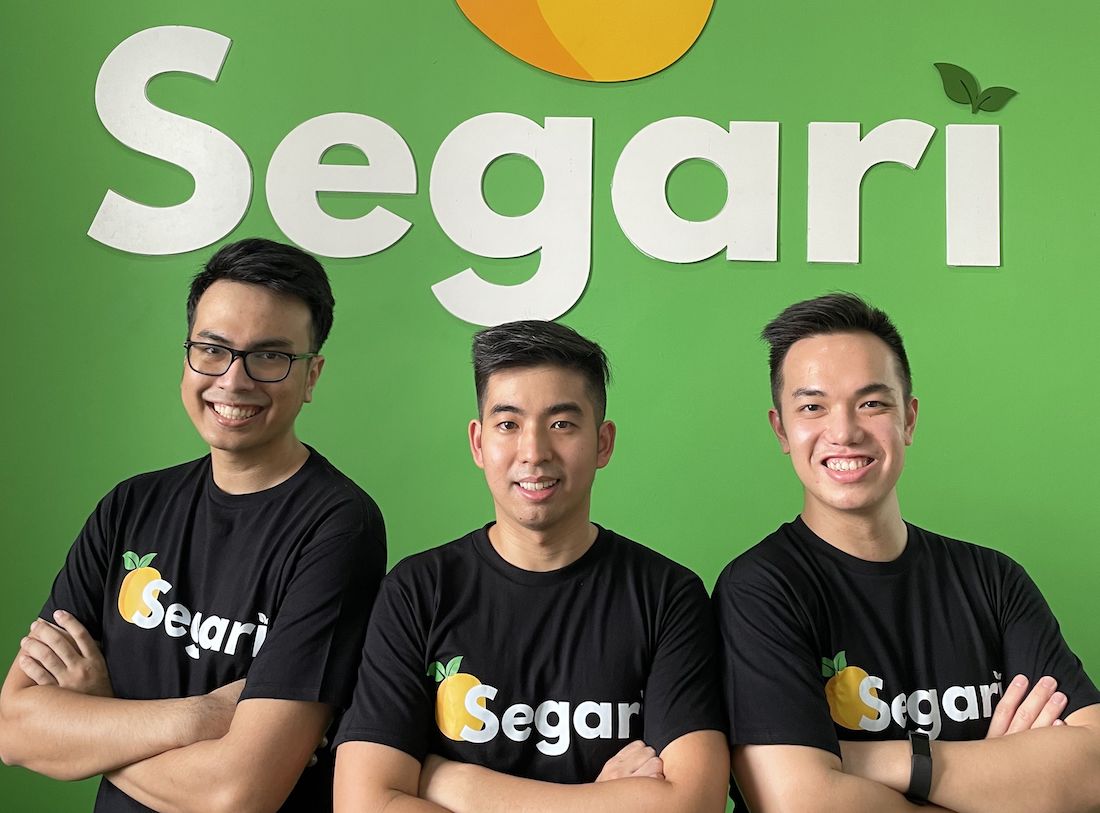
The episode is useful because its sequence is ordinary before it becomes newsworthy: someone shops, forms an opinion, then backs the business. It also keeps the connections in Setiawan’s story in proportion. Segari was a three-founder undertaking. Anugerah held the operating role, Ramadhana the technology role, and Setiawan the chief executive role. The photograph contains three people for a reason.
“we build infrastructure to focus on quality”
Yosua Setiawan, March 2021
Capital arrives. The work gets less photogenic.
In March 2021, Segari announced seed investment led by BEENEXT, with AC Ventures and Saison Capital participating. In September, it raised a $16 million Series A led by Go-Ventures. Other participants included Susquehanna International Group, Alfamart, Gunung Sewu Group, and Intrinity Capital, alongside earlier backers. The proposed uses were familiar to anyone following Setiawan’s language: strengthen infrastructure and add people across operations, technology, and marketing.
By October 2021, the company was reporting around 250,000 users. It also reported that users, orders, and revenue had grown more than twentyfold in less than a year. These figures belong to that early period. They capture how quickly the business expanded, while leaving the longer-term task of serving customers consistently still to be done. A growth multiple measures change; it does not pack tomorrow’s order.
September 2021
reported September 2023
The next chapter included contraction. In January 2023, Segari was reported to have laid off 24 percent of its employees, with the announcement made at a company town hall. Setiawan had not responded to a request for comment at the time of that report. The episode belongs in the same account as the early expansion. Running the business meant decisions affecting employees as well as customers and investors.
That September, a $23.5 million Series B was reported. A subsequent account of share issuance named SIG, Argor Capital, BEENEXT, AC Ventures, and other investors. Argor was the new name of Go-Ventures. The financing continued the company’s relationship with investors who had backed earlier stages. Its presence in the story records capital committed to the company; it supplies no automatic verdict on the experience of buying groceries.
Setiawan’s public remarks in March 2023 were similarly attentive to the customer’s choice. Speaking at the Agriinnovation Conference in Jakarta, he acknowledged that some shoppers preferred physical stores and would return to them, while people accustomed to online ordering would continue. That is a useful restraint in a founder’s account of demand. Convenience has to compete with habits, preferences, and the pleasure of choosing something oneself.
A customer cannot taste a product photograph
By October 2025, Setiawan was describing the checks behind Segari’s promise in more detail. Produce was inspected at the farmer, at the warehouse, and again before dispatch. For fruit, samples could be assessed with a Brix meter to measure sugar concentration. The small instrument is an appealing detail: a business selling taste through a screen still needs a way to examine taste’s material ingredients.
He described afternoon harvests moving to storage that night and then onward to customers. Unsuitable goods at the warehouse were separated rather than sold. Segari also offered returns when products arrived in poor condition. These measures address the particular vulnerability of buying fresh produce online: the customer delegates the selection, then discovers whether that delegation was sensible only after delivery.
Earlier in 2025, Segari had announced halal certification for its chicken and meat processing, covering stages from receiving ingredients through distribution. Setiawan expressed the hope that the certification would make people more comfortable shopping with the company. That adds another dimension to his stated aspiration: make the transaction dependable in ways that matter to the household placing it, including requirements a photograph alone cannot establish.
His career has carried him from Texas real estate roles to Vietnam market expansion, consulting in Jakarta, and a grocery company with a harvest clock. At Segari, the recurring subject is consistency. There is a modestly comic scale mismatch between the vocabulary of venture investment and the judgment awaiting it at home. Millions of dollars, several warehouses, three founders, and then someone looks into a bag and asks whether the fruit is any good.