Wisnu Nugrahadi wanted to know why the workers kept leaving. In his account of his Gojek years, the staffing agencies had a ready explanation: the workers were the problem. He was unconvinced. So he spent weekends among them, posing as a fellow worker and listening. What he heard concerned pay. The amount reaching workers, he said, could be substantially below what had been promised. The explanation looked different when you changed seats.
That episode is a useful place to begin with the CEO and co-founder of Staffinc Group. It puts him close to the part of a business that a polished presentation can hurry past. Someone recruits a person. Someone assigns a task. Someone checks that it happened. Someone pays. Every handoff offers an opportunity for confusion, and the worker has to live with the result.
Wisnu’s company began in 2018 as Sampingan, an Indonesian name meaning side job. By 2022, it had become Staffinc. Between those names lies a widening ambition: to help businesses find workers and handle more of the process that follows. His career makes an argument for taking the apparently small administrative details seriously. A payslip is a rather short document to carry so much trust.
The operator’s education
Wisnu studied at Universitas Padjadjaran between 2011 and 2015. His first professional steps included an operations internship with Uber in Bandung. He was part of its launch team there, then joined Gojek in June 2015. The sequence matters. Before he was running a staffing company, he was learning how services reach a city, acquire participants and keep functioning once the launch excitement wears off.
His Gojek roles moved quickly through acquisition and partnerships, business processes and operations. By October 2015, he was Head of Operations for Go-Life, the company’s lifestyle-services arm. In January 2017, he became Senior Manager of Operations. He stayed in that role until June 2018. It is a career progression with a clear practical theme: making an expanding service work beyond its original setting.
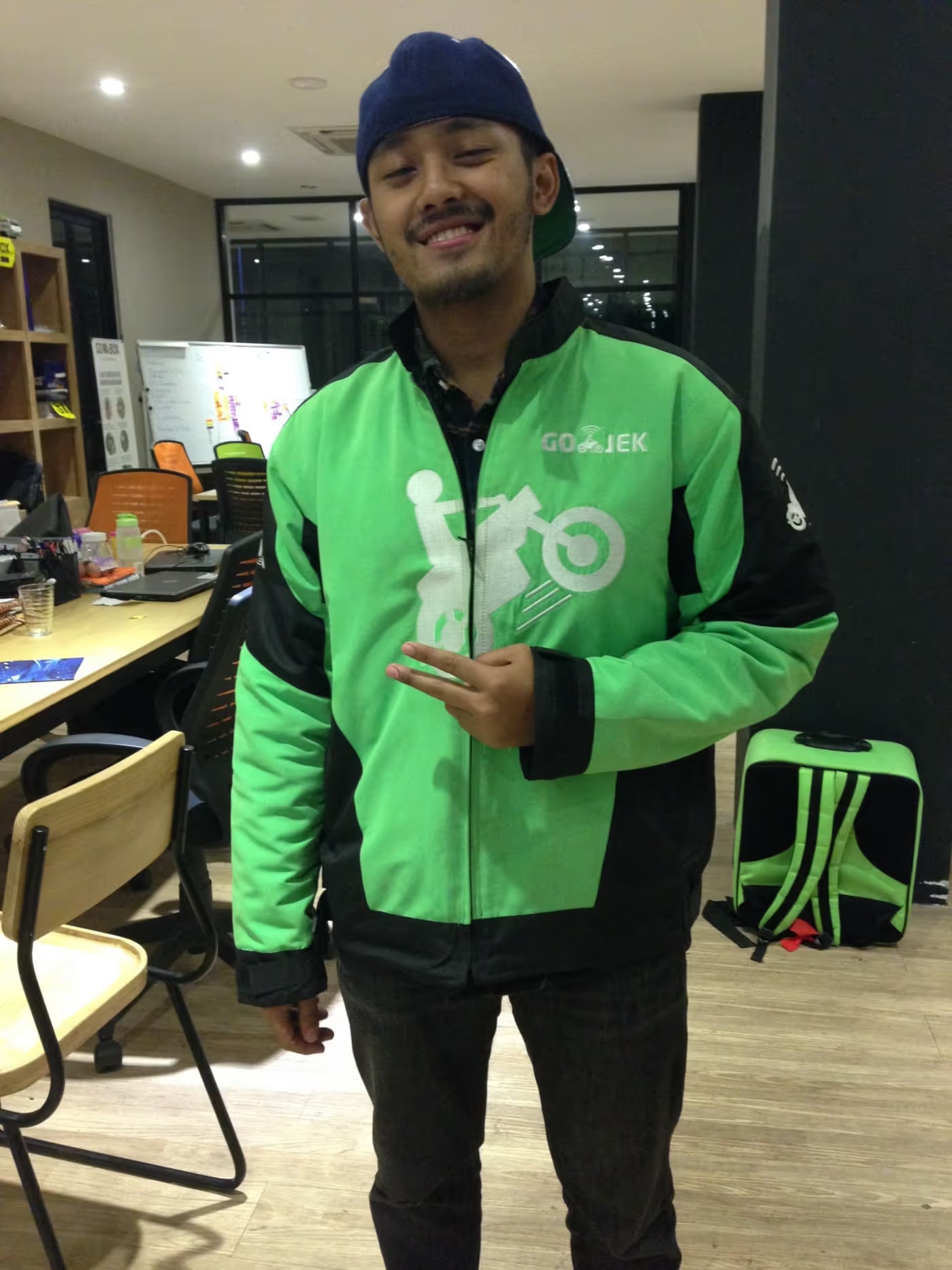
Operations is where a growth plan meets people’s schedules. A service needs enough workers, in the right places, with a clear understanding of the job. A process that behaves perfectly in one office may behave very differently across a network. Wisnu’s subsequent choice of business makes sense against this experience. He had already worked on the employer’s side of the staffing relationship.
Three founders, one practical problem
In July 2018, Wisnu joined Antler’s first Singapore cohort. Within the program’s first eight weeks, he and Margana Mohamad and Dimas Pramudya created Sampingan. The three had a university connection, but their professional experience was complementary. Wisnu brought operations. Dimas had worked in product growth at Gojek. Margana had run an outsourcing business and knew the staffing process from inside.
There is a sensible division of knowledge in that combination. One founder understands the customer’s operational difficulty. Another understands how a product can support the work. Another knows the business of supplying and managing people. Friendship alone would have been a charming founding story. Shared familiarity with the problem gave the friendship something specific to do.
The early service was deliberately plain. Wisnu says they served customers using Google Sheets, Google Forms and WhatsApp before they had a working product. Employers were paying for work to be done. The founders could therefore test demand while the software was still to come. Even a spreadsheet can have excellent timing.

Sampingan’s early assignments included sales, surveys, data collection and merchant acquisition. These were jobs with identifiable tasks and local requirements. By May 2019, Antler reported more than 25,000 platform users in 25 Indonesian cities. In October, it reported more than 150,000 agents. Those figures describe the early network at particular moments, rather than a count of permanent employees or a promise of continuous work.
A job close to home
The early model used a distributed workforce to help businesses gather information and complete tasks. Where an assignment involved fieldwork, Sampingan prioritized people living near the research area. It could also supply temporary workers for days or weeks, or break an assignment into smaller tasks matched to a worker’s experience and skills. Local knowledge had a practical place in the service.
Training was part of this approach. Workers received instruction on completing jobs, improving efficiency and developing softer skills needed for human interaction. Wisnu described the aim as helping them become more productive and earn more. That creates a different kind of responsibility from simply listing an opportunity. A match is useful; knowing how to complete the assignment helps the match survive.
Consider the difference between a database of names and a workforce that can carry out a particular job. A name tells an employer little about availability, suitability or preparation. The service has to connect those details. Sampingan’s task model gave the founders a concrete way to organize them: begin with the required result, then find and prepare the people who can deliver it.
When the side job outgrew its name
In January 2021, Sampingan announced a $5 million Series A led by Altara Ventures. Golden Gate Ventures, Antler, Access Ventures, XA Network and iSeed SEA also participated. The stated purpose was to expand business operations. Capital gave the company room to develop, but the story’s more revealing change was the widening scope of the service itself.
By May 2022, its business covered staffing for logistics, retail, food and beverage, and finance. Forbes included Wisnu and Margana in its 30 Under 30 Asia Enterprise Technology list that year. The company was supplying an employment service that extended beyond the original side-job proposition. Recruitment increasingly belonged to a longer relationship involving the management of workers.
The Staffinc rebrand followed in 2022. Wisnu explained that the old name no longer represented a business providing digital staffing and outsourcing solutions. The change is an unusually readable marker in a company history. Sampingan tells you about the first opportunity. Staffinc points toward the employer’s continuing need for a workforce, including the administrative work around it.
- Recruit
- Select
- Onboard
- Record attendance
- Run payroll
Staffinc’s described service scope. A process diagram, not a measure of performance.
Hiring begins a sequence. An employee still needs to enter the workplace, have attendance recorded and receive pay. Connecting those steps changes what an employer is buying. It also changes the worker’s experience: the question becomes whether the arrangement remains understandable after the first day, when the job is ordinary and everyone has other things to do.
Trust has to survive payday
Wisnu’s public explanations of Staffinc emphasize transparency and trust. In 2023, he described workers being able to see payslip histories and details. He also said the company did not take a cut from workers’ wages. These are his stated operating principles. They make the product’s purpose easier to grasp than a broad promise to improve the labor market.
A record can make a relationship more legible. The worker can see what was calculated; the employer can follow what was managed. That does not make every staffing difficulty disappear. It gives both sides something specific to examine. For a company attempting to serve many employers and workers, a repeatable process is part of how a personal promise becomes an organizational obligation.
Wisnu also identified a mismatch between employer expectations and the workers available. His proposed response included educating both sides, particularly where qualifications failed to reflect the surrounding context. It is a practical observation. A job description can be precise and still be unrealistic. Recruitment works better when the people writing the requirements understand the people being asked to meet them.
“We will continue to support thousands more in the future, so more Indonesians can have the opportunity to improve their lives.”
Wisnu Nugrahadi, 2019
An engineer goes to sales
By 2024, Wisnu and his co-founders had been selected as Endeavor Entrepreneurs at the organization’s 100th in-person International Selection Panel in Dublin. Staffinc was described as operating across more than 300 cities and over 100 job types. The founders’ shared university background had become a much larger professional undertaking.
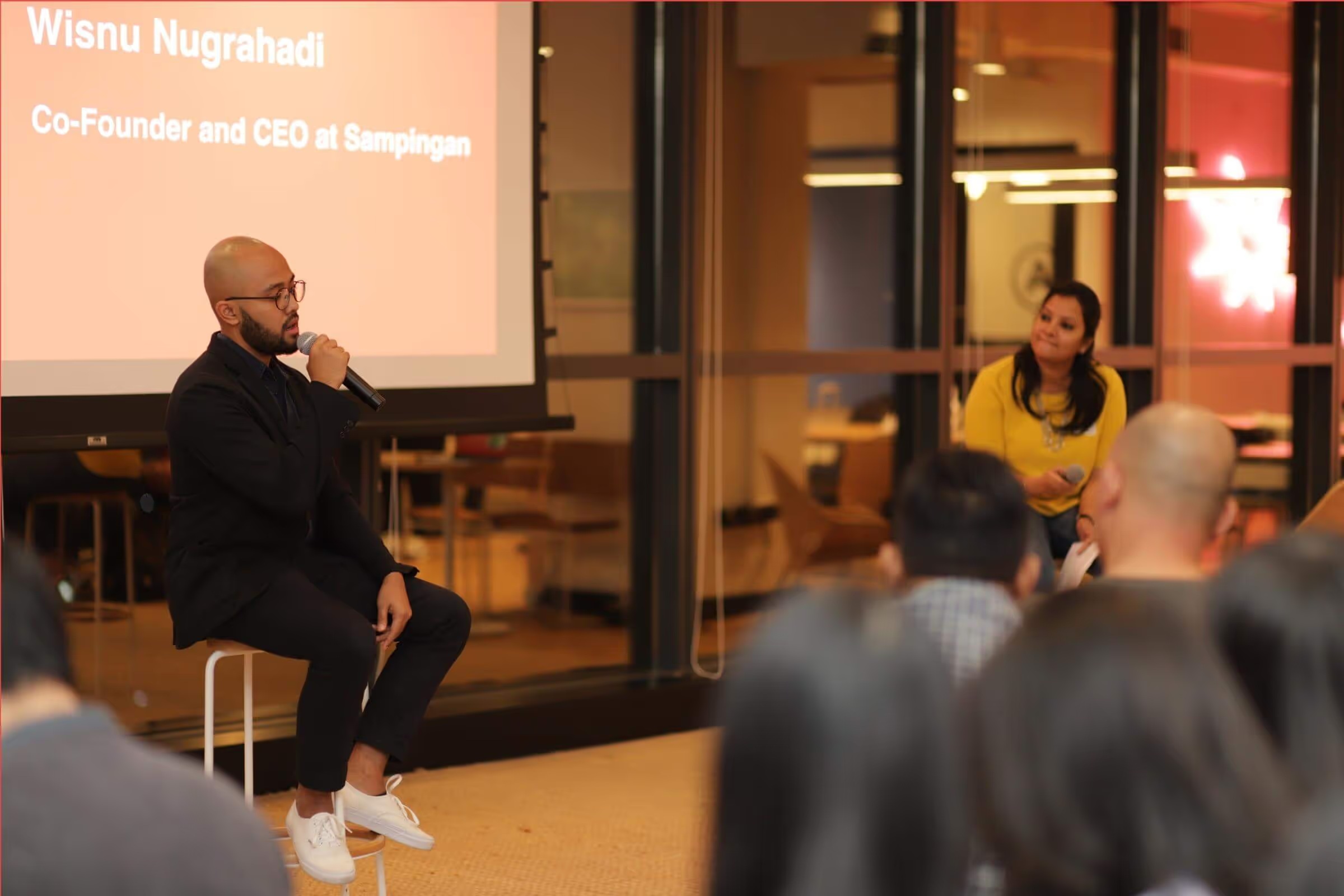
A September 2026 account offers a recent view of Wisnu at work. After experimenting with broad AI access inside Staffinc, he moved toward placing an engineer in each sales squad organized by customer type. The engineer builds that squad’s tools and systems. Performance is evaluated through the squad’s sales results, while engineers meet weekly to exchange what they have learned.
It is another attempt to shorten a handoff. Put the builder near the team using the tools, and the distance between a request and a useful system can shrink. The weekly exchange keeps that close working arrangement connected to the rest of the engineering group. The experiment follows a recognizable concern in Wisnu’s career: how to organize people so that a process actually delivers.
A smaller opponent, a useful lesson
Outside work, Wisnu took up Brazilian jiu-jitsu. In 2023, he recalled being thrown and pinned by someone smaller than himself. He associated the experience with humility and the realization that there was much to learn. His dogs, Chewie and Juno, appear in the same account of his life beyond the company. There is room beside a workforce platform for two rather less formal companions.
The jiu-jitsu anecdote gives his story a fitting final turn. Size and competence are different things. Growing a business creates more processes to understand, more people to serve and more places where a promise can become muddled. Wisnu’s work has followed those details from Gojek operations to Sampingan’s first tasks and Staffinc’s broader responsibilities. The question remains wonderfully concrete: when the work is done, does the arrangement make sense to the person who did it?