Yogen Dalal wanted to work with Vint Cerf. This was Stanford in the early 1970s, when connecting computers was still a research problem and the internet had yet to acquire either its familiar shape or its talent for wasting an afternoon. Dalal had arrived from India in 1972. Cerf had recently joined the faculty. The student kept asking to become his research assistant. Persistence, that unfashionably manual networking tool, eventually worked.
The attraction was communication. As an undergraduate at IIT Bombay, Dalal had become interested in computers as something beyond machines for solving equations. They might let people communicate with one another. He completed his electrical engineering degree in 1972 and headed to Stanford, where his studies would lead to a doctorate in 1977. A technical education was becoming a way into a much larger question: how do separate systems find common ground?
The early relationship with Cerf included teaching duties before Dalal became a research assistant in the summer of 1973. Cerf and Robert Kahn were working out how different packet networks might connect. Dalal entered that effort while its rules were still being argued into existence. There was no mature internet waiting for him to improve a small corner. Even the basic arrangements needed decisions.
That beginning is a useful corrective to the finished-product view of technological history. Looking backward, a protocol can seem inevitable, as settled as the alphabet. Living through its creation means choosing between alternatives, testing assumptions, and learning which elegant ideas refuse to behave. Dalal’s first professional community was occupied with precisely that kind of unfinished work.
Three names, December 1974
Open RFC 675 and the names appear together: Vinton Cerf, Yogen Dalal, Carl Sunshine. The date is December 1974. Its title, “Specification of Internet Transmission Control Program,” has the sober manner of a document with other things to worry about than publicity. It describes how programs should communicate across networks. The authors acknowledge a wider circle of contributors, including Kahn, Ray Tomlinson, and Bob Metcalfe.
The document deals in ports, sockets, connections, fragments, and gateways. Those words can make the enterprise sound bloodless. The underlying ambition was generous: programs on different machines, reached through different networks, should still be able to exchange information. Differences in the local machinery should not make communication impossible. Much of the work was in spelling out exactly what that promise required.
Cerf later identified Dalal as the editor of that first specification. He also recalled a research community that included Sunshine, Judy Estrin, Richard Karp, Jim Mathis, and visiting researchers. The work crossed institutional and national borders early, with implementations at Stanford, Bolt Beranek and Newman, and University College London. The network’s development depended on people comparing results across a network of their own.
A 1980 report on the Stanford TCP project makes the process unusually tangible. It records implementations for different computers and in different programming languages, along with testing and revision. An architecture had to survive contact with actual machines. Stanford’s later “Birth of the Internet” plaque credits Cerf, Dalal, and Sunshine with the first full specification, while placing them among many collaborating researchers. The list is long. That is part of the achievement.
A good idea needs a common language
Dalal joined Xerox in 1977. There he worked on the Xerox Network Systems protocol suite, XNS, and played a central part in developing the 1980 Ethernet specification with Digital Equipment Corporation and Intel. The corporate names matter. A networking system becomes considerably more useful when equipment from different manufacturers can participate. Persuading organizations to agree is another piece of engineering, with rather less predictable components.
Ethernet and the internet occupied different parts of the networking problem. Ethernet connected machines locally; internetworking protocols addressed communication across networks. Dalal worked in both worlds. His career therefore resists the neat division between an invention and its practical surroundings. The surrounding agreements, interfaces, and implementations were substantial work in themselves. A cable, however promising, cannot negotiate its own standard.
The Xerox years also brought a choice. Metcalfe invited Dalal to join 3Com. Dalal stayed because he felt there was more to finish with XNS. In 1982 he left Xerox for David Liddle’s Metaphor Computer Systems. Later came Claris, the Apple software venture he helped start with Bill Campbell in 1987. His work moved from research into organizations that had to put products into people’s hands.
A contemporary Xerox technical publication records the range of his interests: local networks, internetwork protocols, distributed systems, broadcast protocols, and operating systems. It lists his Stanford master’s degree in 1973 as well as his doctorate in 1977. Read together, those subjects describe an engineer concerned with how a whole arrangement functions. The glamorous demonstration is one moment; the connections that keep it working occupy rather more of the calendar.
When the engineer changed seats
At Claris, Dalal encountered the business of making Macintosh application software for a broad audience. He described the experience as a move beyond being purely a technologist. Campbell’s ability to motivate people and understand marketing left an impression. The problem had widened again: even software that works has to make sense to someone with a job to do and little interest in its internal architecture.
Venture capital arrived, in his own telling, “by accident.” Between roles after Claris, he spent time with the Mayfield partners, helping them think about client-server computing. His years at Xerox and Metaphor were relevant preparation. Eventually the question became whether he wanted to build another company or help other entrepreneurs build theirs. He chose Mayfield. The technical background had acquired a different use.
His investment record includes Arbor Software, Vantive, Nuance, BroadVision, TIBCO, and Packet Engines. These were businesses in software, communications, and infrastructure, areas in which his engineering experience supplied useful context. IIT Bombay later recognized him as a distinguished alumnus; its profile also records his selection for Forbes’s Midas Top 100 Technology Professionals. The recognition spans both sides of his working life, building technology and investing in it.
The less easily tabulated part is mentorship. Navin Chaddha has described Dalal as a mentor during his formative years in venture capital. That is a different kind of career evidence from a portfolio list. It shows experience passing between people, with effects that cannot be assigned neatly to a single product or transaction. An investor’s work can continue through the judgment of someone else long after the original conversation ends.
- 1972IIT Bombay → Stanford
- 1977Xerox · protocols & systems
- 1982Metaphor · startup building
- 1987Claris · Macintosh software
- 2010Glooko · founding again
The second chance is part of the system
Asked in 2008 about Silicon Valley, Dalal pointed to its tolerance for failure. “Failure is not viewed as something negative,” he said. Someone who had attempted a difficult thing could receive another opportunity, and sometimes several. It is an observation with practical consequences. A place that recycles experience after a failed company keeps something that a balance sheet can overlook.
That view fits the movement in his own career: university research, Xerox, startups, investing, and founding again. He co-founded and seed funded Glooko in 2010, before retiring from Mayfield in 2015 after roughly a quarter century in venture capital. Glooko now lists him as its founder and a board observer. Each role asks for a different sort of participation. The continuity lies in remaining involved as ideas become organizations.
There is a human scale to that continuity. Mentoring an investor, helping start a software company, and agreeing on a communications standard all involve people who bring different knowledge and incentives. The resemblance is an interpretation of his career, rather than a formula he has offered. Still, it helps explain why a biography organized solely around job titles leaves out much of what makes the sequence interesting.
“Failure is not viewed as something negative.”
Yogen Dalal · 2008
The other kind of network
Dalal’s commitments extend to places where the output is a performance, an exhibition, or a film. He and his wife Peggy live in Palo Alto. His board service has included the Oregon Shakespeare Festival, KQED, TheatreWorks, and Benetech, alongside his involvement with the Asian Art Museum in San Francisco. The couple are also members of Impact Partners, which supports independent documentaries about social issues.
The support has visible recent expressions. Yogen and Peggy Dalal helped make possible the Asian Art Museum’s 2026 presentation of Chiharu Shiota’s “Two Home Countries.” The exhibition ran from April 3 to July 27. Its installations explored memory and belonging through webs of colored thread. The visual echo with a networking career is tempting; the concrete fact is that their support helped bring an artist’s work to a public audience.
The Oregon Shakespeare Festival’s 2026 season brochure also names them as lead sponsors of David Henry Hwang’s “Yellow Face,” scheduled from August 5 to October 23. Theatre adds a useful complication to a technology biography: a roomful of people can share an experience without agreeing about its meaning. Supporting the room and the work inside it is its own contribution.
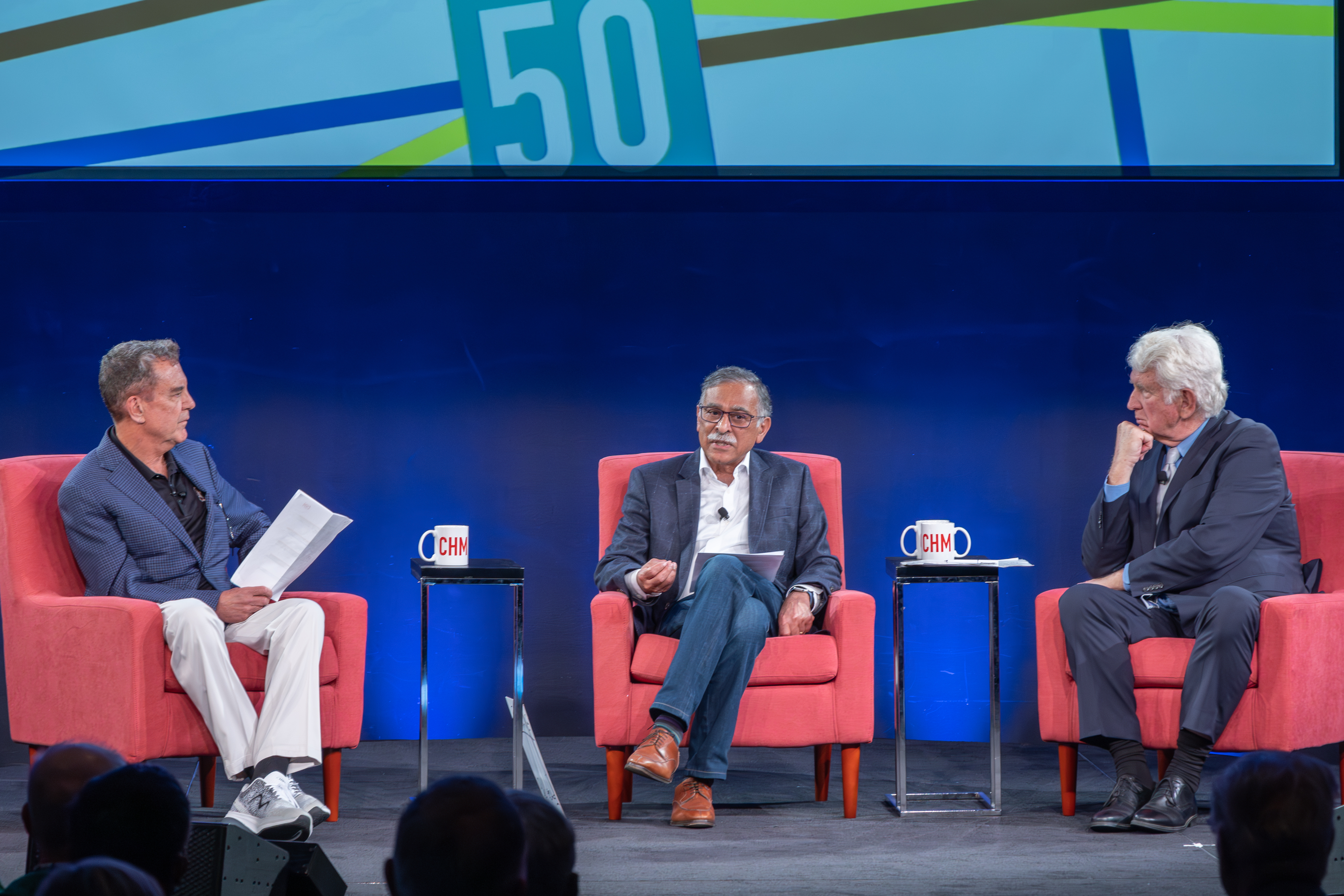
In May 2023, Dalal joined Metcalfe and moderator Rich Karlgaard onstage for Ethernet’s fiftieth anniversary. He explained Ethernet with a cocktail-party analogy, making a technical subject approachable through an ordinary social scene. Decades after the specifications, there was still pleasure in explaining how communication works. The student who had kept asking Cerf for a place in the lab was now helping an audience understand what happened there, and what followed.