Steve Pretre was out for a run in Portland when the Hawthorne Bridge interrupted him. The bridge lifted. He stopped. Around him, roughly 100 bicycles accumulated, their riders waiting to cross. For someone preparing to sell car insurance, it was an encouraging absence of cars. Here were people who had found another way to get about. Their insurance bills, he believed, ought to acknowledge the effort.
This was during the visits that preceded Metromile’s Oregon launch in December 2012. Pretre had co-founded the business with David Friedberg in 2011 and was its first CEO. Portland’s cycling community helped persuade him that the city was the right starting point. A delayed run had supplied a rather good piece of customer research.
The attraction was straightforward: plenty of people owned cars without using them for every journey. Insurance could remain a substantial expense even while the car enjoyed a leisurely week at the curb. Metromile would charge a base amount plus a rate for the miles actually driven. The odometer was being invited into the conversation about price.
A small box with an awkward question
At its public launch on December 5, 2012, Metromile offered insurance in Oregon and announced more than $4 million in funding. NEA, Index Ventures, First Round Capital and SV Angel were among its backers. The proposition arrived with a physical object: a device called the Metronome, plugged into the car to transmit driving data.
The launch offer separated mileage from driving manners. The company said the mileage component depended on how far someone drove, rather than when, where or how. A monthly base charge remained. This distinction matters: a car that stays parked still needs protection, while a car that travels adds another kind of exposure. The bill had two parts because ownership and use were different things.
There was an appealing little reversal in the sales pitch. An auto insurance company wanted its customers to drive less. Pretre saw the product as a way to reward choices people were already making: walking, cycling and taking public transport. A useful business can sometimes begin by giving an existing habit a more agreeable receipt.
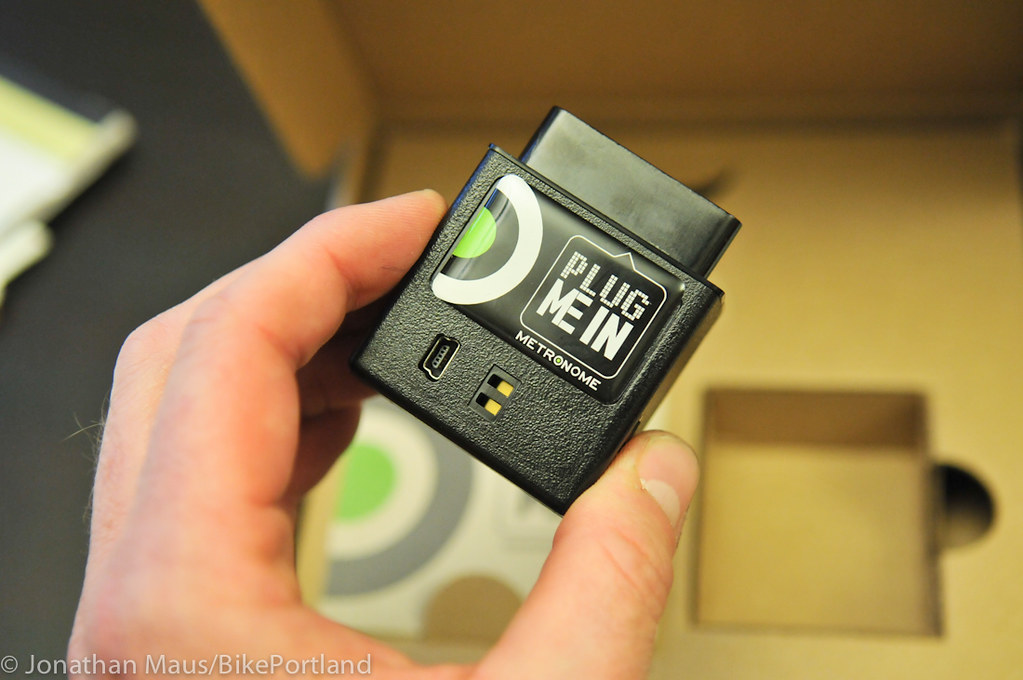
Metromile also made the car’s information useful between bills. An online dashboard let drivers examine their journeys. That was part of the broader ambition: the device could support a relationship with the driver through information, rather than turning up only when a premium or a claim required attention.
The car could remember where it had been
By 2013, Pretre was demonstrating a connected-car proposition with a decidedly everyday vocabulary. The little box had GPS and its own cellular modem. The accompanying smartphone app could show trips, fuel costs and the car’s location. Forgetting where you parked was suddenly a problem the insurance technology might help solve.
One example concerned the daily commute. Comparing journeys could reveal whether leaving a little earlier saved time and fuel. These were modest, recognizable decisions, the sort people make while wondering whether another cup of coffee is worth another queue of traffic. The data had a job to do before anyone needed a complicated explanation of predictive analytics.
That practical emphasis gives the early company its character. A product built around measurement still had to offer something a driver could understand. The insurance bill answered one question; the app answered others. Even the name Metronome suggested an orderly little instrument, quietly counting while everyone else got on with their day.
A monthly bill with a usage component. Conceptual illustration, not a current quote or offer.
The odometer was being invited into the conversation about price.
An education in things that might happen
Pretre brought a particular apprenticeship to this business. He had been the first marketing and product lead at Risk Management Solutions, usually shortened to RMS. The company developed predictive software for catastrophe risk, helping the insurance industry price and transfer exposure to events that everyone hoped would remain hypothetical.
That work gave him experience with the commercial uses of risk models. There is a considerable distance between producing an interesting calculation and making it useful to a customer. Product planning and marketing live in that distance. Pretre’s early responsibilities put him close to the point where technical work had to become something people could buy and use.
At Asurion, he later led the mobile applications business unit. The company’s device insurance reached consumers through wireless carriers. That experience introduced another part of the puzzle: distribution. A product’s route to the buyer could matter as much as the ingenuity inside it. A ready-made channel was a valuable piece of machinery.
His academic training combined a BS in mechanical engineering and a BA in economics at Stanford, followed by an MBA at Wharton, where he graduated as a Palmer Scholar. Engineering asks how a system works; economics asks what its participants have reason to do. Metromile gave both questions somewhere quite literal to travel.

The founding chapter, and what followed it
“I was excited and naive enough to think that we could pull that off,” Pretre later recalled. He also described the friction of getting a new insurance product approved state by state. The arithmetic could be simple while the work around it remained stubbornly complicated. A promising model still needed a business capable of carrying it.
Metromile’s leadership changed as the company developed. Dan Preston, who had been its chief technology officer, became CEO in 2014. Under Preston, the company moved from operating as a managing general agent to becoming an insurance carrier through its acquisition of Mosaic Insurance in 2016. Pretre’s place in this sequence is co-founder and founding CEO.
On July 28, 2022, Lemonade completed its acquisition of Metromile. The buyer highlighted data from 500 million car trips, alongside the premiums, cash and licensed insurance entity it received. Preston moved into a strategic role at Lemonade. The scale of the accumulated driving record showed how far the original experiment had travelled beyond that first Oregon offering.
Those later developments belong to a longer company history, with other people doing consequential work. Keeping the chapters separate makes Pretre’s contribution clearer. He helped establish the early proposition and bring it to market. The company then continued to change, collecting data, changing its operating structure and eventually becoming part of another insurer.
- 2011Pretre and David Friedberg co-found Metromile.
- 2012The Oregon insurance offering launches publicly.
- 2014Dan Preston becomes CEO.
- 2022Lemonade completes its acquisition.
Taking the operator’s seat into investing
Pretre joined World Innovation Lab in 2017. The firm connects technology companies with capital and corporate relationships, with a particular link between the United States and Japan. For a former executive with experience in product and distribution, that setting offered more than a change in job title. It offered another way to work on how companies reach customers.
In April 2018, WiL led PeerStreet’s $29.5 million Series B, and Pretre’s appointment to its board was announced. The business connected private real estate lenders with investors. His explanation of its appeal emphasized the local lenders’ knowledge and the cost of acquiring loans: familiar commercial questions about information, channels and how a marketplace fits together.
His public conversations have ranged beyond individual investments. In 2018, he moderated a discussion about near-term uses of artificial intelligence in insurance. A 2022 InsTech interview covered embedded insurance, low-code tools, data sharing and differences between the US and Japanese markets. These subjects concern how insurance gets built and delivered, including the less glamorous work behind the customer-facing promise.
The attraction of making old systems easier to move
In 2022, Tokio Marine launched a $42 million corporate venture fund with World Innovation Lab. Pretre led WiL’s management of the fund. Its announced focus was early-stage businesses, including insurance technology, financial technology and related fields. The arrangement placed a venture investor alongside an established insurance group with potential commercial relationships to offer.
A later investment brought the discussion down to the machinery inside insurers. In January 2024, Korr announced a $3.2 million seed round led by Motive Ventures alongside Tokio Marine Future Fund. Pretre led the investment for the latter. Korr’s proposition involved moving legacy insurance systems and historical data into a cloud-based architecture.
Pretre’s explanation focused on migration costs. Existing systems could be expensive enough to replace that some books of business remained stuck with them. It was a recognizably operational concern: the new destination might be attractive, but someone still had to make the move affordable. A better system has limited usefulness if reaching it consumes the business case.
There is a connection here to the small box in the car. Each proposition attempts to make information usable within an existing business. The work is specific, sometimes unphotogenic, and susceptible to awkward details. Yet those details determine whether a customer can actually enjoy the improvement promised in a presentation.
A runner’s view of the traffic
Away from those commercial systems, Pretre is a runner and former competitive triathlete. His mentoring biography describes weekends spent watching his children compete in soccer, cross country and track. The bridge anecdote belongs comfortably in that picture: a business observation gathered while he was doing something he already enjoyed.
Its charm lies in how little ceremony it required. He had gone for a run. A bridge stopped him. A crowd of cyclists made the market visible. The company would need devices, financing, software and insurance partners; the customer insight could still arrive on foot.
That remains a useful way to look at Pretre’s career. Risk models, mobile applications, mileage and legacy systems all involve information finding a practical use. At the beginning of Metromile, the question was whether someone who left a car parked more often should see that choice reflected in the bill. Waiting beside those bicycles, he could already see the people for whom the answer mattered.