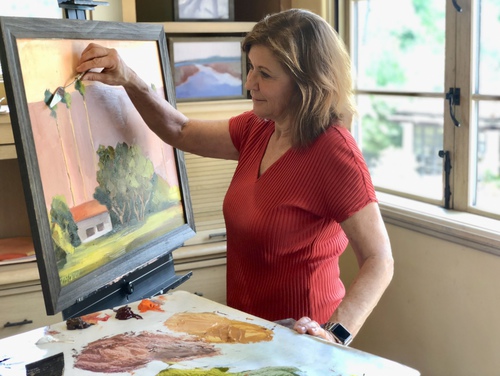
The Woman Who Stayed in the Room
She was told the firm's leader didn't hire women. She joined IVP anyway. By the following year, she was a General Partner - among the first women to hold that title in American venture capital. That was 1983. Silicon Valley was still young enough to pretend it had no rules, and MJ Elmore had already figured out how to work within the ones that actually mattered.
Today, Elmore holds the title of Limited Partner at IVP, the Menlo Park-based late-stage venture firm that has backed companies including Twitter, Snapchat, Netflix, Dropbox, and GitHub. She still writes angel checks through Broadway Angels - an elite all-female investment group - and through Sand Hill Angels. She sits on advisory councils at Stanford's Graduate School of Business and the Stanford Center on Longevity. And since 2015, she has been seriously, prolifically making oil paintings.
The VC-to-artist pivot sounds tidy on paper. In practice, it required the kind of stubbornness that got her through four decades in a room dominated by men who hadn't considered that she'd be better at the job than most of them.
"Understand the power structure as it exists, not what you wish it was."
MJ Elmore, Stanford Legal Podcast, November 2019Indiana Cornfields to Sand Hill Road
Elmore grew up in Indiana. She studied mathematics at Purdue University - a discipline she describes as foundational to everything that came after, including the canvases. She went on to earn an MBA at Stanford, which put her in the right geography at the right moment. The early 1980s in Silicon Valley were a very specific window: microprocessors were becoming real, software was becoming an industry, and venture capital was figuring out what it was.
Before IVP, Elmore worked at Intel's Development Systems Division, part of a small team working directly with the sales force to achieve market leadership for Intel microprocessors at the exact moment that mattered most. She learned what market inflection looked like from the inside. That instinct for timing - knowing which window is open and which is closing - would follow her into every investment decision she made for the next forty years.
Four Decades, Eight Funds
The numbers at IVP are not small. By the time she transitioned to Limited Partner status, Elmore had served across eight IVP funds and sat on the boards of numerous private and public information technology companies. Her investment focus was software, communications, and computer-aided engineering - categories that now seem obvious but required real conviction to back in the 1980s and 1990s when the outcomes were far from guaranteed.
Her portfolio included companies that became infrastructure: Bridge Communications (one of the original networking companies, eventually acquired by 3Com), SynOptics (a pioneer in Ethernet networking), SuperMac (high-performance Mac graphics), Aspect Communications, Red Pepper Software, and others that shaped the contours of enterprise technology before most people knew what enterprise technology was.
The IVP she joined in 1982 was already one of Silicon Valley's established firms, having been founded in 1974. What changed under the partnership she joined was a systematic approach to later-stage investing - backing companies that had product market fit and needed capital to scale, rather than seed-stage bets on unproven ideas. That discipline became the firm's defining characteristic, and it remains so today with $1.6 billion raised in its most recent fund (IVP XIX, closed March 2024).
Alpha Girls: The Book That Named What She Did
Four Pioneers. One Industry. One Book.
In 2019, journalist Julian Guthrie published Alpha Girls: The Women Upstarts Who Took On Silicon Valley's Male Culture and Made the Deals of a Lifetime. Elmore is one of four protagonists. The others - Theresia Gouw, Sonja Perkins, and Magdalena Yesil - were all navigating the same terrain from different angles.
The book documents in specific, reported detail what it actually looked like to be a woman in venture capital in the 1980s, 1990s, and 2000s: which rooms you weren't invited into, which assumptions you had to work around, which deals required twice the evidence before anyone wrote a check. It was adapted for television.
Elmore appeared on the Stanford Legal podcast alongside Guthrie in November 2019, in conversation with Professors Pam Karlan and Joe Bankman - a conversation that moved between legal frameworks and lived experience with the ease of someone who had spent forty years translating between them.
A Mathematician Who Paints
Oil Paint. Plein Air. Wet-on-Wet.
In 2015, Elmore enrolled in Stanford's Distinguished Careers Institute as a fellow in its inaugural class. She was spending a full year at Stanford - thinking, reconnecting, figuring out what came next. What came next was oil painting.
She describes herself as "a mathematician turned artist." The connection is not metaphorical. She photographs landscapes that excite her, converts them to sketches that isolate the mathematical essentials - lines, shapes, proportions, symmetry, forms - and then paints them using wet-on-wet oil techniques. The canvases show abstract landscapes and architecture. The math is visible if you know where to look.
Oil on canvas, wet-on-wet technique, plein air and studio work
Photo to mathematical sketch to painted canvas - geometry first, always
Abstract landscapes and architecture - nature's lines, shapes, and planes
She shows through Silicon Valley Open Studios and maintains a dedicated art website at mjelmoreart.com. Her email for art inquiries is mjelmoreart@gmail.com - a useful signal that she takes this seriously enough to keep it separate from the venture life. She describes her current phase of life as her "third trimester." The phrase is characteristically precise: not a retirement, not a wind-down, but a distinct period with its own arc and ambitions.
"Do one thing every day that scares you. Be everyday brave."
MJ ElmoreBroadway Angels and the Ongoing Work
Broadway Angels is not a passive vehicle. The group - an elite collection of female investors and business executives - actively evaluates deals and writes checks. Elmore has been a member long enough that her pattern-recognition from the IVP years informs how she evaluates opportunities: market inflection, team quality, timing. The evaluation framework doesn't change much. The check size does.
She also invests through Sand Hill Angels, which operates in the early-stage venture space in Silicon Valley. Between the two groups, she remains connected to the deal flow that matters and to the founders who are building now. The community is different from IVP's later-stage ecosystem, and that variety seems to suit her.
Outside of investing, she sits on the advisory council of Stanford's GSB and Stanford's Center on Longevity, serves on the board of trustees of Sacred Heart Schools in Atherton, and is a board member of Children's Health Council in Palo Alto - an organization focused on children and families navigating developmental, behavioral, and mental health challenges.
She is also an arts advocate, recently supporting SFMOMA's exhibition of Mary Lovelace O'Neal's work. The philanthropy has a through-line: education, the visual arts, and the institutions that build intellectual life in the Bay Area.
Five Lines That Capture the Philosophy
Understand the power structure as it exists, not what you wish it was.
Let your performance speak for itself.
Time is not refundable. Use it with intention.
Do one thing every day that scares you.
Be everyday brave.