In August 2025, Ian Rountree published a confession. The founder of Cantos, a venture firm backing robots, reactors and other stubbornly physical things, had been looking at his investments. He reported an awkward pattern. The depth of a company’s technology seemed to have little relationship to its success. Sometimes the relationship even ran backward. A man who made his living funding difficult engineering was questioning how much the difficulty mattered.
- Cantos backs physical-world startups, usually at pre-seed and seed.
- Its fourth fund, announced in June 2026, totals $70 million.
- The useful lesson: judge the business around the invention.
That admission makes Cantos worth understanding. Venture firms sell conviction. Here was one revising the reasoning beneath it. The resulting story is useful to anyone trying to turn an impressive prototype into something that customers will actually pay for.
01 The money meant for business school
Before Cantos, Rountree had savings earmarked for business school. He put them into angel investments instead. In his account of the firm’s beginnings, he describes wanting a supporting role in entrepreneurship: enough proximity to help ambitious founders, without needing to be the protagonist himself. Cantos began in 2016.
By September 2022, its third fund had reached $50 million. The investment logic was specific. Accept uncertainty about whether a technology can work, while seeking businesses whose underlying demand is easier to understand. Cheaper commodities, better medical care and stronger defense capabilities were examples. Climate technology, engineering-led biology, aerospace and next-generation computing supplied the hunting ground.

The distinction matters. A researcher may need money to discover whether something is possible. A company must also discover how to deliver it, sell it and survive until customers return. Cantos supplies early capital and counsel at that awkward junction. It is an investor in those companies; the companies build the machines.
02 Follow the robot onto the floor
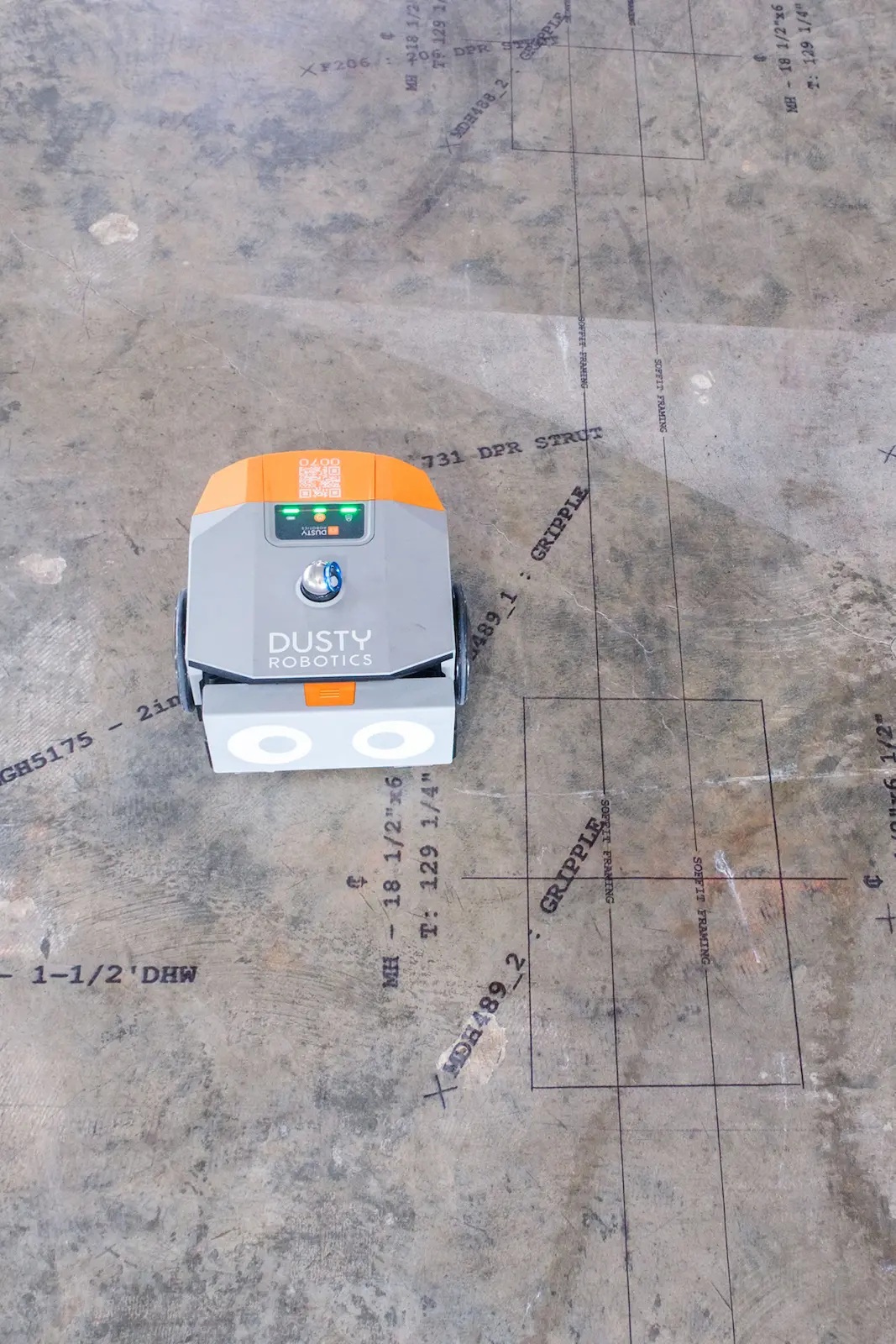
Consider Dusty Robotics, a Cantos portfolio company. Its FieldPrinter puts digital building layouts onto construction-site floors. The buyer gets a way to translate a model into instructions that crews can use where the work happens. The appeal is refreshingly concrete: fewer misunderstandings between the drawing and the building.
Dusty advertises layout output of 10,000 to 15,000 square feet per day with one person. That is a manufacturer’s claim, but it illustrates the kind of promise a contractor can evaluate: time, labor and coordination on a real job. The purchasing conversation has a unit of measurement.
Dusty’s website names construction businesses including Skanska, DPR and Truebeck. These are Dusty’s commercial relationships, rather than customers of Cantos. A fund’s immediate constituencies are different: founders receiving investment, and limited partners providing the money that the fund invests.
Other investments make the scope clearer. Astranis builds small satellites for high orbits. Radiant is developing its transportable Kaleidos nuclear microreactor. Solugen combines enzyme engineering, catalysts and manufacturing. They occupy different industries, but each has to make physical performance meet a customer’s requirements.
Astranis describes a similarly legible offer: dedicated satellite connectivity for customers around the world. Its website reports more than $1 billion in satellite services sold. That figure belongs to Astranis. It shows why an investor might look beyond the spacecraft to the service a customer contracts to receive.
Shinkei supplies a particularly good example. In explaining that investment, partner Grant Gregory described robotic fish processing alongside a vertically integrated business. Processing quality, shelf life and the margins captured across the supply chain all enter the argument. The robot has to earn its place in the economics of dinner.
03 The breakthrough lost its halo
Rountree’s 2025 reassessment sharpened this question. “I fell prey to the myth of the breakthrough,” he wrote. His new emphasis included the team, business model, incumbent competition, regulation and speed of learning. Technical novelty remained useful, but it could not carry the whole company.
“I fell prey to the myth of the breakthrough.”
Ian Rountree / August 2025
There is a practical test hiding here. For a construction robot, ask which part of the contractor’s workflow changes. For a chemical process, ask how production and distribution work. For a satellite, ask who needs the capacity and what they will commit to buying. These questions make an invention’s commercial assumptions visible.
This is also where the approach has limits. An engineering milestone cannot by itself resolve procurement, regulation or production costs. A buyer can need a product and still be unable to buy it on the startup’s timetable. Treating demand as understandable is a starting assumption that deserves testing.
04 A $70 million first chapter
In June 2026, Cantos announced an oversubscribed $70 million fourth fund, closed earlier that year. Rountree has described typical first checks of $1.5 million to $4 million. The point of entry is usually pre-seed or seed, when a founding team is still assembling its business.
Capital committed to a fund. A budget for investments.
For founders, that capital comes with an ownership relationship. Venture investment trades money today for participation in the company’s future value. The dollars raised by a fund should never be mistaken for the firm’s sales.
Cantos shares territory with investors such as Root Ventures, Fifty Years and DCVC. Physical technology has plenty of believers. Cantos’s particular pitch combines early entry with a broad appetite across industries. Rountree has argued that companies working on screens are a narrower specialty than businesses addressing the rest of the economy.
05 Put the team near the front
For someone preparing a pitch, Rountree’s advice is actionable: move relevant team experience toward the front of the deck. At inception, plans can change quickly. The people making those changes deserve attention early.
He also recommends interviewing an investor’s portfolio founders, including someone whose company failed. It is a better reference question than asking only about the good years. The relationship may last far longer than the fundraising process.
Cantos applies a related standard to itself. When Gregory joined in 2024, Rountree highlighted the enthusiasm of founders Gregory had declined to fund. A useful investor, apparently, can leave a good impression even while saying no.
In his account of building the partnership, Rountree favors a small firm where developing investors can become future partners. The hiring decision therefore carries unusual weight: colleagues help determine which founders receive those earliest checks.
The firm’s name comes from the divisions of epic poems. Its new identity even has a winged quill. The literary flourish is fun. The more useful detail is the willingness to edit: change an assumption when the portfolio gives you reason, then ask a better question of the next machine.
Keep following the machinery
Explore Cantos, its essays and portfolio jobs. Follow the firm on LinkedIn and X.