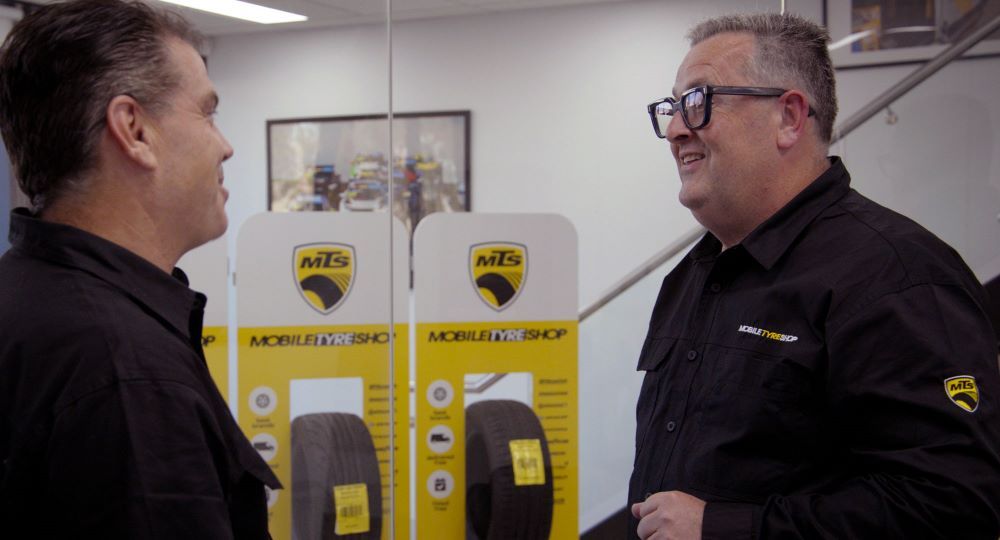
The tyres were ordinary. The business was awkward. Mobile Tyre Shop sent technicians to customers rather than making customers wait at a workshop. When the Australian retailer needed software to coordinate its growth, it chose an off-the-shelf enterprise system. In Claris’s account, implementation took two years. The first month after launch brought an approximately $250,000 sales decline, according to the retailer’s COO. A respectable-looking purchase had become a very expensive interruption.
- What it sells: a platform for building custom database apps, now under the Claris company name.
- Where it earns its keep: unusual operational workflows, shared records, mobile teams, and repetitive handoffs.
- What to copy: prove one small improvement before commissioning a whole business system.
- The tradeoff: easier development still leaves licensing, maintenance, and ownership to arrange.
The repair that came before the replacement
COO Jamie Cartwright remembered FileMaker from an earlier career in music. With Claris Partner Digital Fusion, the retailer began by connecting product data to its website. That modest project persuaded a cautious CEO to proceed. Quote screens and other operational tools followed; separate apps eventually became a custom ERP.
“We’re not an out-of-the-box business.”
Jamie Cartwright / COO, Mobile Tyre Shop
It is an unusually useful admission. Buying standard software also means accepting assumptions about how work happens. A sensible first question is whether those assumptions fit the work you actually do. The retailer’s experience offers a practical starting point: choose a bounded problem whose improvement people can see, then use that evidence to decide what comes next.
A database with opinions about work
FileMaker Inc., the Apple subsidiary in this story, changed its corporate name to Claris International Inc. in 2019. FileMaker remains the flagship product. The distinction matters: Claris is the company; FileMaker is the tool you use to build and run a custom application.
At its center is a relational database. Customers, jobs, stock, invoices, and other records can be connected rather than kept in unrelated lists. Around that database sit visual layout tools, calculations, and a script engine. A developer can assemble screens and behavior in the same environment that manages the underlying information. This is the appeal of a unified platform: fewer separate pieces to assemble before a useful app can exist.
Consider a hypothetical repair business. A customer has several machines. Each machine has service visits. Each visit needs parts, a technician, and a record of what happened. A spreadsheet can capture individual lists. A custom app can make their relationships part of the daily routine: choose the machine, see its history, record the visit. The important design work is deciding which connections people need and when they need them.
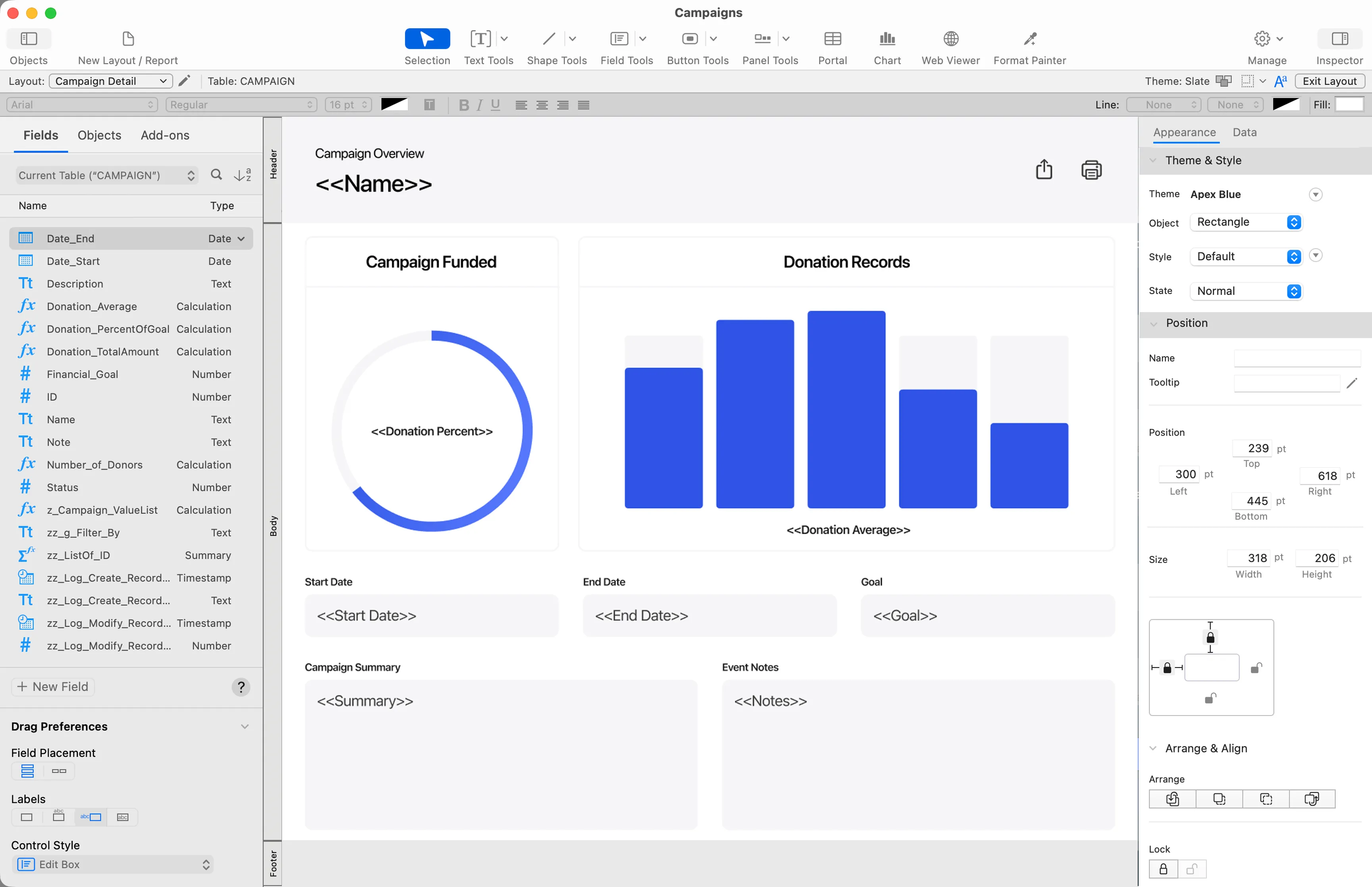
FileMaker Pro is the desktop creation and access environment on Mac and Windows. FileMaker Go takes apps to iPhone and iPad; WebDirect provides browser access. Server gives an organization a self-hosted route, while FileMaker Cloud provides managed hosting. Claris Connect handles workflows between apps and services. Those parts address different jobs, so a purchase starts with how the app will be used and operated.
The person who knows where the time goes
Spikeball supplies a second kind of FileMaker customer. Its events manager, Logan Cornelius, learned the platform through forums, guidebooks, and videos, then built an app for work spread across different tools. Claris’s customer story reports a 90% reduction in inventory management administrative time.
Reported in Spikeball’s customer story. A result from one implementation, rather than a forecast for yours.
The attraction here is authorship. A person close to the work can help shape its software, and sometimes build it. Claris also maintains an ecosystem of professional partners for organizations that need specialist assistance. These are two routes to the same requirement: the builder needs enough access to actual users to discover the awkward exceptions.
Customers span small businesses, enterprise departments, schools, nonprofits, and researchers. OceanX uses FileMaker in its research operations. Harvey Water Softeners reports an estimated £1 million in annual development and operations savings from its custom apps. The range is telling. Claris’s expertise is in tools for data-driven work; a partner or internal developer supplies knowledge of the particular operation.
“For me, FileMaker is my de facto problem-solving toolkit.”
Guy Halligan / Harvey Water Softeners
The licence is only the first bill
Claris makes money from software licensing and services. Plans depend on user count, hosting, and contract length; partners charge separately for their work. During this profile’s October 2026 research, the US store displayed a five-user FileMaker Server annual option at $39 per user per month, or $2,340 billed annually before tax.
That example is a licence price. A self-hosted deployment also needs infrastructure and someone to operate it. Designing the app, moving existing information, training people, and maintaining the result take time or money. Managed cloud hosting changes who handles some of those responsibilities. It is worth comparing the whole arrangement against the recurring work the app is supposed to remove.
A planning framework, not a price breakdown. The proportions depend on the project.
Where does FileMaker fit? Among the alternatives a buyer might evaluate are Microsoft Power Apps, Airtable, Zoho Creator, a packaged ERP, and conventional custom development. FileMaker’s particular proposition is a database, visual interface, scripting, and cross-platform deployment together. Whether that combination wins depends on the workflow and the people who will support it.
A standard package can make more sense when its process already suits the organization. A team committed to another development stack may prefer that stack’s tools and skills. A simple form may need only a simple form. FileMaker deserves a closer look when records, interfaces, integrations, and recurring exceptions need to work together. A trial should test the busiest realistic workflow, including permissions and the devices people will actually use.
Claris has been here before
Apple formed Claris in 1987. Bill Campbell, Randy Komisar, and Yogen Dalal were among its founding figures. FileMaker joined its portfolio through the Nashoba acquisition. In 1998 the company took the FileMaker name; in 2019 it restored Claris and announced the Stamplay acquisition that became Claris Connect. The names record a recurring question: how broad should this software business be?
In August 2026, that question produced a retreat. Claris announced that Studio, its web forms and data-view service, would end on March 15, 2027. Its announcement acknowledged functional gaps it had not closed quickly enough, growth insufficient to sustain the needed investment, and competition from emerging AI tools. Resources would move toward FileMaker’s agentic development capabilities and platform stability. Existing Studio users face a migration decision; the announcement provides continued service and support until the closure date.
The glamour of keeping Tuesday working
FileMaker 2026 arrived in June with richer field and table context for AI, Google Gemini support, and development improvements. It also introduced optional Remote Backup and Standby Server services. One protects an offsite copy; the other maintains a secondary server. Recovery deserves this attention once an app becomes part of how the business operates.
The future-facing work reaches existing data, too. Claris MCP connects selected FileMaker tables and scripts to compatible AI assistants. Its promise is useful access to the information and actions already in a company’s apps. The choices about what to expose remain part of the implementation.
For a prospective customer, the first experiment can remain pleasantly small. Pick one repeated handoff. Record the effort it takes today. Build a version that the people doing the work can test. Assign someone to own it afterward. FileMaker offers the means to turn a specific understanding of work into software; the business still has to supply that understanding. A modest app that earns its next improvement is a good place to begin.
Try it. Watch it. Ask better questions.
Claris website · 45-day FileMaker trial · Plans and hosting · Company blog · Developer community
Watch: FileMaker 2026 overview ↗
Watch: continuity and recovery overview ↗
More Claris demos on YouTube ↗