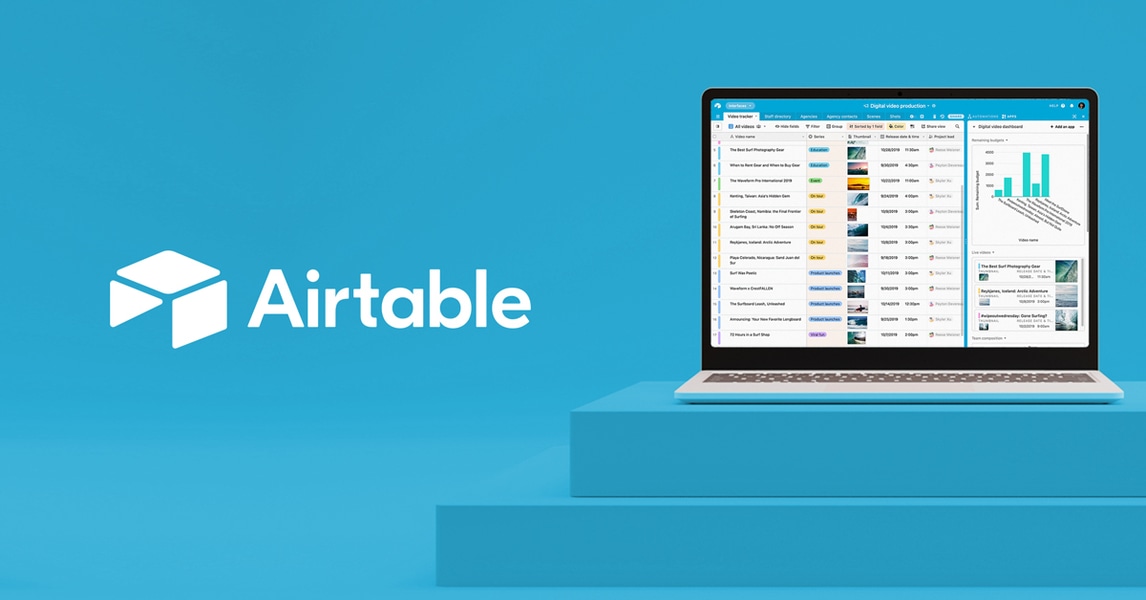
Open any large company's internal toolkit today and there is a decent chance you will find a grid of colored cells doing a job no spreadsheet was ever designed to do - tracking rocket parts, scheduling television, routing a marketing campaign across four continents. The grid is Airtable. It looks like something you already know. It is not.
Airtable, headquartered at 1 Front Street in San Francisco, employs roughly 940 people and reports about $478 million in annual revenue. More than 500,000 organizations run on it, including an estimated 80% of the Fortune 100. By the numbers it is a mature enterprise-software company. By temperament it still behaves like a tool that is faintly embarrassed to be taken so seriously.
The problem they saw
For decades the software world split into two unhappy camps. On one side, spreadsheets: infinitely flexible, instantly understood, and quietly powering trillion-dollar decisions on a foundation of cells that break when you sneeze. On the other, "real" software: robust, structured, and accessible only to people who could write code or afford those who could.
Everyone in the middle - the marketer, the producer, the operations lead - was stuck. They had the ideas for the tools they needed. They simply could not build them. So they abused spreadsheets instead, bending Excel into a database it was never meant to be, and pretending the formula errors were a feature.
The cost of that gap was invisible because it was everywhere. Teams waited months for an engineering ticket to surface a tool they could have sketched in an afternoon. Knowledge lived in tabs nobody could link together. The information technology and services industry had spent forty years building software for software people, and quietly left the rest of the workforce to improvise. Airtable's founders looked at that improvisation and saw a category, not a failure.
The founders' bet
Three Duke engineers decided the middle was the whole market. Howie Liu had taught himself C++ at thirteen, entered Duke at sixteen, and sold his first startup, Etacts, to Salesforce before most people finish college. Andrew Ofstad had helped redesign Google Maps. Emmett Nicholas had spent years in the engine room at Stack Overflow.
Their wager, placed in 2012, was almost annoyingly simple: take the friendliness of a spreadsheet and quietly bolt a real relational database underneath it. Then spend three years - two of them in stealth - making sure the seam never showed. Airtable opened an invite-only beta in 2014 and launched publicly in March 2015.
Howie Liu
Co-founder & CEO. Self-taught coder at 13; sold Etacts to Salesforce in 2010.
Andrew Ofstad
Co-founder & Chief Product Officer. Former Google Maps redesign lead.
Emmett Nicholas
Co-founder. Former Stack Overflow engineer; the team's database backbone.
The product
What they shipped is deceptively boring to describe. You see rows and columns. You link a row in one table to a row in another. You build an Interface - a clean dashboard for the people who should never see the messy underlying data. You set an Automation that fires when something changes, nudging Slack, Salesforce, or Jira without anyone touching a keyboard.
The magic is that none of it requires permission from an engineering team. Airtable's design tenets, profiled at length by Fortune, were built around the "open-ended use case" - the company deliberately refused to tell you what its product was for. That refusal is the product.
It is a strange thing to build a business on, this principled vagueness. Most software wins by narrowing: pick a workflow, optimize it, defend it. Airtable did the opposite. Marketing teams used it to plan campaigns. Studios used it to map production schedules. Operations leads used it to run supply chains, and somewhere a book club used it to track who still hadn't returned the paperback. The same blank grid served all of them because the company kept its opinions to itself and handed the opinions to the user.
The business model rewards that breadth. Airtable runs the now-familiar freemium playbook: a free tier generous enough for individuals and small teams, paid per-seat plans for growing companies, and enterprise contracts that layer on governance, security, and AI. The free grid in the corner of one department has a habit of spreading, department by department, until procurement notices and the contract gets large. It is land-and-expand with a friendly face.
The slow build, then the leap
A milestone timeline
The proof
Talk is cheap; net dollar retention is not. At its peak growth, Airtable reported retention numbers that outran its tidier rivals, and the customer list reads like a tour of how modern companies actually run. AWS uses it for marketing operations. Netflix has leaned on it for content planning. Blue Origin has tracked rocket parts in it - which is either a triumph of flexibility or a slightly terrifying fact about rocketry, depending on your mood.
The capital backed the conviction. Across seven rounds Airtable raised about $1.35 billion, walking up the alphabet from a $3M seed in 2015 to a $735M Series F in late 2021. The investor roster gathered names that rarely share a cap table: Thrive Capital, Benchmark, and Coatue led the early growth rounds; Greenoaks anchored the Series E; the Series F pulled in XN, Franklin Templeton, Salesforce Ventures, Silver Lake, T. Rowe Price, and Michael Dell's MSD Capital. At that peak the company was valued at $11.7 billion.
Then the market did what markets do. As the 2021 software bubble deflated, Airtable's paper valuation reportedly settled toward $4 billion by late 2025 - a humbling number on its face, and a largely cosmetic one underneath. Valuations are votes; revenue is weight. The weight kept climbing. Reaching cash-flow positive in late 2024 mattered more to the people who actually run the company than any nine-figure markdown, because it meant the business no longer depended on the next round to exist.
Annual recurring revenue
Reported ARR, approximate, USD
A ~27% jump in a year when many SaaS peers stalled. The line that matters most isn't on this chart: in late 2024 the company stopped burning cash. Source: company and industry reporting.
The mission
Through all of it the stated goal never moved: democratize software creation. The phrase has the worn edges of every mission statement, but Airtable has the unusual distinction of being measured against it daily. Either a non-engineer can build the tool they need, or they cannot. For 500,000 organizations, the answer has been yes.
The 2025 relaunch is where the mission and the moment collide. Airtable now calls itself an AI-native app platform, anchored by Omni - a conversational builder that generates entire apps, tables, interfaces, and automations from a plain-language description - and Field Agents, AI workers that live inside your data and run operations on their own. CEO Howie Liu has framed it not as a feature release but as a "refounding moment."
Omni
Agentic AI builder. Describe the app; it assembles the data, logic, and interface.
Field Agents
AI agents embedded in your bases, running analysis and updates autonomously.
Governance
Enterprise permissions, security, and admin controls for deployment at scale.
Why it matters tomorrow
There is a tidy irony in a no-code company betting its future on AI. For a decade Airtable's promise was that you didn't need an engineer. Now the promise is that you barely need a builder - you need a sentence. If that works, the addressable market is no longer "people who can drag and drop." It is everyone with a problem and a keyboard.
The skeptic's question is fair: does an AI-native grid hold up when the agents get things wrong, when the data is messy, when the stakes are a launch and not a book club? Airtable's answer is that its agents build on real, production-ready components, all the way down to the data and logic layer - not improvised guesses. Whether that holds at enterprise scale is the story still being written.
Back to that internal toolkit, the grid of colored cells doing a job no spreadsheet was meant to do. A decade ago, building it required a developer, a budget, and a quarter of patience. Today someone described it in a sentence and watched it appear. The grid still looks like something you already know. It still is not.