A person can have a perfectly sensible financial life and a thoroughly incoherent financial screen. The salary arrives at one bank. The credit card belongs to another. The retirement account sits elsewhere, quietly becoming the largest number nobody checks. Each institution offers a view. None of those views is the whole picture.
Yodlee sells the work of assembling that picture. Banks, fintech companies and wealth firms use its software to connect accounts with the consumer’s permission, retrieve information and make it usable inside their own products. It is the sort of company you can encounter without remembering its name. The budgeting app gets your attention; the connection beneath it gets your data.
- The job: connect scattered financial accounts, then clean up what they say.
- The buyers: financial institutions, app builders, wealth firms and lenders.
- The change: independent under STG since September 2025.
- The lesson: a broad network still needs a comprehensible last click.
The internet, before the bank became the story
In 1999, Yodlee’s ambition extended beyond money. Its early service gathered email, travel, shopping, news and financial accounts into one place. This was an internet that could already scatter your personal information across websites, but had not yet made gathering it particularly pleasant. Yodlee proposed a single place to look.
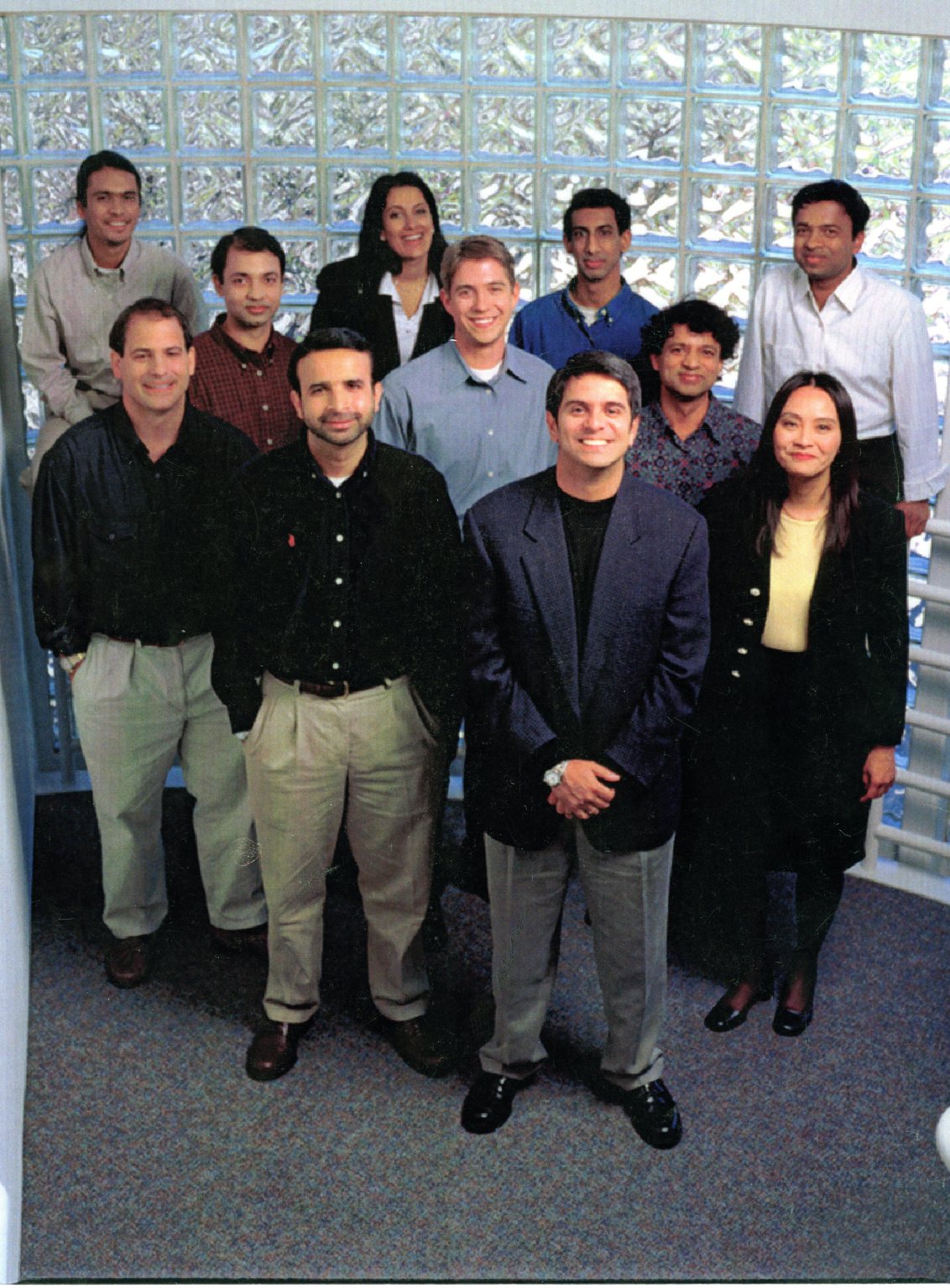
Contemporary reporting identified a founding group drawn from academia, Microsoft, Amazon and the Stanford Research Institute. Among them were Venkat Rangan, Sam Inala, Schwark Satyavolu and Sukhinder Singh, later known as Sukhinder Singh Cassidy. The company reported $2 million in angel backing, followed by a $16 million venture round led by Accel and Sequoia in October 1999.
By December 2000, Yodlee had announced a deal to acquire aggregation rival VerticalOne. Financial institutions and internet portals were already customers of the two companies. The interesting evolution is visible in the contrast between that early everything-in-one-place service and today’s specialist financial platform. Money supplied a durable reason to connect information: a missing account can distort a budget, a lending decision or a retirement plan.
The contrast suggests a useful business lesson: gathering information becomes easier to sell when the customer has a decision to make with it. Financial applications give aggregation a purpose beyond the convenience of having fewer browser tabs open.
The useful part is the translation
Think of a bank transaction as a sentence written for another computer. Retrieving it is useful. Making sense of it is a second job. Yodlee’s transaction enrichment cleans and categorizes records so an application can work with spending patterns instead of a pile of cryptic descriptions.
The product stack follows that practical sequence. FastLink supplies the account-linking experience: find the institution, authenticate, give permission and choose accounts. Aggregation brings back information such as balances and transactions. Enrichment adds meaning. Personal financial management tools help institutions offer spending, budgeting and cash-flow experiences.
A wealth adviser can use aggregation to see assets held at institutions outside the adviser’s own platform. A digital bank can let customers examine accounts elsewhere. An onboarding team can use account verification to establish account details without relying on a slow micro-deposit journey. The capability matters when it removes a specific obstacle.
Credit is another application. Credit Matrix produces income, expense and asset information for lending workflows. In October 2025, Yodlee announced that its subsidiary Yodlee Credit had completed the steps needed to operate as a Consumer Reporting Agency. The proposition is to give lenders additional cash-flow information for their models. Better information is an input; an approval remains a lending decision.
Yodlee also describes a separate alternative-data business supplying de-identified spending insights for research. That distinction deserves attention: connecting someone’s accounts for an application and providing research data are different uses of financial information. A buyer should understand the permissions and data practices attached to the particular service being purchased.
The economics of the invisible company
Yodlee is principally a business supplier. Its customers pay for software and data capabilities that become ingredients in their own services. Historical filings describe recurring subscription fees associated with paid users, plus professional services. In 2014, subscription revenue was about $76 million out of $89.1 million in total revenue. Those are historical accounts, not a forecast of today’s business.
The development sandbox offers a free way to experiment with preconfigured test users. A production deployment is a separate commercial discussion. The useful cost question therefore includes implementation, monitoring, reconnection support and the data fields a product actually needs. An API fee alone does not tell a team what the finished service will cost to run.
The ownership history supplies firmer numbers. Yodlee went public in 2014. Envestnet announced its purchase the following year at approximately $660 million in fully diluted equity value. At closing in November, the stated value was approximately $610 million, reflecting the cash-and-stock consideration and Envestnet’s share price. The two numbers describe different moments in the same transaction.
Envestnet sold Yodlee to STG in a deal completed on September 2, 2025, after a decade together. The company returned to an independent Yodlee brand. In November, it amended its long-standing JPMorganChase data access agreement, including a pricing structure. Financial connectivity has counterparties, contracts and costs behind the screen.
The first thing to fail is often a connection
Yodlee advertises access to more than 19,000 data sources. That breadth helps explain its place in the market. It also describes an upkeep problem: the product depends on institutions with their own authentication systems, available data and changing interfaces.
Its developer FAQ makes the limitation concrete. On credential-based connections, a changed bank password prevents retrieval until valid credentials are provided again. Refreshing is also more complicated than a perpetual live feed: the platform supports on-demand retrieval and background cycles whose timing can depend on user activity.
API-based open banking changes part of that arrangement. The user authenticates with the financial institution, which supplies an access token; the connection no longer needs Yodlee to store the user’s bank login credentials. In June 2026, Alkami announced an FDX API integration with Yodlee using OAuth 2.0, replacing screen scraping for those connections. This is a concrete change in how data travels.
Plaid and Mastercard Open Finance sell overlapping account connectivity and enrichment capabilities; MX is another alternative. Yodlee’s case rests on its financial-institution relationships, account coverage and product range across wealth, banking and credit. None of those facts establishes that it wins every comparison. A team should test the institutions its customers use, the fields it needs and what happens when an account stops refreshing.
A very small click, a very large lesson
The most revealing recent Yodlee document is unusually unglamorous. In June 2026, its FastLink release notes described friction at the account-selection step in standalone verification. The proposed improvements included more visible radio buttons, clickable account cards and clearer feedback about which account had been selected.
“Funnel analysis identified friction at the account selection step.”
Yodlee · June 2026 release notes
The update also removed automatic preselection of verified accounts. Users now had to choose explicitly before proceeding. Funnel evidence prompted a design change; preventing unintended resubmission mattered alongside making the screen easier to use. The release notes limit these changes to standalone verification, so they should not be mistaken for a redesign of every FastLink journey.
There is a lesson here that a small product team can copy. Watch where people hesitate. Make selection visible. Give the person enough control to understand what is happening. Then check whether the change helps the actual journey. A collection of impressive connections cannot rescue a screen that leaves someone unsure which account they are sharing.
The approach depends on real conditions: the relevant account must be supported, permission must be granted and the data must be fresh enough for the task. A cash-flow forecast built from incomplete records remains incomplete. An account-linking tool cannot supply consent on the user’s behalf. The sensible promise is a better view of money, with enough care to know where that view ends.
Yodlee’s long-running problem is still recognizable from 1999. People have information in several places and would like to use it together. The business has become more specialized. The human at the account-selection screen remains wonderfully particular.
Try the machinery
Explore the platform, inspect the developer tools or watch an account-linking walkthrough before deciding what to build.