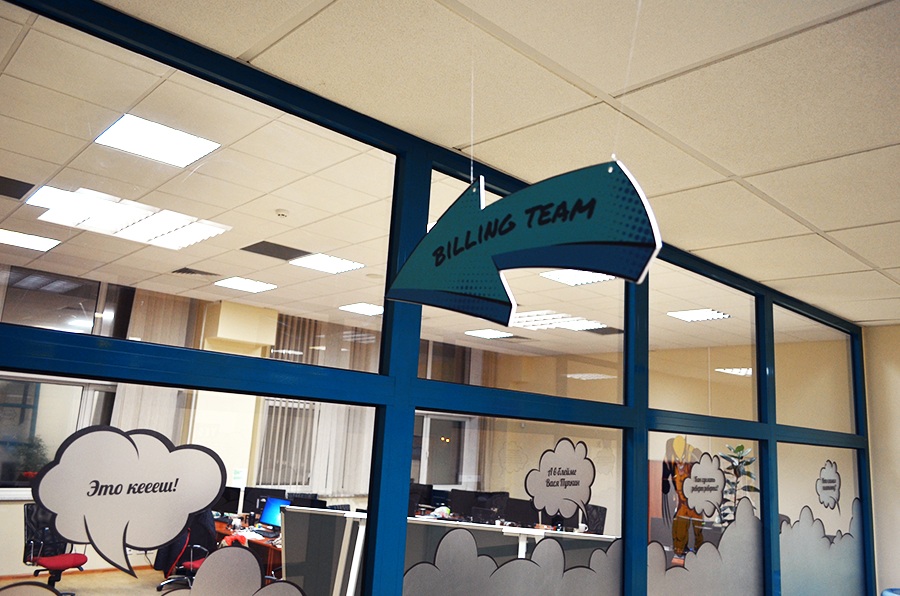
There is an arrow in one of Yellow Stone’s office photographs. It hangs above a glass partition and says “Billing Team.” Below it sit desks, monitors and speech-bubble decorations. It is an ordinary office scene, which is precisely why it is useful. An online gaming business can look, from the outside, like a collection of games and advertisements. Here is a reminder that somebody has to make the money move.
That photograph offers a way into Yellow Stone. The company describes a technology platform connecting international gaming products with users. Its public-facing language emphasizes traffic and growth. Its product pages and recruitment notices reveal a more interesting collection of jobs: finding players, understanding their behavior, processing payments, monitoring risk and answering questions. The second visit depends on how those jobs fit together.
The story in three moves
- One connected operation: gaming content sits alongside marketing, payments, BI, risk and care.
- Retention is a team sport: job descriptions connect product, design, CRM and engineering.
- A useful habit to borrow: examine the handoffs across a customer journey before chasing more traffic.
A checkout has a geography
The company’s product offering brings six functions around a gaming platform. Alongside content and marketing are payment processing, business intelligence, risk management and customer care. It says its payment service offers more than 60 methods, in over 18 countries, across 15 currencies. Those are company-stated coverage figures. Read them as a description of the offering, rather than a guarantee about any particular market.
The distinction matters commercially. A marketing campaign can cross a border more easily than a payment habit can. For an operator, attracting an interested player and offering a usable transaction experience are connected product decisions. Yellow Stone’s proposition puts both inside the same conversation. Its market position is at the intersection of gaming software and the services needed to run it.
Its commercial audience includes gaming businesses and partners; its work also reaches the players using their products. A company-authored DOU profile describes thousands of users worldwide. That makes the business model more involved than delivering a software project and walking away: acquisition, operations and continuing player relationships all appear in the work it describes.
The experiment behind the welcome
Consider its September 2025 product-owner listing. The responsibilities include landing pages, welcome sequences and bonus programs, with coordination across CRM, retention, technical, product and design teams. What appears on a player’s screen has a small organizational map behind it. Someone requests a design. Someone builds it. Someone needs to know whether it worked.
Reading the platform / An editorial map
An April 2026 CRM vacancy makes the feedback mechanism explicit. It asks for communication sequences in chatbots, analysis of the user base, business-hypothesis testing and evaluation of results. The interesting part is the sequence: propose something, test it, then decide. A test earns its keep when it changes the next action.
A product-marketing vacancy adds customer interviews and competitor research to conversion and retention metrics. Read together, these descriptions suggest an operating preference for combining observed behavior with direct questions. They describe the intended work, rather than proving a particular improvement. For another product team, that distinction is healthy: copy the discipline, then measure your own result.
Someone has to keep it running
There is a physical limit to any clever campaign: the service must be available when people arrive. Yellow Stone’s September 2026 DevOps recruitment describes high-load production environments, cloud infrastructure, deployment pipelines, monitoring and incident response. Its requested skills span infrastructure automation, databases and container orchestration. The growth story has an engineering shift attached.
This breadth helps explain the offering’s appeal. A gaming business could assemble separate tools and suppliers for each function. Yellow Stone presents them as related parts of its platform. The prospective advantage is coordination. Whether that is valuable for a particular operator depends on its existing systems, integration needs and ability to act on what the data reveals.
An extra day off, won at poker
The people become easier to see in the archive. A January 2019 company report describes a Casino Royal-themed party with poker and an auction. One product manager bought the right to choose an office seat. An analyst bought an extra vacation day. Even the party had an allocation mechanism.

Another company archive records attendance at JSFest and Krupa 2019, including designers getting Don Norman’s autograph. Today’s recruitment offers learning opportunities and mental-health support. These are employer accounts, but they show how Yellow Stone presents professional development: product work, conversation and time spent learning outside the immediate assignment.
“I worked my way up from a content writer to a team lead here”
LENA / COMPANY-PUBLISHED CAREER TESTIMONIAL
Follow the handoffs
The portable lesson is to follow one customer across departmental borders. Ask what the advertisement promised, what the landing page delivered, what happened at payment and what support heard afterward. Agree on the problem before commissioning another campaign. That exercise is useful wherever several teams share responsibility for one experience.
It needs enough reliable data to compare outcomes, people authorized to change the product, and a service customers have reason to use. Coordination cannot rescue an unwanted offer. Yellow Stone’s proposition is most interesting in that space between departments, where an apparently successful click can still become an unfinished visit. The billing arrow points toward one part of the answer. The rest requires the teams on both sides of the glass.