Kevin Moore once charged $5,000 for software that took months to build. Revisions were included. Somewhere in that transaction is a small monument to the difference between knowing how to make something and knowing what it is worth. The code could work perfectly while the business quietly failed its own arithmetic.
That was Éclipse Technologies, his first company, launched after an IT diploma in 2001 and an internship in Panama. He eventually sold it, later spent seven years doing defence research and development at DMR, and tried entrepreneurship again with Vooban in 2011. The second attempt came with colleagues and experience. It also came with a name that caused trouble at an awards ceremony: Moore recalls preparing to accept a prize, only to discover somebody else had already gone onstage after the announcer mangled “Vooban.” Even success, apparently, can require debugging.
The developer leaves a trail
For a less ceremonial glimpse of Moore, look at his old programming activity. His Stack Overflow profile connects the CEO title to questions and answers about Azure deployment, source control and rules engines. These are the modest plumbing problems of software development, the sort that consume an afternoon without supplying much material for a keynote.
There, Moore describes an appetite for challenging existing technologies and methods. He also describes continuing to work as a software engineer across company projects and encouraging open source work. The profile is a historical snapshot, rather than a current timesheet. Still, it helps explain the kind of executive he became: somebody whose public vocabulary once included the stubborn particulars of getting software to behave.
“I believe challenging idea is the best way to keep evolving!”
Kevin Moore, Stack Overflow profile
That slightly rough sentence has the charm of a programmer leaving the office before the copy editor arrives. It also puts a useful condition on his enthusiasm: improvement begins with questioning something already in place.
A company small enough to know everybody
When Vooban turned ten in 2021, Moore looked back on a pitch deck at the convention centre in Lévis and friends persuaded to join. Ten people had once seemed like a substantial enterprise. By the anniversary, the company had more than 70 employees. His recollection dwelt on people as much as projects.
He thanked five early colleagues individually. Steve Bélanger had gone unpaid for three months to join sooner. Marc Landry had helped devise the name. Moore also thanked Martin, his cofounder, whose path had separated from his in 2019, and Hugues, his then-current partner. A founder's retrospective can become a solitary victory lap; this one had a crowded passenger list.
The same account identified 2017 as a hinge: Vooban established its AI team and stopped consulting to concentrate on custom, turnkey projects. The consequences of that choice are practical. Delivering a complete project puts the finished result at the centre of the relationship. A clever recommendation has to survive contact with an actual workplace.
- 2011Start Vooban with former colleagues.
- 2017Build an AI team; move to project delivery.
- 2023Bring in the first outside investor.
The first outside cheque, twelve years in
In September 2023, CDPQ became Vooban's first external investor. Twelve years had elapsed since the founding. The announced purpose was expansion, especially into Ontario and the United States, through internal growth and acquisitions. At the time, Vooban counted 135 employees and reported annual revenue growth of 50 percent over the preceding years.
Those numbers belong to that moment. What makes the transaction interesting in Moore's story is its timing. He had already built an operating company before bringing in this institutional partner. The new relationship added another set of expectations to the founder's job: the expansion plan now had an investor alongside it.
It also put a recognizable shape around his ambition. Ontario and the United States were named markets, and acquisitions were an explicit route. Such details are more revealing than a general promise to grow. They describe decisions a management team must actually make, including where to hire and what capabilities to buy.
Buying the work that comes before AI
The March 2024 acquisition of Stratéjia supplied one answer. The business intelligence company brought expertise in managing and analyzing data. Moore explained that these capabilities were essential to implementing AI. Behind the fashionable technology sat an older obligation: get the information into a condition where people can use it.
The acquisition announcement put the combined workforce at 190, up from 130. It described a service running from digital strategy through data structures to AI in operational processes. Hugues Foltz connected the larger team to the Ontario expansion. The transaction was therefore both a technical addition and a way of preparing the organization for another market.
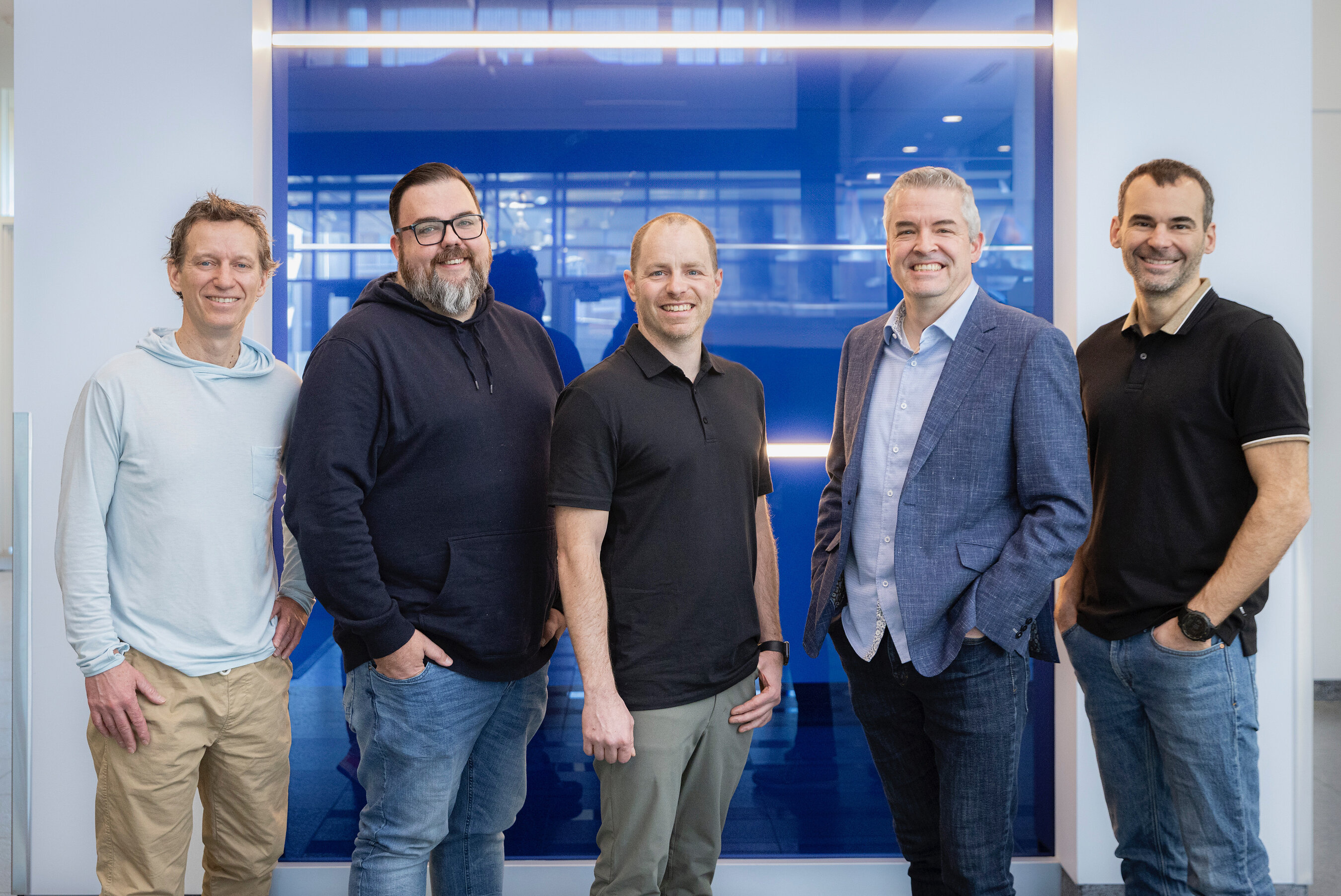
The photograph is appropriately collective. An acquisition changes who works together, and the data expertise was attached to people. Buying a capability means making room for their judgment, habits and experience as well as their names on an organization chart.
Toronto brings a different hiring list
By March 2025, Vooban had opened its Toronto office and was planning 20 to 25 Ontario hires before year-end. The roles included sales architects, cloud solution architects and account executives. Five people were already working in Ontario, while the broader company had close to 200 employees.
The range of jobs matters. Expansion requires people who can translate a customer's situation into a workable proposal, then connect it to systems the customer already uses. The hiring plan reveals a business concerned with that entire journey. A new office needs more than a delivery address and a handsome key card.
Foltz described customers returning for further AI projects as others approached for the first time. For Moore, leading the company through that mix means serving organizations with different starting points. Familiarity with AI cannot be assumed simply because the supplier has been working with it for years.
Dated snapshots from the tenth anniversary, investment and acquisition announcements. The 2024 figure includes Stratéjia.
The CEO goes back to the classroom
Moore's work also includes coaching teenagers aged 15 to 18 in the CEED program at École d'Entrepreneurship de Beauce. His LinkedIn profile records his own time at the school in 2015 and 2016. The founder appears on both sides of the learning relationship, first developing his leadership and later helping younger participants consider entrepreneurship.
In April 2025, the Association québécoise des technologies featured him following his selection as a finalist for its CEO of the Year award with National Bank. The account connected his business to process automation and named clients including Grues Guay and Simard Cuisine. It also noted Vooban's internal use of AI to accelerate growth.
That combination gives his public role a particular texture. There is the company to run, the technology to explain, and an audience of other entrepreneurs to whom the experience might be useful. The early pricing error becomes more valuable when somebody else can avoid repeating it.
When the software starts doing the work
In February 2026, Moore joined host Kripa Anand on the CanadianSME Small Business Podcast to discuss agentic AI. The conversation's advertised subjects included digital workers, multi-agent systems, productivity and cybersecurity. Forecasting and computer vision appeared alongside language models, keeping the discussion connected to more than conversational software.
The leadership question changes when software can take actions across a workflow. Managers must decide which decisions to delegate, how to supervise them and where human judgment remains necessary. Those are organizational questions as well as engineering questions. Moore's passage from programmer to CEO puts him at the intersection of both.
His current professional biography describes an ambition to expand people's capabilities through AI and to turn ideas into working systems more directly. That is a statement of intent. Its usefulness will depend on the particular systems, the people using them and the decisions those people retain.
The knowledge nobody wrote down
In May 2026, Vooban launched Morphe, a conversational AI product designed to capture employee expertise. It uses 30-minute sessions to ask about work, decisions and informal practices, then organizes the answers into a knowledge base for teams and AI agents.
The premise is familiar to anyone who has watched an experienced colleague leave. A procedure can explain the official steps while omitting the reasons, exceptions and little adjustments that make them work. Morphe is aimed at that undocumented layer. Its promise is specific enough to be examined: can a conversation preserve useful operational knowledge?
A month later, Vooban announced plans to recruit 70 people while using AI throughout its own departments. It reported that one marketing employee could manage nine social accounts, compared with two previously. The company also disclosed that a content position eliminated the prior year had reopened around new requirements. These are company-reported examples, with the complications left in. Automation was changing the work and the hiring list together.
Moore began with a problem of valuing what he knew. His company's newer product addresses the difficulty of preserving what other people know. Between those two problems sits his career: code, colleagues, customers, an investor, acquisitions, and years of learning what an organization needs in order to keep working. The knowledge has become more valuable. It still belongs, first, to somebody.