In 2009, on a drive to the airport, Laurent Simoneau was bothered by a piece of business choreography. Coveo bought a server in the United States, shipped it to a lab in Canada, installed its software, and shipped the machine back to an American customer. Useful search required a surprisingly well-travelled box.
He wondered why the software could not simply be provisioned in the cloud. A process involving hardware, borders and waiting could become a service available in under an hour. The episode captures a particular sort of ambition: looking at a familiar procedure until its absurdity becomes difficult to tolerate.
Anyone who has watched a parcel depart for somewhere it has just left will appreciate the objection. Yet changing the itinerary meant changing the product, its economics and its delivery. Simoneau was thinking about the work behind the interface, the part customers would rather never have to consider. That concern runs through his career.
A search box with a difficult interior
Before Coveo, there was Copernic. Simoneau became its chief technology officer and later its chief operating officer, overseeing product strategy and core research. Copernic's consumer search business gave him a close view of a deceptively simple experience: type a few words, receive something useful. The little rectangle was easy to understand. Delivering on its promise was another matter.
Explaining Coveo's beginnings in 2008, he traced its research effort to work at Copernic around 2000. The team explored building its own indexing technology. Business users presented a more demanding problem than an ordinary web search: information sat in different systems, changed at different speeds and came with restrictions on who could see it.
An employee searching for an answer has little interest in the departmental history that scattered it across five applications. The software, however, must respect that history's consequences. A useful result must be findable, current and permitted. Convenience has quite a lot of paperwork underneath it.
The enterprise search division became Coveo in a 2005 spin-off. Simoneau built the company with Richard Tessier and Marc Sanfaçon. Its early opportunity included helping organizations search beyond the boundaries of Microsoft SharePoint. The bet was that a company could make access simpler while leaving room for the complexity of the information itself.
The missing qualification
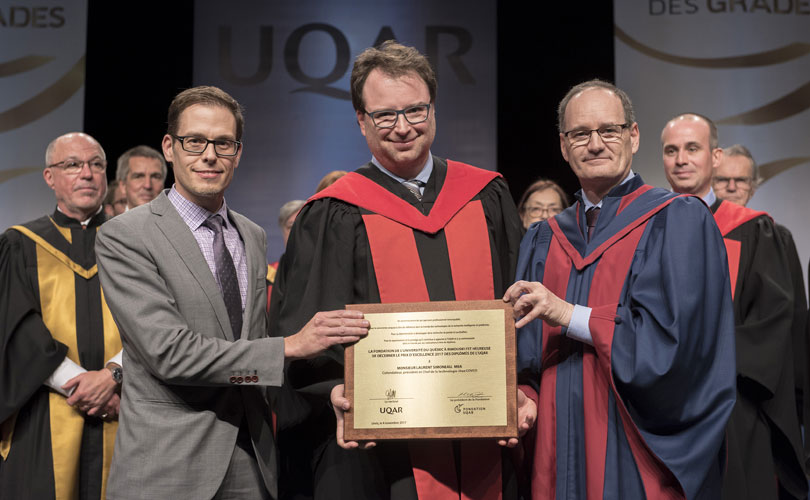
Simoneau's own route through education had a wrinkle. After studies in science and computing at Cégep de Sainte-Foy, he joined Copernic in 1996. Later, as he built Coveo, he wanted more management knowledge. He entered the executive MBA at UQAR's Lévis campus through recognition of professional experience, without a bachelor's degree.
Professor Richard-Marc Lacasse affectionately called him the “sans-papier”. Lacasse remembered a quiet student whose strength showed through observation and analysis. The university awarded Simoneau its 2017 alumni excellence distinction. There is something pleasing about that sequence: an institution admitted him for what he had already learned, then honoured what he went on to do.
Fourteen years in the engine room
In July 2011, Coveo appointed Louis Têtu CEO and named Simoneau president and CTO. Têtu had built Taleo; Simoneau brought the search technology and the experience of getting it into customers' hands. Their arrangement gave each a defined job. It also allowed a founder to remain central to his company without keeping its chief executive title.
At the time, Simoneau spoke warmly about working with his friend and colleague. He wanted to focus on the platform and its application to business. Coveo then reported more than 700 implementations for over 500 customers in 43 countries. The scale had already moved beyond a small founding team testing an idea.
His next stretch lasted until 2025. Fourteen years is a substantial period to spend refining a company's machinery while someone else occupies the chief executive's chair. Calling it a departure would miss the work. He remained president, led technology and kept shaping the product. The title changed; the subject of his attention stayed remarkably consistent.
This makes his later return especially interesting. A conventional comeback asks what a founder learned elsewhere. Simoneau's case invites a different question: what does a founder learn by staying, through changes in customers, infrastructure and the expectations placed on the same basic product?
- 2004-2011Founding CEO
- 2011-2025President & CTO
- April 2025Returns as CEO
Coveo dates his initial CEO tenure to 2004; the Copernic enterprise division was spun off in 2005.
His unfashionable advice: stop moving the data
In an April 2011 article, Simoneau argued that companies were fighting a losing battle by trying to gather all their information into one system of record. New content would keep appearing elsewhere. His proposed answer was a unified index: a way to find information across systems without requiring the organization to settle every disagreement about where it ought to live.
He urged organizations to stop moving data. The suggestion has the appeal of someone finally suggesting that the furniture might remain where it is. Search could separate access to knowledge from the particular application that happened to store it.
The argument also reveals a practical view of organizational life. Businesses accumulate tools for reasons. A search product has to work among those accumulated decisions. Asking everyone to begin again may produce a beautiful architecture diagram and a rather unhappy Monday morning.
By June 2015, Coveo was announcing Coveo Cloud. Simoneau highlighted the possibility of using cloud efficiency, usage analytics and machine learning to tune relevance automatically. His emphasis had expanded from locating information to improving the choice of information, using what happened when people actually interacted with it.
“My advice to organizations is to stop moving data.”
Laurent Simoneau · 2011
When the answer started talking back
Generative AI gave the problem a new interface. A person could ask a question and receive a composed answer, rather than a list of places to investigate. For a search technologist, that change raises a familiar practical concern: which material should the system use before it begins writing?
In September 2024, while Simoneau was still president and CTO, Coveo introduced its Relevance-Augmented Passage Retrieval API. It offered organizations building their own large language model applications a way to retrieve relevant passages for those systems. Coveo also sold a complete generative answering product. Customers could choose different amounts of the finished experience.
That distinction matters to understanding his work. A model can produce fluent language; an enterprise still needs the right company information, selected for the question and governed by access rules. Retrieval becomes part of the preparation for the answer. The text on screen is the visible end of a longer process.
For Simoneau, this creates a through line from enterprise indexing to conversational systems. The questions have become more natural, and the responses more elaborate. Underneath, his company still has to establish what is relevant. The conversation has acquired manners; the filing problem remains.
Back in the chair, with familiar company
On April 1, 2025, Simoneau returned as CEO. Têtu became full-time executive chairman, John Grosshans was promoted to chief operating officer, and co-founder Sanfaçon became CTO. The change redistributed responsibilities across people who already knew the business. It placed Simoneau's long experience of the product inside a broader operating role.
His announcement on LinkedIn dwelt on colleagues. He thanked Têtu for his leadership and mentorship, noted that the executive chairman would remain involved, and named the team around him, including Tessier and Sanfaçon. The public account reads as a continuation of working relationships built over years.
It is tempting to make a founder's return into a solitary scene: one person, one desk, a decisive new chapter. Here the supporting cast belongs in the picture. His career has developed alongside co-founders, customers and a fellow executive who spent fourteen years running the company. The continuity is part of the story's interest.
The role also widens the test. A CTO can explain why a system works. A CEO must make sure the organization can sell it, support it and pay for its improvement. Simoneau's background gives him a long acquaintance with the first question. The second is now his daily responsibility again.
The new test is ordinary usefulness
By July 30, 2026, Coveo was reporting US$37.4 million in quarterly SaaS subscription revenue and US$38.5 million in total revenue. Its net loss was US$5.8 million. Those figures put a useful frame around the AI discussion: this is a subscription business with continuing costs and a financial result to improve.
Simoneau also described a transaction signed shortly after quarter-end with a Fortune Global 500 technology company. Coveo said the expansion took that customer's annualized SaaS subscription spending into eight figures. The customer's name was undisclosed. The significance was its use of Coveo across both internal and customer-facing AI applications.
In September, Coveo's expanded Metcash partnership supplied a more everyday example. The Australian wholesaler was bringing conversational search into AskROSS, its retailer communications portal, building on its use of Coveo in the Sorted B2B marketplace. Independent retailers needed answers and support. Behind the AI terminology sat the old commercial requirement to make someone's working day easier.
The next scheduled checkpoint is October 29, 2026, when Simoneau, Têtu and CFO Karine Hamel are due to discuss second-quarter results. There will be numbers to explain, customers to retain and questions about what comes next. His aspiration to make enterprise AI useful will keep meeting those concrete tests.
The airport story is a good place to leave him. A server was making an unnecessary journey, and he thought the process could be shorter. Years later, a question can pass through more sophisticated machinery, but a customer still wants the same small courtesy: an answer that arrives without taking the scenic route.
Keep following the search
- Coveo
- Coveo product talks · YouTube
- Laurent on LinkedIn
- The airport story · audio interview
- Transforming Search · podcast
- The 2008 conversation
- Simoneau’s 2011 essay
- The UQAR alumni portrait · French
- Leadership changes · 2011
- Leadership changes · 2025
- Coveo Cloud · 2015
- Passage retrieval · 2024
- Quarterly results · July 2026
- Metcash partnership · September 2026
- Next results call · October 2026