Yasuo Sato’s career contains an unusually persistent activity: starting things inside places that already have plenty going on. E-commerce at NIFTY. New business at Yahoo! JAPAN. Electronic books at 2Dfacto. A Korean startup’s Japanese operation. Eventually, an artificial-intelligence company with colleagues whose working relationship had already survived an acquisition. The employers change. The work keeps a family resemblance.
That history matters when Sato talks about AI. He is Allganize’s co-founder and Japan CEO, and a director of its holding company. His responsibilities include the Japanese business and finding customers for its software. His vantage point is the place where a promising technology encounters somebody else’s purchasing process. There are fewer fireworks there. There are considerably more questions.
His professional chronology begins at NIFTY in 1998, first developing e-commerce services and later working on corporate planning and preparations for a stock-market listing. He moved to Yahoo! JAPAN in 2005, working as a producer and project manager on new ventures and projects across the company. Between 2006 and 2008, he also completed an MBA at Kenichi Ohmae Graduate School of Business while working.
By 2010 he was helping launch and expand an e-book business at 2Dfacto. A short spell at Rakuten followed in 2013. These are different businesses, but each put him near the junction of a product, an organization and a new market. Starting again was becoming a professional specialty.
The colleagues came before the company
In September 2013, Sato became the Japan country manager of 5Rocks, the South Korean mobile-app analytics startup. Its business involved understanding how people used applications and helping their operators improve performance. In 2014, the US company Tapjoy acquired 5Rocks. Sato subsequently served as an executive officer and later an adviser at Tapjoy Japan.
The acquisition supplied a connection that would outlast the transaction. Changsu Lee, 5Rocks’ founder, became one of Sato’s fellow founders at Allganize. So did Kibin Shin, whose background included engineering at Naver and Line. Sato brought experience in new businesses and Japanese market development. The partnership joined different kinds of work that a young software company needs done.
The team had encountered early AI while working on app growth and prediction. In Sato’s account, the opportunity became more practical as the available data, computing resources and technology improved. Allganize was founded in California in July 2017. Its Japanese subsidiary followed in January 2019, with Sato as its representative. He was once again opening a market with people he knew.
- 20135Rocks
Japan business - 2014Tapjoy acquires
5Rocks - 2017Allganize
co-founded - 2019Japan subsidiary
established
A machine should save someone a job of work
For Sato, the case for AI has long started with the time people spend trying to find information. Search can be work before the actual work: locate the manual, identify the relevant paragraph, decide whether it answers the question. A company may own the answer and still make finding it rather an expedition.
Allganize’s early work addressed natural-language understanding, including a chatbot called Alli. In 2021, Sato described a commercial problem familiar to anyone who has watched a labor-saving device acquire its own maintenance department. Improving an AI system’s quality could require enough preparation, training data and continuing effort to undermine the efficiency it was meant to deliver.
His concern was the combined burden of introducing and operating the software. A tool that needs elaborate care has to justify that care. The company worked on answering questions from existing documents while reducing manual preparation. The ambition was understandable without knowing a single model name: let the person asking a question reach the useful answer sooner.
That focus also put Allganize in contact with companies whose expertise lay elsewhere. A September 2021 partnership with SEGA XD brought its natural-language technology together with a business concerned with communication and user experience. The planned applications included customer support, internal questions and company manuals. The arrangement treated conversation as something to design and improve through use.
The bank, the invoices and the trust
One particularly concrete application arrived with Sumitomo Mitsui Banking Corporation. In January 2023, the bank and Allganize launched Alli for Green, a service supporting data collection for greenhouse-gas emissions calculations. It used document-understanding technology to extract relevant information from invoices and reports, including documents arriving on paper or as PDFs.
The practical difficulty was that these documents did not politely arrive in one format. Information had to be found across varying layouts before it could support a calculation. This is an unglamorous problem of the sort that keeps a real business busy. The atmosphere around AI may be futuristic; the input can still be an electricity bill.
Discussing the collaboration, Sato emphasized measurable results and shared intentions. A startup, he explained, has to earn the trust that an established supplier may already possess. Working with the bank involved responding to feedback and matching expectations. His colleague Yuki Ikegami also described the need for human checking. Automation had a boundary, and the collaborators had to make that boundary workable.
Sato’s part in this story is recognizable from the earlier chapters: helping a new offering become something another organization can accept. The product sits inside a relationship, with expectations, revisions and decisions attached. A successful demonstration is an introduction. Trust takes more meetings.
“Without earning trust, an unknown startup cannot do business.”
Yasuo Sato · translated from Japanese
Japan stopped being just another market
The Japanese business also changed Allganize’s organizational center. In July 2022, the company announced that it had moved its headquarters functions to Japan and established Allganize Holdings. The announcement credited the performance of the Japanese operation and described a reorganization placing the national businesses under the holding company.
Sato’s comment on the move concerned proximity: hearing the market and customers more quickly, and responding with solutions to their problems. It was a practical explanation for a consequential corporate change. The business he had been building in Japan had helped make Japan central to the group’s plans.
The company also announced preparations for an initial public offering. Preparation is a stage of work, rather than an outcome to award in advance. For Sato, the more immediate continuity was the task of listening to buyers and translating their requirements into a business. The geography of the company had changed around that task.
Choosing a different race
The arrival of large language models sharpened a strategic decision. Allganize had developed its own natural-language technology. Then much larger technology companies began investing heavily in the models themselves. By January 2026, Sato was explaining why the company had chosen to concentrate its resources on the environment in which customers could actually use AI.
Alli LLM App Market, launched in September 2023, brought applications and, subsequently, agents into a platform able to work across multiple model providers. Allganize continued to use its own language-processing technology alongside those models. The choice gave the team a different place to apply its experience: connecting capabilities to business requirements.
For Sato, that put familiar questions back on the table. What does a customer need to accomplish? What information does the work require? How will the product enter an existing organization? The newest technology had returned him to a set of operating problems he had been encountering for years.
A partnership announced with NS Solutions in May 2024 offered one route into more organizations. The agreement covered distribution of Alli LLM App Market. NS Solutions described more than 100 applications usable without entering prompts. Its customer offering included support for choosing applications, implementation and operation. Selling access was part of a longer process of helping companies put the software to work.
A reading guide to the adoption questions in Sato’s interviews; not a product architecture or performance measurement.
A public argument, tested in-house
Sato has taken these questions beyond sales conversations. He appeared in a KBS television feature on AI in 2023, discussing business adoption in Japan. His public engagements also include Morning Pitch, where he presented Allganize in January 2025. Speaking across these settings fits a job that requires explaining an unfamiliar purchase before anyone can decide whether to make it.
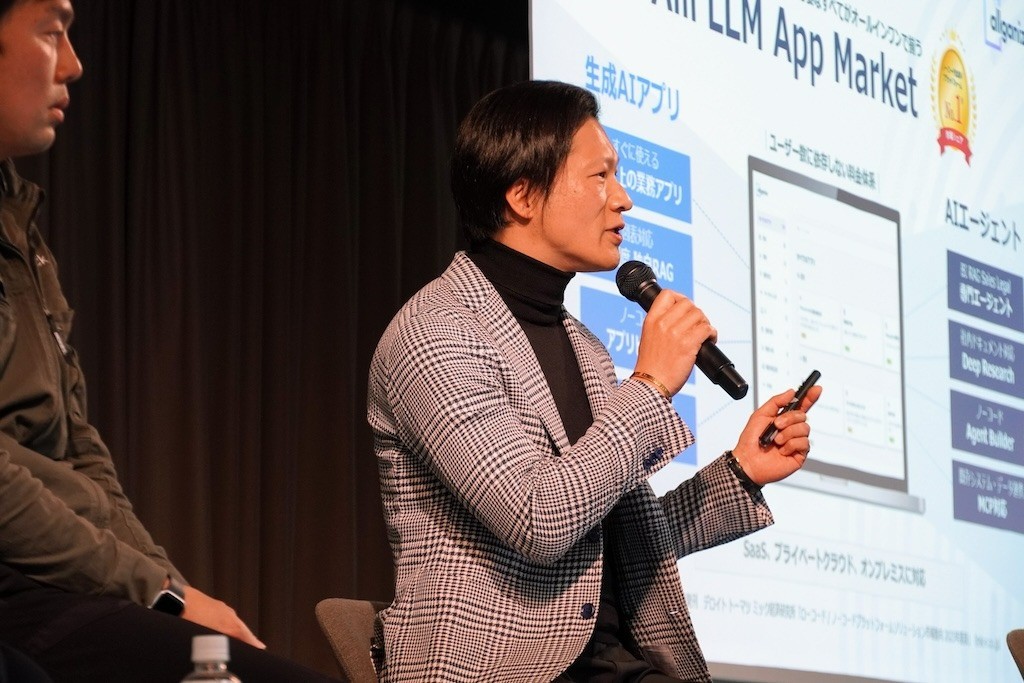
At KDDI Business AI Fes in March 2026, he joined MODE’s Shuhei Mitoma and Deeping Source’s Kyung Dong Kim for a discussion about AI and business. Sato argued for separating rapidly changing technology from the more durable problems customers need solved. Otherwise, following each new model can become a rather demanding occupation in its own right.
He also described Allganize’s internal use of AI, including accounting work and agents available through familiar tools such as Slack and Teams. The logic was straightforward: using the company’s own solutions was necessary for a persuasive case to others. The seller had daily work of its own on which to try the proposition.
His enthusiasm came with a specific concern about agents that can be created through natural-language instructions: they may act while their inner workings remain unclear to the user. That observation belongs beside his argument for adoption. As software takes on more tasks, somebody still has to understand what it is doing.
The next task is already on the desk
There is an expansive ambition behind Sato’s attention to ordinary work. In his own career profile, he says he wants to help companies in Japan and around the world evolve through AI. He describes launching foreign businesses in Japan as a strength and invites people to join the effort. The outlook is international; the work begins with a particular customer.
His career offers a useful way to read that ambition. He has worked inside established internet companies, helped a Korean startup enter Japan, continued through its acquisition by an American company, and co-founded another business with a former colleague. Those are repeated encounters with the distance between an idea and an organization that will use it.
At Allganize, that distance has contained manuals, invoices, bank reviews, distribution agreements and internal accounting. Each is a less photogenic subject than artificial intelligence itself. Each supplies a reason for a customer to care. Sato’s story runs through the patient business of getting those details to agree with the promise.
Follow the work
Profiles, conversations & video