In January 2020, Ramendra Shukla addressed a technology conference in Pune to talk about business intelligence. His subject included conversational AI: letting people get at company data through conversation. The setting was a banking and financial services gathering. The problem was recognizably human. An organization could possess a great deal of information and still make its employees work rather hard to obtain an answer.
Generative AI would later acquire a much larger audience. Shukla’s talk offers a useful earlier marker. Here was an enterprise technology founder, then Exponentia.ai’s chief operating officer, discussing how people might consume data more easily. The question had a life before the current vocabulary. It also had customers, budgets and colleagues who needed to get on with their jobs.
Follow his career forward and the same concern keeps appearing. The tools become more capable. The conversation moves from business intelligence to language models and agents. Yet the final stretch remains awkward: an answer must arrive where someone can understand it, trust it and use it. That stretch has supplied Shukla with a substantial amount of work.
An engineer learns the other half of the problem
Shukla studied mechanical engineering at BITS Pilani between 1997 and 2001. He subsequently worked in enterprise technology at i2 Technologies and Infosys. Then came the Indian School of Business in Hyderabad, where he studied in 2006-07. Engineering, consulting and management education gave his professional path several changes of scale, from understanding systems to understanding the organizations buying them.
His later career included strategy and general management work, along with leadership at UEM Group. These were established businesses with existing operations. A proposed improvement had to find a place among other people’s responsibilities. That background is useful context for a founder whose public discussions so often concern the practical arrangements surrounding technology.
In 2014, Shukla and Rohit Mathur co-founded Exponentia.ai. Their business would work on enterprise data and AI, combining advice with the engineering needed to put systems into use. Shukla became CEO; Mathur remains identified as a co-founder and board member. The partnership is an important part of the story. A founder’s portrait can accidentally crop out the other people who made the founding possible.
A microphone in Surat
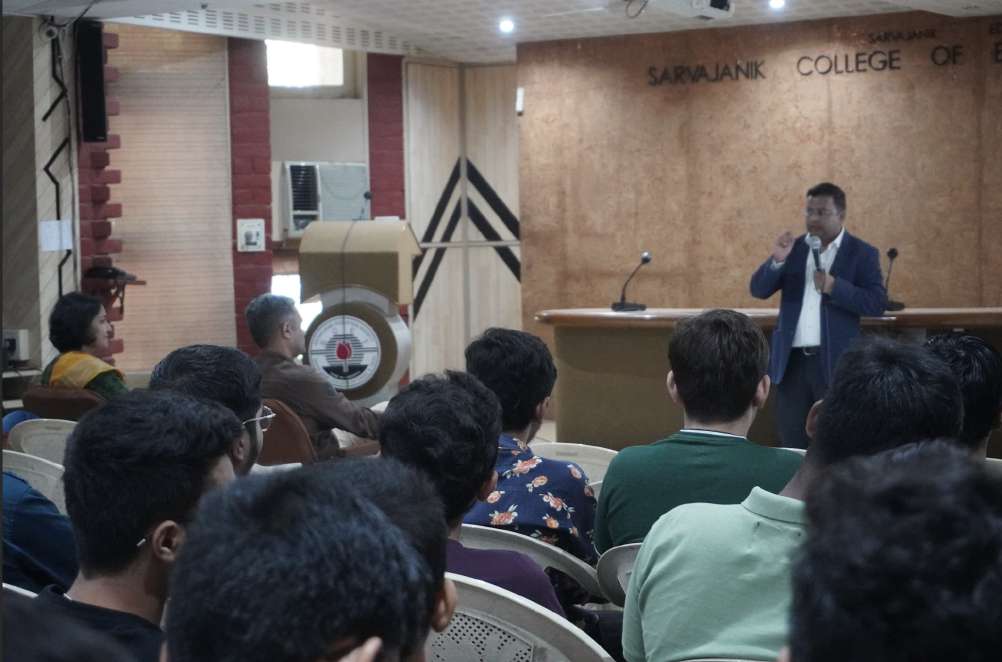
On 9 October 2023, Shukla visited Sarvajanik College of Engineering and Technology in Surat. The session concerned generative AI and entrepreneurship. He spoke about his journey from engineering student to company founder, discussed applications and explained why a project had to serve its particular use case. There was also a question-and-answer session.
The photographs bring the occasion down to a useful size. Shukla stands with a microphone in a seminar hall, facing rows of students. There is a lectern, a college name on the wall and an audience with its own reasons to be curious. Entrepreneurship here has an ordinary physical form: someone who has built a business explaining the work to people nearer the beginning.
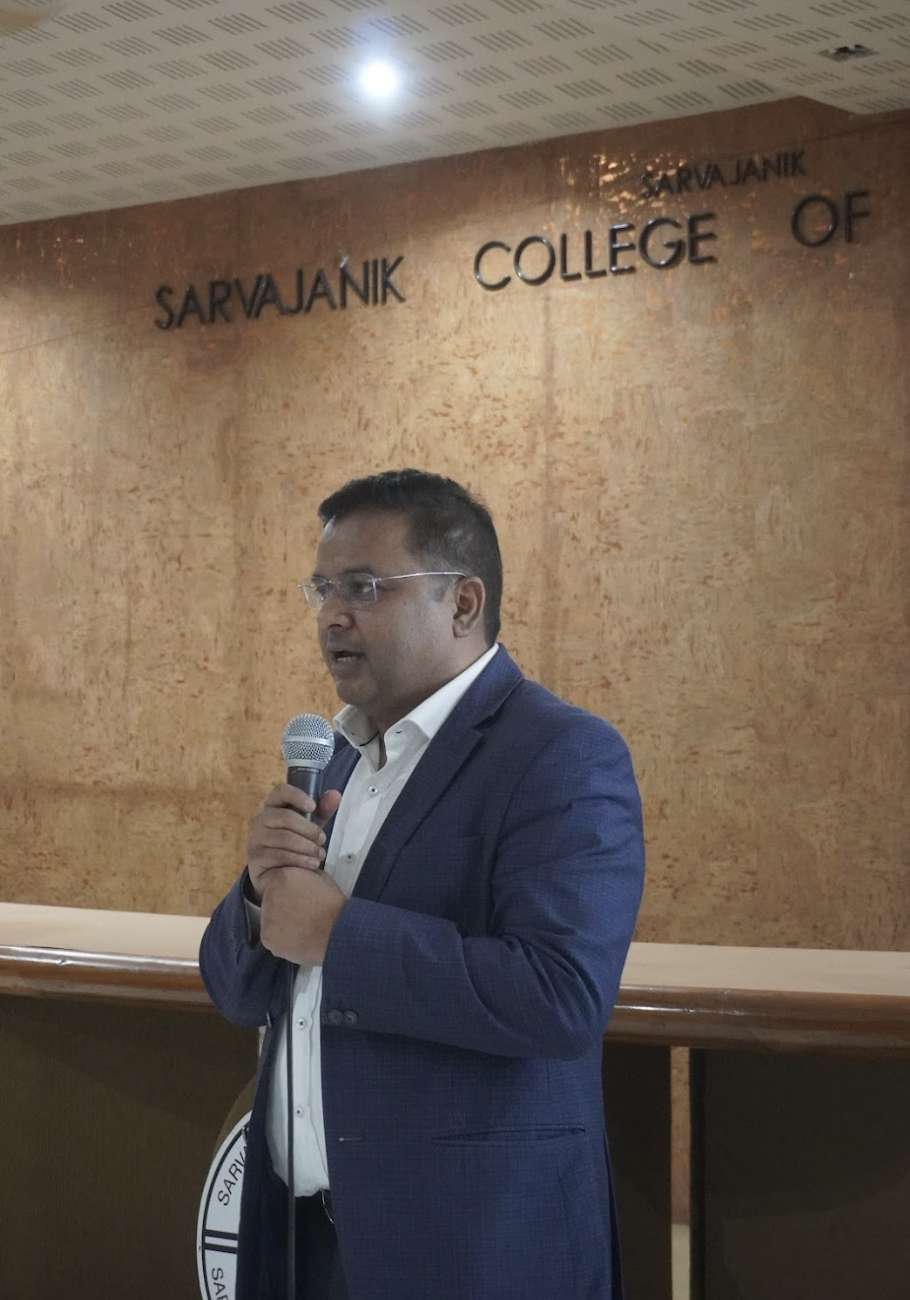
The visit also gives his educational history a pleasing return route. He had once been an engineering student. Now he was talking to engineering students about the uses and difficulties of a technology business. The afternoon included discussion of language-model chaining alongside entrepreneurship. The technical mechanism and the business question shared the same afternoon.
A company built around the follow-through
Exponentia.ai’s commercial work has included sales intelligence, analytics and data platforms. Those subjects can sound abstract until an employee needs a product detail or a manager needs information from several systems. Then the quality of the plumbing becomes personal. A meeting can survive a disappointing slide. A working day is less forgiving of a system that cannot supply what someone needs.
In February 2022, the company announced investment from Amit Midha and Technog Solutions. The stated uses included strengthening its AI offerings, developing industry-specific text and voice models, and entering additional geographies. Shukla spoke then about placing AI capabilities inside sales and customer engagement processes. Even the expansion announcement returned to the work happening within a business.
The names around him matter, too. Midha became an investor and is listed on Exponentia.ai’s board. Mathur is the co-founder. Shukla is also identified as a co-founder of Engagely.ai, a conversational AI business. These connections place him among people concerned with enterprise software, business development and the practical problem of serving customers. His career has several organizational addresses.
Today, his Exponentia.ai responsibilities include company strategy and business expansion in the United States and Singapore. Growth brings its own version of the original challenge. A firm that helps other organizations coordinate technology must also coordinate its own people, delivery and customer relationships. The founder’s calendar becomes another system requiring maintenance, although it is unlikely to come with a convenient restart button.
The questions travel
Shukla’s public conversations reach beyond one industry. In a transportation webinar with Santosh Mishra and Exponentia.ai’s Kamlesh Pant, the discussion covered applications such as finding operating information, supporting staff and responding to disruptions. Shukla urged organizations to educate their teams and begin with internal applications where experimentation could be contained. The advice gave adoption a starting place small enough to inspect.
His manufacturing writing in April 2026 considered decisions involving equipment, schedules, parts and production. The proposed role for AI agents was to bring those pieces together and recommend or take bounded actions. He also emphasized the ability to explain recommendations, keep records and involve people. The factory in this argument is a collection of interdependent decisions, with consequences outside the software itself.
How does an answer become useful?
- 01A particular jobDefine the decision someone needs to make.
- 02Usable informationBring the relevant context into reach.
- 03A responsible personMake ownership and human review clear.
- 04A next stepConnect the result with everyday work.
In March 2026, Exponentia.ai announced its Applied AI Outcomes podcast. Shukla’s conversation with Ashish Srivastava, chief digital officer at Daikin Applied Americas, addressed the move into production. Another conversation, with Bhaskar Borah of Dow Jones, explored data foundations. These are people dealing with particular organizations. Their presence gives the conversation something firmer than a prediction about what every business will someday become.
There is an earlier connection with this conversational habit. Sanjay Kumar publicly thanked Shukla for inviting him to an Exponentia.ai team session about data governance and strategy. Kumar now leads the firm’s UK and Europe business. The public exchange offers a small glimpse of professional relationships developing through discussion, before a leadership page turns them into a row of titles.
Who gets to press the button?
By July 2026, Shukla’s writing was concentrating on organizational integration. Teams could build a capable AI model while leaving operational departments only partly involved. Recommendations could arrive in a separate place, requiring employees to step outside familiar processes. His concern was what happened when the system met the routine of an actual working day.
He placed learning and cooperation alongside engineering. People needed to understand changing responsibilities and have confidence in the recommendations they received. That is a demanding brief for a company leader: a technical deployment, an explanation and an agreement about responsibility all have to hold together. The impressive part of a demonstration may occupy only a few minutes of that work.
“The real issue is not a lack of data. It is a lack of decision discipline.”
Ramendra Shukla, July 2026
The observation gives his argument an unusually concrete antagonist: the unresolved decision. Another dashboard can be commissioned. Another report can be circulated. Neither guarantees that the person receiving it knows what to do next. A business can become very accomplished at preparing for action. Preparation, unfortunately, has no natural closing time.
There is a tension here that his work keeps bringing into view. AI promises speed, while organizations need confidence about who may act and when a person should intervene. Shukla’s public position gives human judgment a continuing role. It leaves room for the colleague who understands an exception, the customer relationship or a consequence the system has not adequately represented.
A calendar with very little spare room
Recalling the Global Meetup 2024-25, Shukla described sessions that ran late into the night and strategy conversations that resumed early in the morning. It is a modest anecdote, but an apt one for this particular founder. The work appears in the space between people: talking through a plan, asking another question, returning to the discussion.
That does not turn every meeting into progress. Shukla’s own emphasis on decisions would make such a claim difficult to sustain. It does suggest why his work includes so many conversations alongside the technical subjects. Running a business that applies AI involves explaining it to customers, colleagues, partners and students, each bringing a different version of the question: what will this help me do?
The route from the Pune conference to the Surat classroom and the later practitioner discussions is not especially theatrical. Its interest lies in repetition with a purpose. Shukla keeps encountering the point where an organization has acquired a capability and still needs to put it to work. Somewhere beyond the dashboard, someone has a decision to make. His career keeps travelling the remaining distance.