The financial-services chatbot had a persuasive voice and a practical problem: its answers did not reliably survive a factual check. It could retrieve relevant documents, yet still mishandle what they said. In v4c.ai’s account of the project, the trouble began with something almost comically modest. The documents had been cut into the wrong pieces.
- v4c.ai helps enterprises build and operate data and AI systems, with Databricks at the center.
- Its work includes migration, engineering, governance, machine learning, and workflow automation.
- The useful lesson: measure the broken step before replacing the whole machine.
The firm changed the chunking strategy, keeping the questions and other pipeline components constant. On an 81-question evaluation, grounded answers rose from 45 to 67. Semantic boundaries helped preserve meaning. That small engineering decision offers a useful introduction to a company whose business sits beneath the shiny surface of enterprise AI.
Better boundaries. Better answers.
A specialist changes its center of gravity
v4c.ai launched publicly in July 2024 as a strategic services partner for Dataiku. Its proposition was straightforward: help businesses implement, improve, and use an established AI platform. President Jeremy Stensland fronted the launch announcement. The firm was selling the expertise needed to put someone else’s technology to work.
By 2026, Databricks occupied the center of its public identity. The company’s May funding announcement identified Vijay Rao as founder and disclosed a Series A investment from Tquila and Databricks Ventures. Tquila led the round. The platform supplier had become an investor in a business helping customers adopt its platform.
“Databricks is at the heart of our go-to-market.”
Michael Gibson / CEO appointment, October 2026
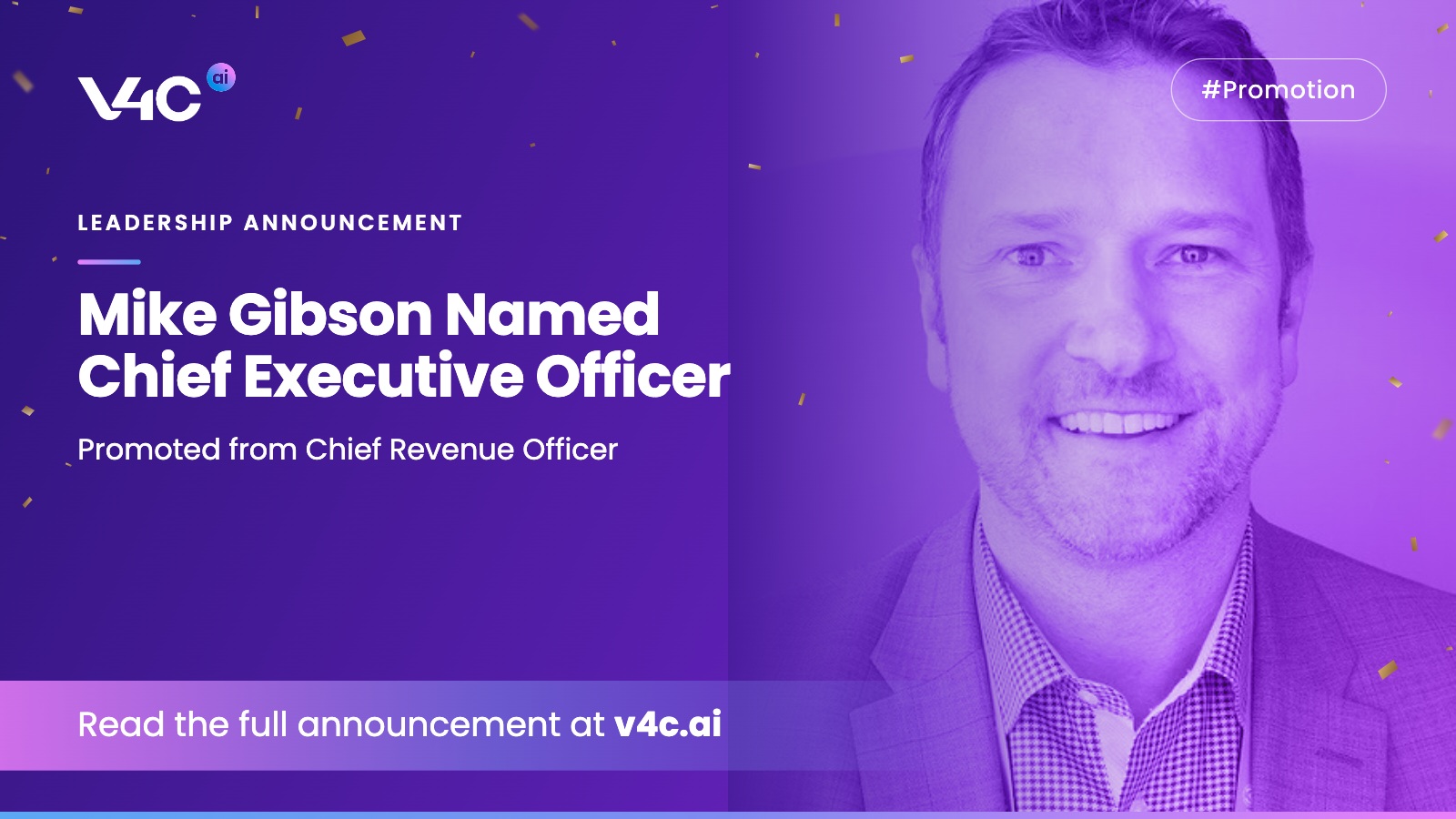
That relationship became more explicit in October, when Michael Gibson moved from chief revenue officer to CEO. Dataiku remains visible in the firm’s services and webinars, but the commercial emphasis is clear. Specialization is the organizing choice.

Vijay Rao, identified as founder in the 2026 investment announcement. A platform needs people who know how to put it to work. Company portrait.
The customer buys the work between systems
What does that expertise look like on an ordinary project? Start with an inventory of the things an enterprise already owns: databases, applications, historical reporting logic, permissions, and workflows that people cannot simply switch off. v4c.ai offers assessment and migration, then engineering, optimization, and support for the resulting environment.
Its advisory practice connects proposed AI uses to business priorities and data readiness. Governance work covers quality, access, and control. Machine-learning services extend through deployment and ongoing model operations. Generative AI projects include knowledge assistants and automation. The customer is buying coordinated implementation across these layers, with training and enablement alongside delivery.
The market is enterprise rather than consumer. The firm targets financial services, healthcare, manufacturing, and retail, among other sectors. Its website displays customers including Pennant, Prolink, and Trader Interactive. A buyer can compare this specialist approach with an internal engineering team, another Databricks partner, or a broad systems integrator. The meaningful comparison is delivery fit: who understands the existing mess, and who will maintain the result?
Twelve systems, one place to ask questions
An unnamed beverage distributor illustrates that mess. It had data scattered across 12 ERP systems and other databases. v4c.ai says it consolidated them into a unified data warehouse, using Fivetran for extraction and loading and Apache Airflow for orchestration. The project also moved processing from dbt to stored procedures.
That last detail is interesting because it resists an easy technology fashion story. A particular workload received a particular engineering choice. The reported result was consolidation of all 12 ERP systems and retirement of costly legacy infrastructure. The practical question for a buyer is which expense disappears after migration, and which new operating expense takes its place.
An editorial simplification of the migration work described in v4c.ai’s services and accelerators.
A healthcare claims processor faced a different bottleneck. Its old C# parser and tightly coupled downstream pipelines required manual reruns and fixes. A tested third-party parser covered only about 20% of the needed field mappings. v4c.ai describes replacing that approach with modular Spark processing on Databricks, separating extraction from business rules and improving traceability.
The firm reports a 60% reduction in ETL maintenance for that engagement. The transferable idea is architectural: when one change forces repairs across several components, separating responsibilities can matter as much as faster computation.
Package the chores that keep coming back
Repeatable delivery appears in the accelerator portfolio. The Data Ingestion Accelerator supports batch and streaming data from cloud, SaaS, and on-premises sources. The SQL Migration Accelerator translates dialects and offers review tools, including assistance for difficult SQL patterns. These address recurring project work rather than a new consumer application.
LakeMover approaches relational database migration to Databricks Lakebase through readiness checks, dependency-aware loading, and validation. LakeForge tackles environment provisioning and Python connection authentication. Together they show where the company places its engineering effort: the setup, translation, and verification work that otherwise gets rebuilt for each engagement.
Another published project attacks a human cost. A regulated enterprise could spend up to four hours documenting ten minutes of work. v4c.ai built a system that aligns screen activity, narration, and interaction records to generate operating procedures. The idea is appealingly concrete: capture expertise while it happens, instead of asking an expert to reconstruct it afterward.
A useful result has an edge
The chatbot example also supplies a boundary. Semantic chunking raised offline embedding work, and 14 of the 81 evaluated answers still failed the grounding check. Questions spanning distant sections or documents remained difficult. Better segmentation alone could not solve that reasoning problem. The copyable method is the controlled comparison, followed by investigation of the errors that remain.
For a buyer, v4c.ai makes the clearest sense when Databricks is an intended destination and implementation demands exceed the available team’s time or expertise. That focus also ties the relationship to one platform’s direction. Choose it with a defined workload, a baseline, and an acceptance test. Then ask the wonderfully unglamorous question: does the machinery actually work?