Yash Sabharwal’s next business partner lived next door. Sabharwal had a problem familiar to anyone who has tried to make a complicated project behave: the information existed, but finding it, connecting it, and putting it to work consumed far too much effort. His neighbor, Ryan Shillington, knew software. The distance between a frustrating working day and a new company turned out to be rather walkable.
There is something pleasingly domestic about that beginning. Technology companies often describe their origins in the language of destiny. This one has a street address in its backstory. Cherry Circle Street in Austin supplied the early company name, CherryCircle Software. QbDVision became the name around which the business eventually gathered. Before the product had an audience, its founders had proximity.
Sabharwal brought experience managing development and manufacturing operations. Shillington brought decades of software experience. Their partnership put a practical complaint beside the ability to build an answer. It also continued a career in which Sabharwal had repeatedly crossed from technical work into the less tidy business of organizing people, money, and decisions.
A scientist with the accounts to keep
His academic route began with optics at the University of Rochester, followed by master’s and doctoral degrees in optical sciences at the University of Arizona. Those are disciplines concerned with seeing precisely. His later work would involve another sort of visibility: whether an organization could see what it already knew.
In 1997, he co-founded Optical Insights, an imaging business. The venture commercialized imaging platforms and analytical software. It belonged to the world of instruments and technically demanding customers, where a clever idea has to become something another person can actually use. Scientific sophistication alone does not settle the accounts or negotiate a sale.
Sabharwal served as chief financial officer as well as helping lead technical and business development. That combination matters. A CFO has to consider how an enterprise continues to function while its technical people pursue the next difficult question. The business gives the science a timetable, a budget, and an obligation to make itself understood.
Optical Insights was sold to Roper Industries in 2005, a transaction Sabharwal helped negotiate. He had acquired experience well outside the boundaries of his degree. By the time he became a founding executive at Xeris Pharmaceuticals, serving as COO and CFO, he was accustomed to working on both the invention and the company surrounding it.
- 1997Co-founds Optical Insights
- 2005Imaging company sold to Roper Industries
- 2010–2016Operations and finance roles at Xeris
- 2017Launches the QbDVision project
The shifts were substantial: optics, finance, operations, software. Yet each stage required him to translate specialist knowledge into decisions others could act on. A researcher, a buyer, an investor, and a manufacturing colleague may look at the same enterprise and ask very different questions. Learning to answer them is part of learning to run it.
The spreadsheet had become part of the job
At Xeris, Sabharwal oversaw manufacturing process development and scale-up. As programs grew, so did the amount of information they produced. The problem that led him toward QbDVision emerged inside that work. Important knowledge accumulated over years, while the tools for bringing it together remained awkward and fragmented.
Excel and Word were carrying work he believed needed a more connected system. A spreadsheet can be useful without being an adequate memory for an entire development program. Once information spreads across files, the organization must keep reconstructing its own understanding. People become the missing links between records.
The company’s earlier origin story places the initial idea on Cherry Circle Street in 2015. Sabharwal handed off to the next Xeris management team in 2016; his later biographies date the QbDVision project’s launch to 2017. Those are different stages of a beginning: recognizing the problem, leaving an operating role, and building the proposed solution.
Discussions with industry veterans reinforced the need. The next-door partnership combined knowledge of the work with knowledge of software architecture. Its appeal was practical. Sabharwal had spent time doing the thing he now wanted to improve. He could explain where the friction occurred without first inventing a customer’s working day.
Giving information somewhere useful to go
QbDVision works in CMC, short for chemistry, manufacturing, and controls. The initials describe a complex field; the underlying organizational question is easy to recognize. How does a team retain a usable account of a product, the process for making it, and the reasons behind its decisions?
Sabharwal has returned to that question in his writing. A 2023 series on data governance and integrity examined the difficulty of turning accumulated information into a resource that people can use. Records locked in documents and individual memories make the task harder. Saving something and making it available for another purpose are separate achievements.
“To put a resource to use, it has to be in a usable form.”
Yash Sabharwal, on data governance
In June 2024, he made the argument more concrete. His explanation of a digital quality target product profile broke the work into three steps: atomize, assemble, and link. Separate individual pieces of information, organize them into meaningful groups, then define their relationships. The sequence gives a reader something more useful than an instruction to embrace digital transformation.
Atomize
Separate the information into individual records.
Assemble
Group records using a shared vocabulary.
Link
Connect records to their relationships and context.
The attraction is in the detail. When one underlying fact changes, a connected system can make that change available wherever it is needed. A document-based workflow may instead require several people to update several files. The humble revision has a social life of its own, and occasionally a very long one.
A company that needs its neighbors, too
At the 2023 Biomanufacturing World Summit, Sabharwal discussed a collaborative approach among service and software providers. The interview, released in April 2024, considered systems that work together, move information between them, and give users a common basis for learning. It extended the company’s founding logic beyond two people on one street.
That is a consequential position for a software founder. Customers rarely conduct all their work inside one supplier’s product. Their knowledge must travel across organizational boundaries as well as technical ones. A company can compete for business while recognizing that a customer needs several providers to cooperate.
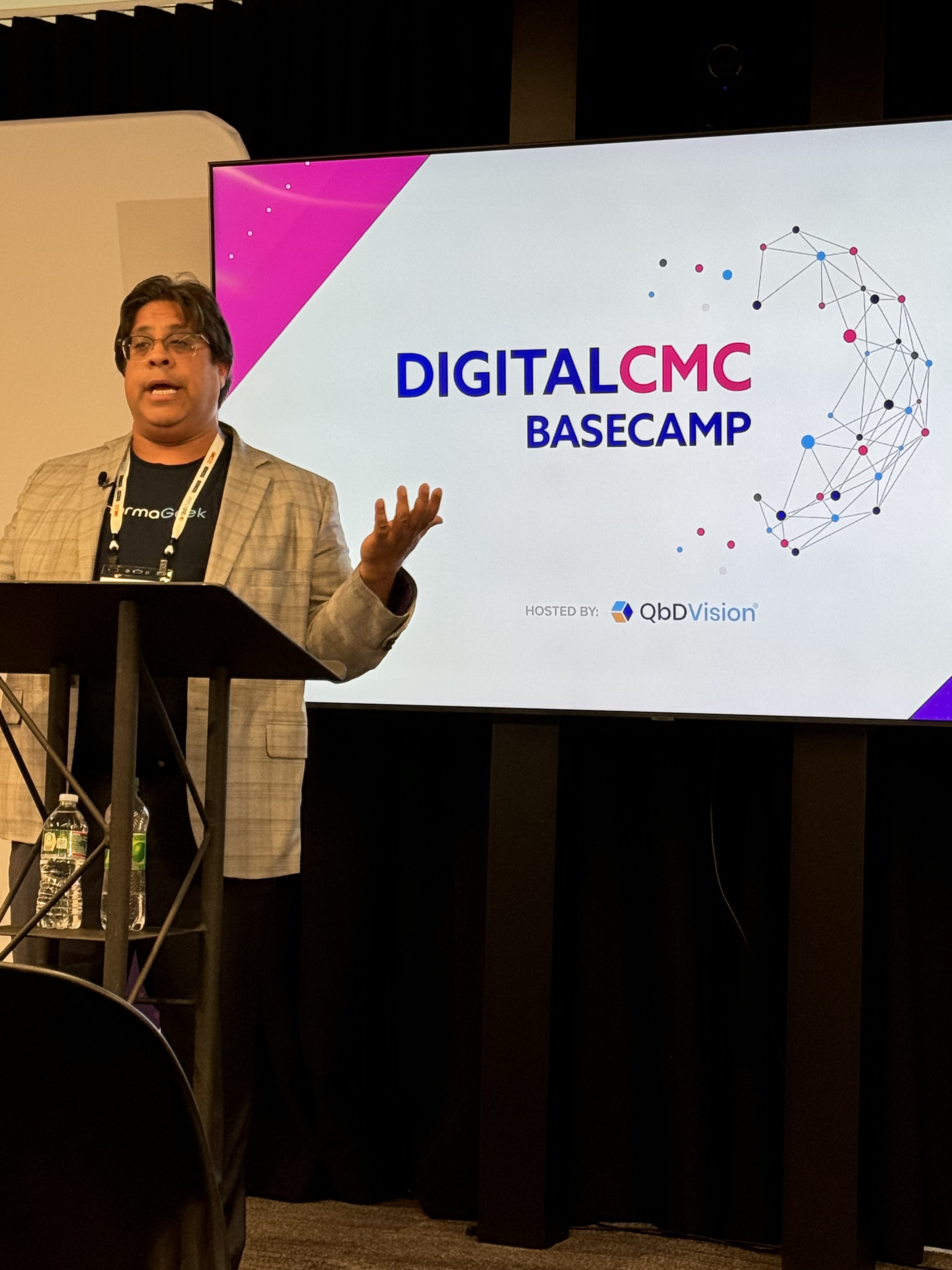
At Digital CMC Basecamp in Boston in 2024, Sabharwal’s opening presentation focused on attending to data early in a product’s lifecycle. The event brought together people concerned with development, manufacturing, and digital systems. His emphasis placed the preparation of knowledge ahead of the promise of what advanced tools might eventually do with it.
The topic has followed him into the current AI conversation. His September 2026 Lab of the Future Europe agenda listed a session on network models for structured CMC knowledge and scalable AI. The subject is a continuation of his earlier work: giving information a dependable shape before asking software to draw more elaborate conclusions.
The founder has to leave some room
Sabharwal’s public leadership advice has a similarly practical character. He favors careful hiring, executive colleagues who think differently, and responsibility close to the people doing the work. His own difficulty, he says, is resisting the urge to step into every problem and solve it himself.
“It takes courage to let go and trust your team.”
Yash Sabharwal
That admission gives his management philosophy some weight. The founder who can identify a problem and build a business around it has good reasons to trust his judgment. Growth creates another demand: making room for someone else’s judgment. A person hired for a different perspective needs the freedom to exercise it.
His first key leadership hire at QbDVision was a COO. International sales travel meant the business needed someone concentrating on everyday execution. Choosing that role acknowledged that a founder’s schedule has limits, however enthusiastic the founder may be about ignoring them.
There is a connection here with the software itself. Both the company and the product depend on knowledge becoming usable beyond its original owner. A founder cannot remain the answer to every question indefinitely. Nor can a development team build a durable process around the recollections of whichever colleague happens to be available.
More capital, more knowledge to move
In May 2025, QbDVision announced $13 million in financing led by existing investors Northpond Ventures and S3 Ventures, with participation from Create Health Ventures and company insiders. The announcement also named Mike Stapleton as chief business officer and Chas Peacock as vice president of engineering. Funding arrived alongside additional responsibility for building and running the business.
By 2026, the business had another public measure of progress: QbDVision appeared at number 688 on the Inc. 5000, with 502 percent three-year growth. The figures describe the company’s growth, rather than a return for its investors. They add scale to the story that began with two neighbors comparing experience and a problem neither could solve alone.
Later in 2025, Sabharwal wrote about reshoring and technology transfer. Moving manufacturing, he argued, also means moving the knowledge that makes a process work. Equipment can arrive at a new site while the reasoning, history, and relationships needed to operate it remain dispersed elsewhere. Relocation gives the old information problem a new destination.
His ambitions therefore concern what organizations carry forward. Experience should remain useful when a project grows, a team changes, or work moves between sites. The challenge is familiar from his own career, where scientific training became one resource among many needed to build an operating company.
Away from that work, Sabharwal has described cooking, learning guitar, and being a sports dad to two daughters. The guitar detail is a pleasant one to keep in mind beside the executive titles: even a repeat founder has activities in which progress requires practice. His professional story began with learning to see. Its continuing question is how much other people can see, use, and carry onward.