Life Sciences / Digital CMC
Mike Stapleton
He sells software for a living and keeps telling the industry the software is the easy part.
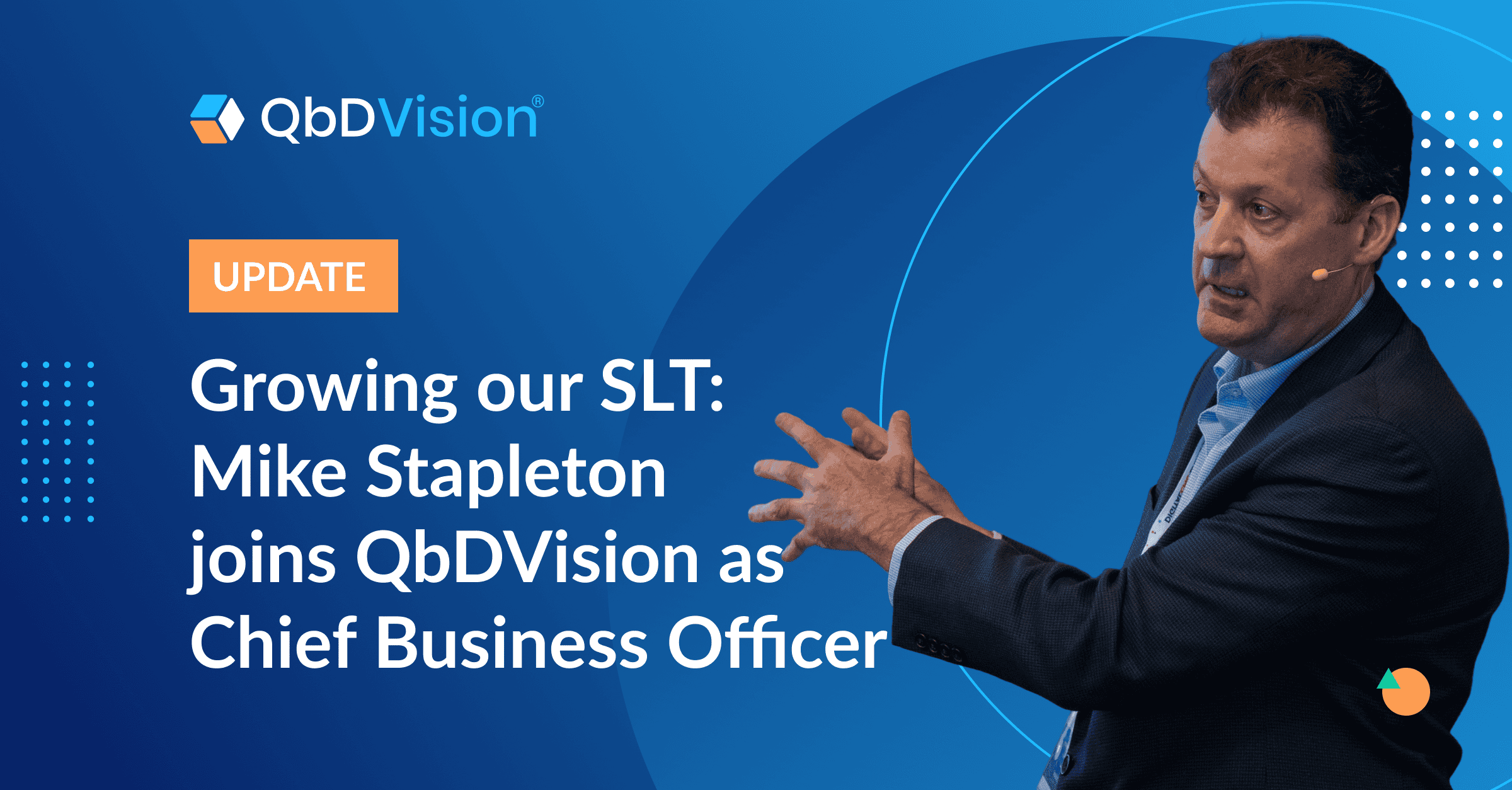
He sells software for a living and keeps telling the industry the software is the easy part.
A sk Mike Stapleton what fixes drug development and he will not name a tool. He runs commercial strategy at QbDVision, a 65-person company in Austin selling exactly the kind of platform you would expect him to evangelize. Instead he says the platform is beside the point. The real question, he keeps repeating to rooms full of scientists and regulators, is not how the industry solves its data problems but who will agree to solve them together.
Stapleton joined QbDVision first as an advisor, then as a board director in 2024. Most people stop there. A seat, a quarterly meeting, a measured opinion. He couldn't manage it. "After joining the board," he has said, "there was simply no way I wasn't going to get more involved." In April 2025 he took the operating job: Chief Business Officer.
The category he is selling is Digital CMC - Chemistry, Manufacturing, and Controls, the unglamorous backbone of how a drug actually gets made, documented, and approved. It is the part of pharma that has lagged furthest behind on cloud adoption, long after drug discovery moved on. QbDVision's argument is that the knowledge generated across a product's lifecycle should be structured, curated, and linked, rather than buried in documents and spreadsheets that no machine can read.
His mandate is commercial: build the market leadership strategy, expand consultancy partnerships with names like Accenture Life Sciences, ZS, Zifo and ZAETHER, and drive adoption. But he frames it as infrastructure work. "Throughout my career, that's always been what I loved," he says, "establishing the frameworks that enable modern technical development."
The timing helped. Weeks after he took the role, QbDVision closed $13 million in new financing co-led by Northpond Ventures and S3 Ventures, with Create Health Ventures and insiders joining. That pushed its Series A to $28 million. The pitch landed because the customers were already there - three of the world's six largest pharma and biotech companies.
It's not about how we solve them, technically speaking - no platform will be the answer. The most important part is who will solve them.Mike Stapleton, on the industry's foundational data questions
There is a reason that line lands as a surprise. The default move for a software company is to claim that the right product, properly deployed, will untangle a messy industry on its own. Stapleton refuses the script. He talks about pioneers from the scientific, regulatory, and business communities sitting down to agree on standardized data models and shared frameworks. The technology, in his telling, is downstream of that agreement. Get the people aligned and any number of platforms can carry the load. Skip that step and the best software in the world inherits the same chaos it was meant to fix.
That belief shapes how he is spending QbDVision's new capital. Rather than only chasing logos, he is putting weight behind Project Artemis and a Digital CMC Consortium - efforts aimed less at selling seats than at convening an industry around common ground. He is also leaning on a web of consultancy partners, from Accenture Life Sciences and ZS to Zifo and ZAETHER, because adoption in pharma rarely happens through a download. It happens through the people who already sit inside these organizations advising on process.
Most executives specialize. Stapleton did the opposite - software, consumables, instruments, services, consulting, and pharma itself. The throughline is not an industry vertical. It is a habit: walk into a function that hasn't been digitized, build the foundation, leave it running, move on.
He started where almost nobody in life sciences software starts - at the bench, as a senior scientist at BP. Oil and gas, not pills. The detour matters. He learned data as a practitioner before he ever sold it as a product, which is why he is so allergic to selling it as a magic box.
From there the pattern repeats with different logos. At Accelrys he was Executive Vice President and Chief Operating Officer while the company grew from a startup into a global operation. At Life Technologies he ran informatics, marketing, and ebusiness and delivered what was billed as the first life sciences eBusiness transformation. At PerkinElmer he built and led the scientific software business outright. At Merck he sat on the buyer's side as Vice President and CIO of R&D IT, deploying cloud-based data and analytics offerings inside one of the largest pharmaceutical companies on earth. At Microsoft he ran global operational excellence - contract management, cloud-cost optimization, subscription and billing. At Accenture he built the North America Life Sciences innovation practice as Managing Director. Software vendor, hardware maker, big-pharma insider, hyperscaler, consultant. He has stood on every side of the same negotiating table.
CMC stands for Chemistry, Manufacturing, and Controls. It is the part of a drug's life that the public never sees - the recipe, the equipment, the specifications, the proof that what comes out of the factory is what the label promises. It is also where an enormous amount of an organization's hard-won knowledge lives, and historically where that knowledge goes to die: trapped in PDFs, locked in spreadsheets, scattered across teams and decades in formats no computer can reason about.
QbDVision's wager is that this knowledge should be treated as structured data from the moment it is created - captured, curated, and linked across the entire product lifecycle. Do that, and you unlock the things everyone wants but few can reach: automation, AI that actually has clean inputs, and digital regulatory submissions that don't require armies of people to assemble by hand. Drug discovery embraced the cloud years ago. CMC is the laggard, and that lag is precisely the opening Stapleton is selling into.
His framing keeps coming back to the patient. Faster, cleaner development is not an efficiency story for its own sake; it is the difference between a medicine arriving on time and arriving late. He describes that goal as squarely within reach - a notably optimistic posture in an industry that prides itself on caution. Optimism, for him, appears to be less a temperament than a working assumption about what is possible if the foundations get built right.
Began in oil and gas, learning data from the inside before it was a category to sell.
Helped grow the company from a startup into a global operation.
Delivered the first life sciences eBusiness transformation.
Built and led the company's scientific software business.
Deployed novel cloud-based data and analytics offerings inside big pharma.
Oversaw contract, cloud-cost, subscription, and billing optimization at scale.
Built and ran the North America Life Sciences innovation practice.
Couldn't stay on the sidelines. Stepped in to run commercial strategy.
"In many ways, the drug development industry may change relatively slowly - but it is always evolving." Patience is the strategy, not a weakness.
"We're building cutting-edge data architecture on best-in-class cloud infrastructure from providers like AWS." The boring layer is the differentiator.
The industry needs scientific, regulatory, and business communities to agree on shared data models - not to crown a single winning app.
It's not about how we solve them - no platform will be the answer. The most important part is who will solve them.On foundational data questions
After joining the board, there was simply no way I wasn't going to get more involved.On taking the operating job
The drug development industry may change relatively slowly - but it is always evolving.On the pace of pharma
Establishing the frameworks that enable modern technical development - that's always been what I loved.On his throughline
At Rady Children's Hospital-San Diego, Stapleton advises the board of the Institute for Genomic Medicine and serves on its Board Data Analytics Task Force - the same data-foundation obsession, pointed at sick kids.
He holds advisory and board positions tied to venture and software, including Northpond Ventures and Scitara, which keeps him fluent in both the deck and the diligence.
At industry summits he has been known to ask the audience to put their phones away so the room can actually talk. A small tell from a man who thinks the human part is the hard part.
An engineer by training: a Bachelor of Engineering with honours from University College Dublin, a diploma from Dublin Business School, and a master's from the Smurfit Graduate School of Business.