The first customer in the Petcube story had four legs, an objection to being left alone, and no intention of keeping that objection private. Rocky, a Chihuahua belonging to engineer Alex Neskin, barked when his owner went to work. The neighbours complained. Neskin assembled a webcam, an Arduino-based contraption and a remotely controlled laser pointer. From elsewhere, he could move a spot of light around the room and play with his dog. Rocky had acquired an internet connection without ever agreeing to the terms and conditions.
Yaroslav Azhnyuk saw the invention and joined Neskin and designer Andrey Klen to build a company around it. Petcube began in 2012. Its proposition was easy to grasp: you could be at your desk and still see, talk to and play with the animal waiting at home. The harder proposition was turning a clever piece of improvised electronics into something people could buy, unpack and use.
Fourteen years later, Azhnyuk is still concerned with cameras, software and the distance between a person and a machine. The circumstances have changed profoundly. He leads The Fourth Law, a Kyiv-founded robotics company developing drone autonomy, and co-founded camera manufacturer Odd Systems. His career follows an uncomfortable continuity: expertise accumulated making a playful household object became useful to a country defending itself.
A small cube, a long journey
Before Petcube, Azhnyuk had already learned to sell ideas. He grew up in Kyiv, studied applied mathematics at Kyiv Polytechnic Institute and started the social-media agency SM digital while at university. The agency was acquired by Prodigi, where he led social-media marketing. Klen worked there too; so did Neskin. Their future hardware company emerged from colleagues comparing notes, rather than strangers assembled around a pitch deck.
At the September 2013 Kickstarter launch, the camera was a four-inch aluminium cube with a microphone, speakers and a laser. Backers could pledge $99, against an expected retail price of $199. The team had spent time with hardware accelerator Haxlr8r in Shenzhen, learning how to work with factories and suppliers. An attractive object on a screen still needed a factory willing and able to make it.
The campaign passed its original target in six days. A cube designed for the living room had found an audience beyond Kyiv.
Those six days supplied an answer to the immediate question of demand. They also generated more work. Azhnyuk used the campaign to look for engineers as well as buyers, writing publicly about the search for a backend developer. Crowdfunding could gather a crowd; the crowd could also contain a future colleague. The cheerful product required a rather less photogenic infrastructure behind it.
Petcube announced that it had begun shipping in November 2014. The gap between the campaign and delivery is a useful part of the story. Manufacturing, software and distribution had to meet inside the same box. Customers had bought the promise of a simple experience. Producing that simplicity was the founders’ job, complete with all the complications that never appeared in a photograph of the cube.
Go where the customers are
Azhnyuk moved to San Francisco in 2014. His explanation was practical: the customers were there. Petcube later joined Y Combinator’s Winter 2016 batch. The chronology matters. The move preceded the accelerator; the business was already being built before one of its more recognisable credentials arrived. Kyiv, Shenzhen and San Francisco each supplied a different part of the operation.
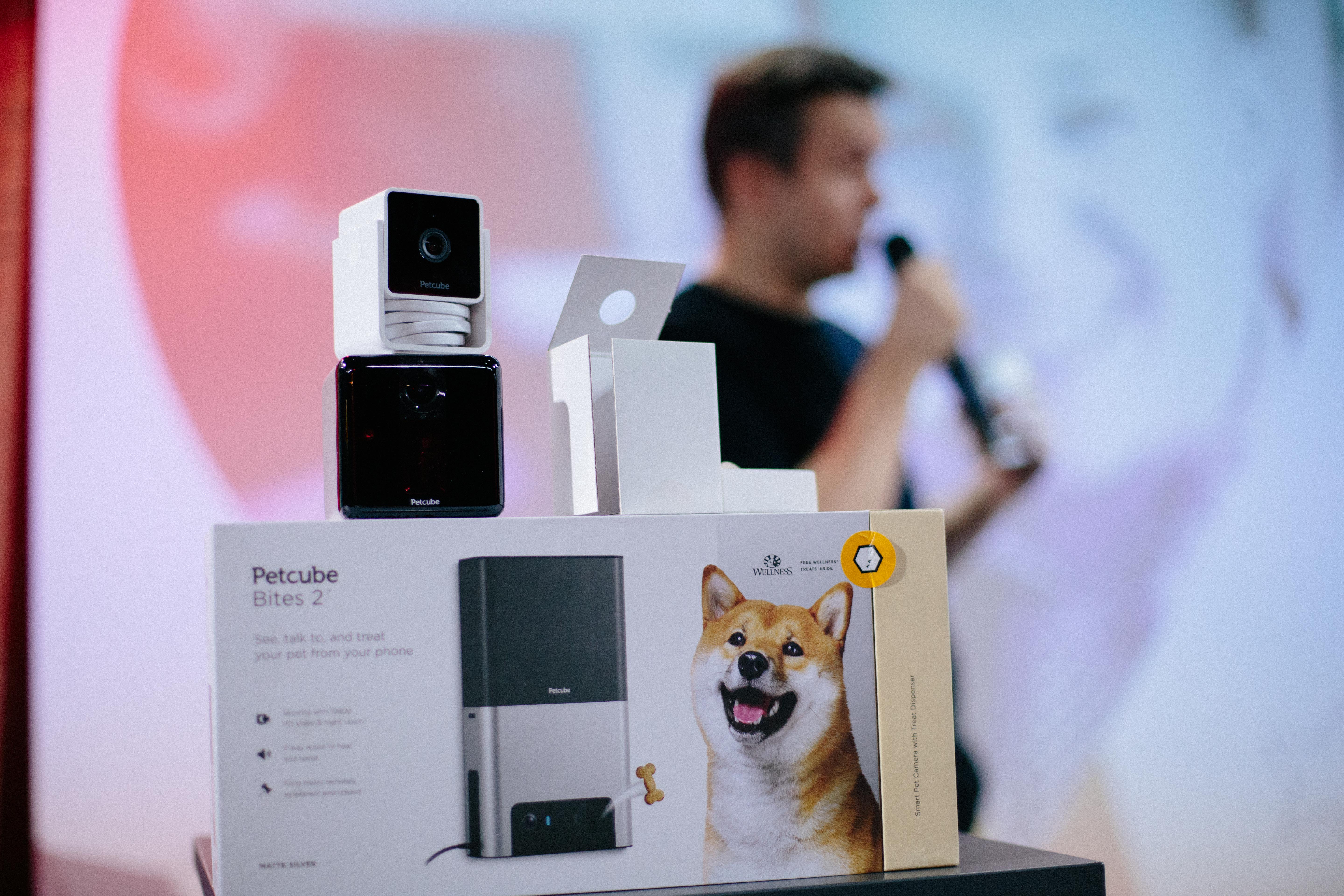
The product also grew beyond its original laser game. Petcube Bites added remote treat dispensing; cameras and the app let owners watch and speak to their animals. Here was a business in which a customer could interrupt a meeting to fling a biscuit across a distant kitchen. Behind the novelty lay familiar product decisions about video, software, pricing and what people would actually use.
His life abroad had a less obvious connecting device: lindy hop. In a 2018 conversation, Azhnyuk described beginning to dance in Kyiv and finding a community through it internationally. It offered a way into a city beyond the office. A founder can spend years discussing networks in the abstract, then discover a pleasantly literal one on a dance floor.
There is a similar outward-looking habit in his older personal writing. A reading list on his blog ranges from childhood adventure stories and Jules Verne to mathematics, philosophy and entrepreneurship. He describes approaching unfamiliar subjects through foundational books. The list is eclectic, but the impulse is consistent: go back far enough to understand how a subject works, then compare what you are doing with a wider world.
The country inside the camera
For all its international movement, Petcube carried an explicit Ukrainian identity. One early motherboard bore a trident and the words “designed in Ukraine.” Most customers would never open the device to see it. The inscription was still there, a small statement tucked inside the electronics. For Azhnyuk, making a product abroad did not require erasing where its engineering came from.
He has also described enjoying the way Petcube encouraged other Ukrainians to start companies, including ventures that might overtake it. That is a particular measure of achievement: the example keeps working after somebody else improves on your result. A successful device could become evidence that a team from Kyiv could build for customers much further away.
“The main task of any company is to create value.”
Yaroslav Azhnyuk
Azhnyuk returned to Kyiv in 2019. When Russia launched its full-scale invasion in February 2022, his existing connections acquired immediate practical uses. He worked with other entrepreneurs on outreach to American lawmakers and on connecting Ukrainian defence innovators with investors and public institutions. His account places him among the participants whose coordination efforts contributed to what became Brave1, and among those who helped start defence investment fund D3.
Making room for different work
In September 2022, Petcube announced Anastasia Kukhar as its new CEO. Azhnyuk became president and remained chairman. The announcement marked a decade of his leadership and said the company had connected more than 500,000 pet families. It also made an important distinction between founding a business and continuing to run its daily operations. The former did not oblige him to keep the latter indefinitely.
The same year, he and Klen helped launch Spend With Ukraine, a showcase encouraging people abroad to buy Ukrainian products and services. Its mechanism was straightforward. Someone looking for a way to support the country could become a customer of one of its businesses. Their earlier experience in design, marketing and international sales gave them something concrete to contribute.
His other ventures included Ozero Design and Fuelfinance. The range is revealing: physical products, design work and financial management all address different pieces of running a company. It also meant that changing his main job did not make him responsible for every operational decision across every organisation. Partners and executives mattered. His later move into defence would depend on that ability to choose where he spent his own time.
- 2012Petcube begins
- 2014San Francisco
- 2019Back in Kyiv
- 2022CEO handover
- 2023The Fourth Law
- 2026Project Foundation
What fourteen years of cameras can teach
By late 2023, Azhnyuk had settled on drone autonomy as the problem he wanted to work on directly. The Fourth Law began in Kyiv that year; its existence became public in January 2024. Odd Systems followed into public view in February. One concentrated on autonomy, the other on manufacturing drones and cameras. Azhnyuk described himself as an investor and co-founder of Odd Systems, with managers running its operations.
The connection to Petcube was industrial experience. He and his partners had learned procurement, manufacturing and international logistics while making cameras at volume. Those skills could move into a different application. The consequences were vastly different, but suppliers, components and production remained stubbornly physical concerns. A computer-vision idea still needed suitable hardware, available parts and an organisation capable of delivering them.
In July 2025, The Fourth Law announced funding from investors in Europe, the United States and Canada, without disclosing the amount. It introduced its TFL-1 autonomy module and Lupynis drone system, describing software that could continue guidance when communication was disrupted. The company also outlined a longer progression towards fuller autonomy. That progression was an ambition, rather than evidence that every stage had already been completed.
The literary name provides a glimpse of its founder’s interests. The Fourth Law refers to Isaac Asimov’s Laws of Robotics. Azhnyuk’s technological world has room for fiction, though his companies now operate under demands considerably less forgiving than a novelist’s. The naming habit would continue into the next project, as the question shifted from what a camera could see to who could manufacture the sensor inside it.
The next problem is inside the sensor
On October 8, 2026, The Fourth Law and Odd Systems announced Project Foundation, an initiative to manufacture uncooled thermal sensors in Europe and the United States. Headquartered in Eindhoven, it set out plans for facilities called First Foundation and Second Foundation. The announcement described planned capacity and financing arrangements still to be confirmed. The names came from Asimov again; the proposed work belonged to semiconductor manufacturing.
This latest move brings Azhnyuk’s story further inside the machine. Rocky’s owner needed a way to play from another room, another building, another part of town. Petcube turned that need into an object shipped to customers. Azhnyuk’s later companies carried the accumulated knowledge into Ukrainian defence. Now the announced ambition reaches the supply of a component on which cameras depend. Each step asks a more demanding version of the same practical question: what has to exist before this thing can work?
Follow the next chapter
Find Azhnyuk’s writing and conversations, and the organisations in this story.
WATCH & READ
San Francisco, 2018Peter Santenello talks with Azhnyuk about Petcube, moving abroad and dancing. Watch on YouTube ↗Kyiv, 2026A conversation with Ukraїner Q about Ukraine’s technology sector and its future. Watch on YouTube ↗The 2022 handoverPetcube’s CEO succession announcement ↗October 2026The Project Foundation announcement ↗