Before KIBAR had a building, it had a recurring administrative problem: where was everyone supposed to turn up? Yansen Kamto and his team worked in food courts and moved between cafés. Employees wanted an office address they could give people. He offered them a future address instead. One day, he told them, they would have their own building. He already had a name for it: Menara Kibar.
The route there involved some rather smaller premises. In 2012, he borrowed a friend’s office space measuring two by four metres. A six-by-six-metre warehouse followed. Then came a shared house in Menteng. On 19 July 2017, Menara Kibar opened in Cikini, Jakarta. The name had survived the journey from the food court. The office arrangements had improved considerably.
That early story supplies a useful way into Kamto’s career. He has spent years trying to make the next step available to other people: a place to meet, someone to work with, a program to join. The distance between having an idea and having somewhere to take it can feel surprisingly long when you are standing at the beginning.
Ten tables in Pontianak
Kamto was born in Pontianak, West Kalimantan, on 3 August 1981. From primary school through the end of secondary school, he grew up around his parents’ small restaurant. It had ten tables. Food was readily available to him, a piece of good fortune his mother made sure he understood. She took him to share meals with children in an orphanage.
His parents’ businesses provided other lessons. His father ran a photocopying operation and developed a reading habit through the documents customers brought in. His mother tried a fashion boutique, then pursued the restaurant, travelling to Jakarta for cooking classes. Enterprise, in this family account, involved study, another attempt, and the willingness to commit money before knowing the ending.
For Kamto, those memories joined ambition to a responsibility beyond the household. A business could improve its owners’ circumstances while also making something available to other people. Years later, when he urged young Indonesians to build companies around useful problems, that argument had a recognisable domestic ancestor. Before the startup workshops, there had been a restaurant.
The advertising graduate with an MTV ambition
He studied marketing at the University of Technology Sydney and worked in advertising, including a stint at Leo Burnett. Arriving in Jakarta in early 2003, he discovered how far an entry-level agency salary stretched in the capital. In a later recollection, a café charging Rp35,000 for plain iced tea became a memorable introduction to fashionable city life. The eventual meal was a fast-food value deal.
The public-speaking version of Kamto could make a room laugh at his own expense. In Surabaya in 2015, he joked about his good looks before an audience of 2,500. He also recalled wanting to become an MTV VJ in secondary school. That ambition did not work out. He found other uses for a microphone.
His familiar uniform included shorts, even as his work brought him into conversations with ministers. The humour served an argument about confidence: young people who wanted to make things needed to get past the assumption that somebody elsewhere was automatically better equipped. It was an accessible message from a speaker quite willing to make himself the joke.
A thousand needs a route
By 2015, Kamto was taking that message into universities. At Universitas Gadjah Mada, he opened an Innovative Academy event attended by roughly 320 students from different faculties and study programs. His presentation addressed “Moonshot Thinking”, including tenfold improvements and a willingness to take risks. The audience itself mattered: entrepreneurship was being discussed across disciplines, beyond a single technical department.
He also had a more detailed proposal for Indonesia’s emerging founders. In conversations about a planned Silicon Valley visit with communications minister Rudiantara, Kamto described a progression from introductory gatherings to workshops, hackathons, bootcamps and incubation. People needed opportunities to learn and form teams before they could reasonably be expected to produce investable businesses.
His favourite explanatory territory included music. A singer has teachers, rehearsal and recording facilities, and routes to an audience. A prospective technology founder also needs a sequence of support. Merely putting people in a shared workspace leaves much of that sequence unfinished. The analogy made an abstract discussion of startup infrastructure sound like something you could actually arrange.
On 17 June 2016, KIBAR and Indonesia’s Ministry of Communication and Informatics launched Gerakan Nasional 1000 Startup Digital. Kamto was its initiator and KIBAR’s chief executive. The public ambition was to develop 1,000 digital startups by 2020, with a combined business valuation target of US$10 billion. Those numbers described the program’s goal at launch.
- 01 TalksOpen the door
- 02 WorkshopsLearn the skills
- 03 HackathonsForm & make
- 04 BootcampsDevelop the prototype
- 05 IncubationBuild the business
Ten cities, and a talent for saying no
The proposed starting footprint included Jakarta, Bandung, Yogyakarta, Semarang, Malang, Medan, Makassar, Pontianak, Denpasar and Surabaya. That list gave the project a geography extending beyond the capital and Java. It also gave the organisers a substantial practical assignment: bringing together communities, universities, businesses, government and media in different places.
Kamto could be expansive about ambition and specific about capacity. When Rudiantara asked for a program in 50 cities, he recalled saying he could undertake ten. The smaller number still supported the national target. Agreeing to everything would have been a more agreeable conversation. It would also have left the work of making it happen exactly where it had been.
In Malang in January 2017, he spoke about the city’s talent and worked with Beon Intermedia as the movement’s official hosting partner. His advice compared choosing a partner to choosing a spouse: suitability mattered alongside quality. For a program built on collaboration, it was a practical point dressed for a wedding speech.
The invitation to beginners was similarly concrete. A laptop, an internet connection and friends could be a beginning. People without coding or design skills could find collaborators who had them. In Yogyakarta, he described bringing design talent and people who could code together. The proposed unit of progress was often a team.
“Memilih partner ibarat memilih jodoh”Yansen Kamto, 2017
Choosing a partner is like choosing a spouse. Translation from Indonesian.
The calendar was a shared resource
The everyday machinery behind all those connections was less ceremonial. In 2015, Kamto described a working life organised around his phone. He read news in the morning and checked calendar updates at the end of the day. His team could see his itinerary and update it with meetings. Travel made offline reading useful.
He used Google Keep for ideas and notes and Hangouts for group conversations. He left laptop tasks to colleagues partly so they could learn to develop concepts and presentations. His account of Instagram was rather less managerial: he enjoyed posting pictures, while admitting that taking good ones, especially food pictures, was hardly his speciality.
These are small details, but they fit the work. A network depends on people being able to reach one another, know where someone will be, and carry an idea out of a conversation. A shared calendar does not make an inspiring conference slide. It does prevent an impressive number of unnecessary phone calls.
People who kept the conversation going
Nicole Yap met Kamto while working on entrepreneurship education in Indonesia. He continued sending her updates about the country’s digital economy. When she moved to Indonesia in 2017, he was the first person she called. Their discussions led to Digitaraya, the Jakarta-based accelerator they created together.
By December 2019, Digitaraya had supported 73 startups from 12 countries. Its partnerships included Google for Startups and Google Developers Launchpad. That record belonged to an organisation and its team, including Yap as managing director. It also showed how an introduction, followed by years of conversation, could acquire a fairly substantial institutional form.
Kamto’s work later included investing. He and Steven Vanada started Kinesys Group in 2019. Looking back on its beginnings, he wrote about the difficulty of recruiting people to a newly established investment company, then thanked a team with experience across several sectors. His public professional profile lists him as a founding partner.
The organising continued alongside the investment work. In a 2022 post, he described co-hosting Stripe’s first founders meetup in Jakarta. More than 70 founders, investors and other startup participants attended. He traced the event through an introduction in Singapore and credited the people who helped run it. Even a meetup has a supply chain.
Getting a good idea onto a shelf
Senyawa+, which Kamto founded, brought another set of makers into view. His experience with the creative portfolio platform Kreavi had exposed a problem: artists needed opportunities to develop intellectual property of their own. Senyawa+ connected creators and local brands with business support, corporate opportunities and routes to customers, including a physical store.
The emphasis was on what happened after something had been made. A distinctive product still needed buyers, distribution and the ability to meet demand. In July 2024, he put the commercial test plainly: “Even a product with excellent value will fail if it doesn’t address consumer problems.” It was a demanding standard for creativity, and a useful one for anyone trying to pay the bills with it.
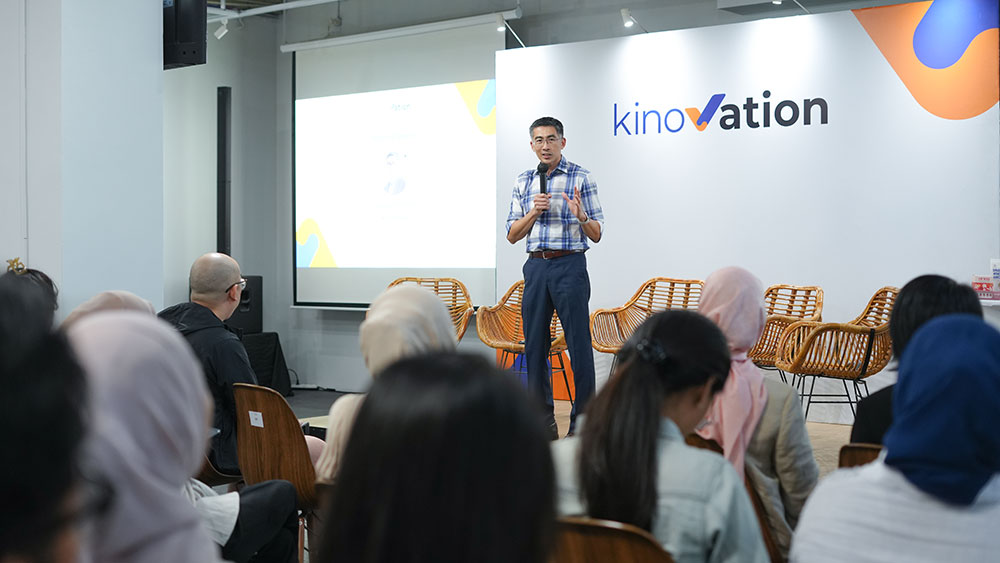
In August 2024, he appeared as Senyawa+’s founder and a mentor in Kinovation’s third batch, a Kino Indonesia program for local brands. Ten brands were selected from 198 applicants. The month-long training brought together e-commerce, retail and digital media expertise, with mentoring from specialists and alumni. The vocabulary had moved from hackathons toward consumer products. The practical attention to preparation remained.
There is a pleasing continuity between the ten-table restaurant and the rooms full of founders. Kamto’s work keeps returning to the making of a business and the people who might benefit from it. A prospective entrepreneur still needs a collaborator, a customer, a useful introduction, a next appointment. He has devoted much of his career to putting those things within reach. Once, the meeting place was a food court. Finding the next place to begin became his business.
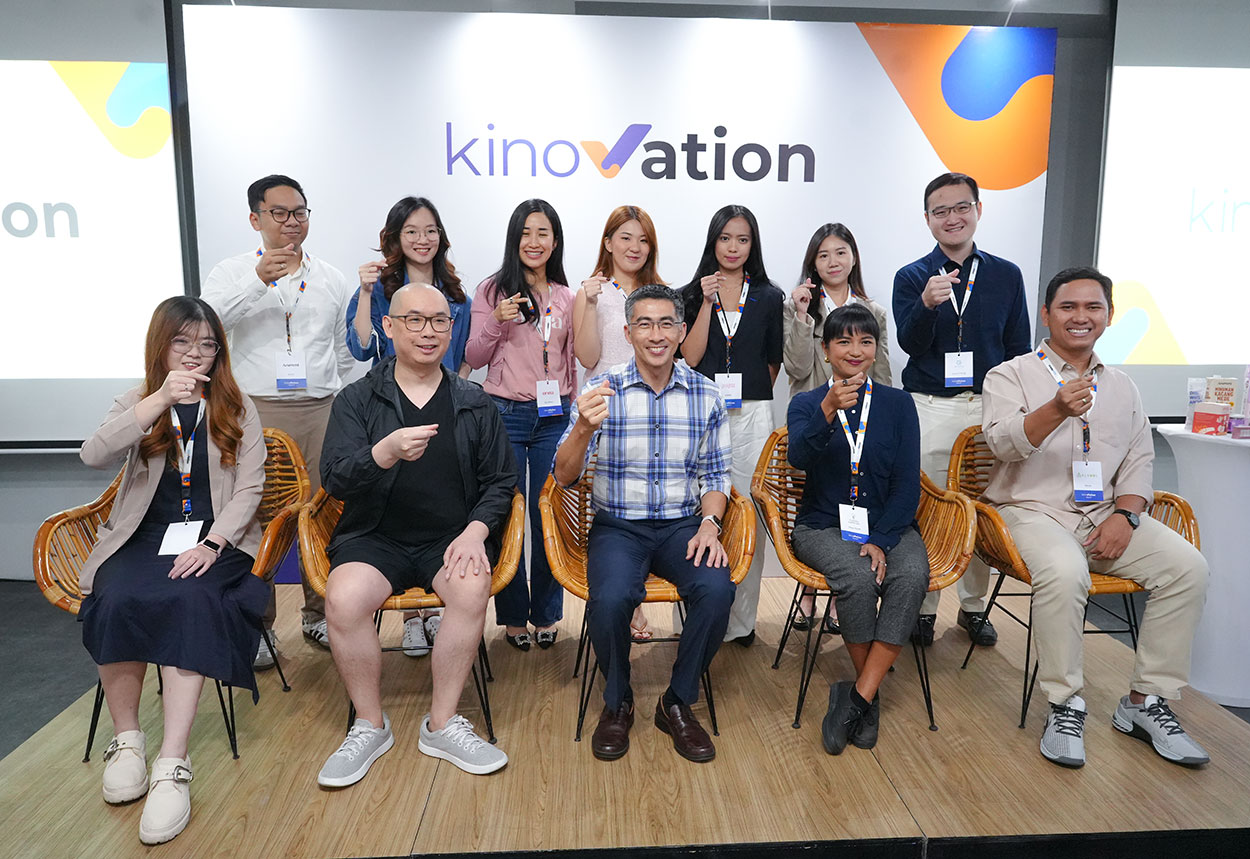
Kinovation batch 3 · 2024