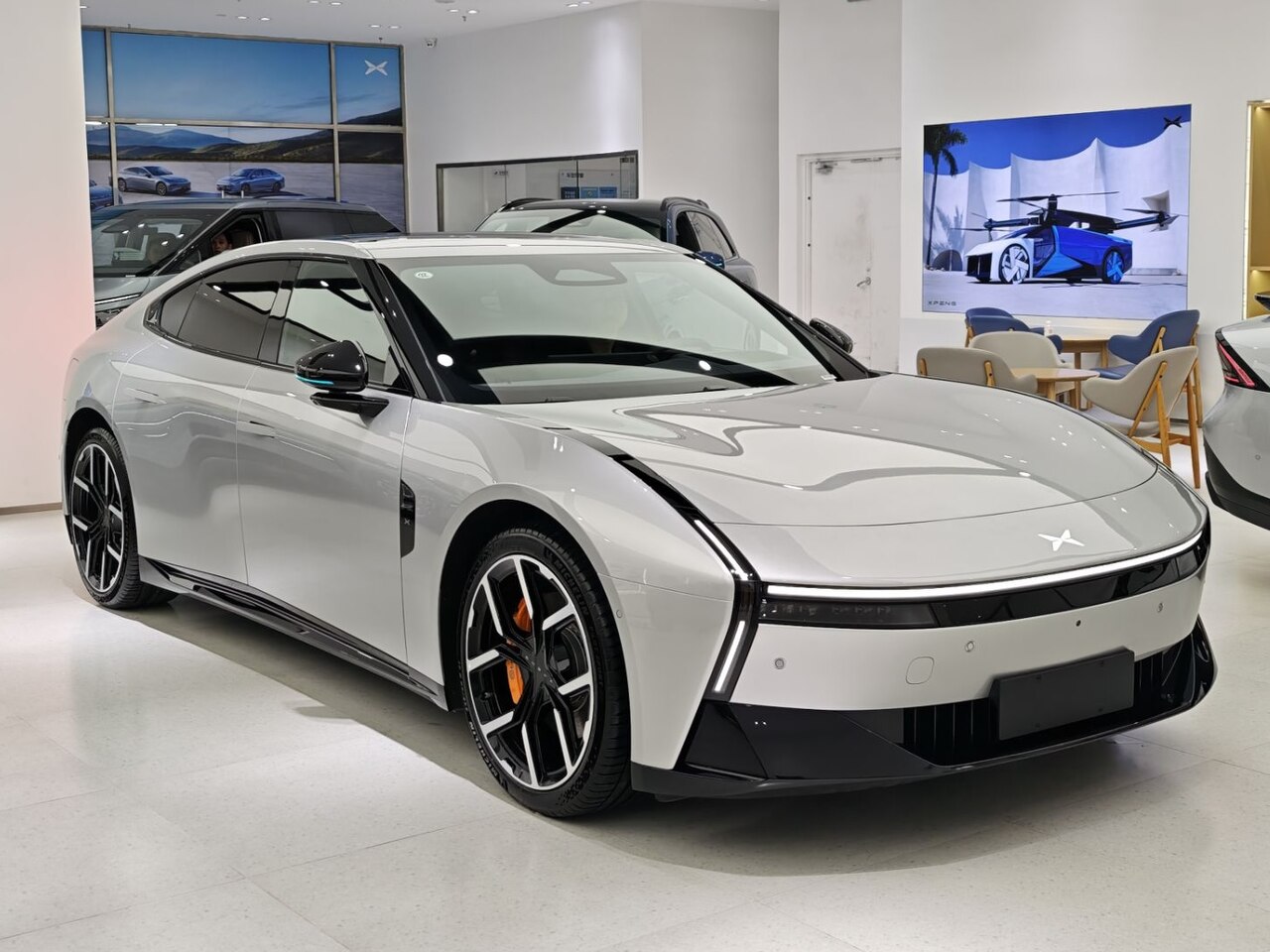
Let's start with a number: 30,000. That's how many people pre-ordered the Xpeng P7+ in one hour and forty-eight minutes when it opened for booking in October 2024. Not test-drive requests. Not newsletter sign-ups. Firm orders, deposits down, ready to buy a car they'd never sat in. For a brand most Europeans couldn't have picked out of a lineup a year earlier, that is an extraordinary vote of confidence. The world just didn't get the memo yet.
The Xpeng P7 is a battery-electric executive fastback sedan from XPeng Motors, founded in Guangzhou in 2014. The name comes from He Xiaopeng, the former Alibaba executive who backed the company early and eventually became its chairman - "Xiaopeng" means "small roc," a mythical Chinese bird of vast wingspan. The ambition embedded in that name has not gone unmet. XPeng's P7 was certified by China's Ministry of Industry and Information Technology as the longest-range electric vehicle made in China when it launched in June 2020. It was not a fluke. It was a mission statement.
Who the P7 is actually for
Before anything else: understand who this car is not for. If you buy on brand heritage, park Porsches in the mental garage of your self-image, and equate price with quality, the P7 is not for you. Not yet. But if you are the kind of person who switched from a BlackBerry to an iPhone in 2007 and immediately felt smarter for it - the P7 deserves your full attention.
The P7 is for the professional who commutes far and charges slowly at home, and wants a car that handles the highway without bothering them. It's for the family that wants four massaging seats, a roof full of legroom, and a 15.6-inch screen that physically rotates to entertain the passenger on the right - all without paying German luxury-car prices. It's for the early adopter who reads chip architecture specs for fun and considers "ADAS TOPS count" a valid dinner party topic. And it's for the buyer who has watched Tesla turn increasingly inward, who looks at the P7's price-to-feature ratio and does the maths with a raised eyebrow.
In Europe, the P7+ launches from €43,990. The Tesla Model 3 Long Range starts around €48,000. The Volkswagen ID.7 from roughly €54,000. The P7+ brings a larger boot (573 liters), more rear legroom (994 mm of rear passenger space - that is limousine territory), faster charging, and more powerful ADAS at a lower price. Not more expensive. Less expensive. That matters. A lot.
XPENG's NGP system seemed more safety and comfort oriented than Tesla FSD - it performs smoothly and seems to learn quickly.
- CleanTechnica, European hands-on test, January 2026Designed to slice the air
Rafik Ferrag, the BMW-trained designer XPeng recruited in 2018, built the P7 from scratch. He described the process as being free from references - no homage to European saloons, no callback to historic Chinese design. The result is low, wide, and clean in the way only true aerodynamic intent can produce. Over thirty iterations of the body were tested before engineers settled on a drag coefficient of 0.236 Cd for the original model. The second-generation P7 pushed that to 0.201 Cd, putting it among the most aerodynamically efficient production sedans on the planet.
The P7+ introduced what XPeng calls the "X-BOT face" - a backlit illuminated bar spanning the nose that changes expression depending on what the car is doing. Six animation themes are downloadable via OTA updates. The car pulses when charging, blinks when locked, and waves (literally, a waving animation) when it encounters another XPeng vehicle. This is either charming or alarming depending on your relationship with anthropomorphism. Either way, people stop to look.
Then there is the Wing Edition - a limited variant with electrically operated scissor doors on the front. The clever part: each door carries its own radar sensor, calibrated to stop opening automatically if it would hit an obstacle. Smart doors for human-size oversights. The car is quietly solving problems you did not know you were having.
The technology stack is the story
XPeng built its brand on ADAS. From the beginning, the P7 carried more sensors than most competitors thought necessary - 31 in the original 2020 model, including five millimeter-wave radars and fourteen HD cameras. That was with NVIDIA Drive AGX Xavier at 30 TOPS. The 2023 P7i facelift added two LiDAR units and dual NVIDIA Orin X chips at 508 TOPS. Then came the P7+ in 2024, and XPeng made a strategic pivot that raised eyebrows across the industry.
LiDAR went away. Entirely. XPeng, like Tesla before it, decided that cameras plus compute beats LiDAR plus cameras plus compute when the compute is powerful enough. The "AI Hawk" vision system uses twelve external cameras with single-pixel LOFIC sensors designed for low-light performance, twelve ultrasonic sensors, and three millimeter-wave radar units. The processing power behind it: dual NVIDIA Orin X at 508 TOPS. The current 2026 Turing-chip variants take that to 750, 1,500, or 2,250 TOPS depending on configuration. XPeng built that Turing chip themselves. In-house. With a 40-core processor and 273 GB/s memory bandwidth. That is not a rounding error in automotive compute - that is a full data centre's worth of inferencing sitting behind the dashboard.
The top Turing chip configuration gives the P7 2,250 TOPS of onboard AI compute. For context: a PlayStation 5 runs at approximately 10 TOPS. The P7's brain is roughly 225 PlayStations.
The software stack - Xmart OS, now at AIOS 6.0 - is updated over the air, regularly and meaningfully. In December 2024, a single OTA update delivered what XPeng calls "door-to-door" ADAS: the system handles the entire journey from your home garage to your destination parking spot, across mixed urban and highway conditions, without requiring you to touch the wheel. Not "highway assistance." Door to door. The gap between that and full self-driving is now a question of ambition, not architecture.
The battery, the charger, and the twelve minutes
The P7+ uses an 800-volt electrical architecture. This is the same fundamental choice made by Porsche for the Taycan, Hyundai for the Ioniq 6, and Kia for the EV6. It enables what XPeng calls 5C charging: a charge rate five times the battery capacity per hour. In practice, that means 10 to 80 percent in twelve minutes. Not quite the speed of a petrol pump, but close enough that "range anxiety" becomes a theoretical condition rather than a daily experience.
The standard P7+ carries a 76.3 kWh battery (European spec) and achieves 570 km on the WLTP cycle - a realistic, conservative European standard, not the generous Chinese CLTC figure. The long-range Next P7 Gen 2, launched August 2025, carries a 92.2 kWh NMC pack and achieves 820 km CLTC. The EREV (extended-range electric vehicle) variant, launched at the start of 2026, pairs a 49.2 kWh battery with a 1.5-litre turbocharged engine and claims a combined range of 1,550 km. For reference: London to Rome is about 1,800 km. This is a vehicle that could get close on a single tank of electrons and petrol.
Inside: the living room with a steering wheel
The interior of the P7+ is designed around the presumption that you are spending real time in it, not just commuting. The 15.6-inch center touchscreen physically moves on three axes: rotating to face the front passenger, tilting up and down, nodding in response to voice commands. There is no other production car that does this. It is, in the finest sense of the phrase, completely unnecessary and entirely delightful.
All four seats are heated, ventilated, and massaging. You typically find this in a Mercedes S-Class or a BMW 7 Series. The P7+ offers it at a quarter of the price. Front seats feature active lateral bolsters - they tighten around you during cornering with a 10-millisecond response time, approximately the speed of a reflex. The cabin's audio system is a Dynaudio 20-speaker setup in a 7.1.4 Dolby Atmos configuration. The voice assistant, "Hey XPENG," handles climate, lighting, seat adjustment, and navigation in natural language. The 2026 Turing-chip variant adds a VLM (Vision-Language Model) that cross-references voice commands with the car's camera feed. You can ask it to "find somewhere to park near that blue building ahead" and it will try.
The Volkswagen validation
In July 2023, the Volkswagen Group paid $700 million for 4.99 percent of XPeng. This is not a passive financial investment. VW entered a joint development agreement to use XPeng's electrical and electronic architecture across future VW models - including ICE and plug-in hybrid platforms. The first jointly developed cars are due in 2026. The world's largest legacy automaker just licensed its core software stack from a nine-year-old Chinese startup. That sentence deserves to sit quietly for a moment.
The implication is not subtle: XPeng's software is good enough that Volkswagen - which employs 35,000 software engineers - decided it was more efficient to buy the expertise than build it. That says something about XPeng's code that no marketing brief can replicate.
Criticisms worth knowing
The P7 is not for everyone, and it should not pretend to be. Reviewers consistently flag the touchscreen-dominant cabin as frustrating for minor adjustments. There is essentially no tactile feedback from the steering wheel at spirited pace - it is accurate and planted, but communicates little emotion. The CLTC range figures the company quotes are optimistic; real-world European results come in closer to WLTP figures, which are still excellent but require mental recalibration when reading the spec sheet.
The biggest structural challenge is what the British press calls "China speed." The P7 launched in 2020 and has already had a major facelift (P7i), a full redesign (P7+), a facelift of that redesign (P7+ 2026), and an entirely new second-generation model (Next P7) - all within five years. This is genuinely unsettling for European buyers accustomed to a seven-year model cycle. You can buy a P7 today knowing it will be superseded within eighteen months. That is a real cost. OTA updates help, but they cannot change the hardware underneath.
We're going to have to get used to 'China speed', where manufacturers upgrade or change their models every couple of years rather than every six or seven years.
- Electrifying.com, P7+ reviewThe safety data
Five stars from C-NCAP with 93.08 percent occupant protection and 88.1 percent overall. Five stars from Euro NCAP for European-spec models. Brembo brakes on the European specification. Double wishbone front suspension, multilink rear. Vehicle-to-Load functionality for powering equipment from the car's battery. XPeng has not cut corners in areas with documented consequences.
What this car means
The Xpeng P7 is not merely a Chinese alternative to a European car. It is an argument about what a car should be. It argues that the future of driving is software, not steel. That compute matters more than cylinder count. That a car which updates itself monthly is more valuable than one built to last unchanged for a decade. That you can charge in the time it takes to drink a coffee, cover 820 kilometers on a charge, let the car drive itself from your garage to your destination, and do all of this for under €44,000 in Europe.
It is, quietly, one of the most significant vehicles of the 2020s. Not because it is perfect - it is not. But because it sets new coordinates for what the benchmark looks like. Every premium sedan maker reading the P7's spec sheet late at night is rethinking their timelines and their pricing. That is the surest sign of a product that matters.
A roc is a mythical bird of enormous size, strong enough to carry an elephant in its claws. He Xiaopeng named his company after himself and his ambitions. Looking at the P7's order books and its architecture and the fact that Volkswagen wrote a $700 million cheque to get close to it - the name fits.