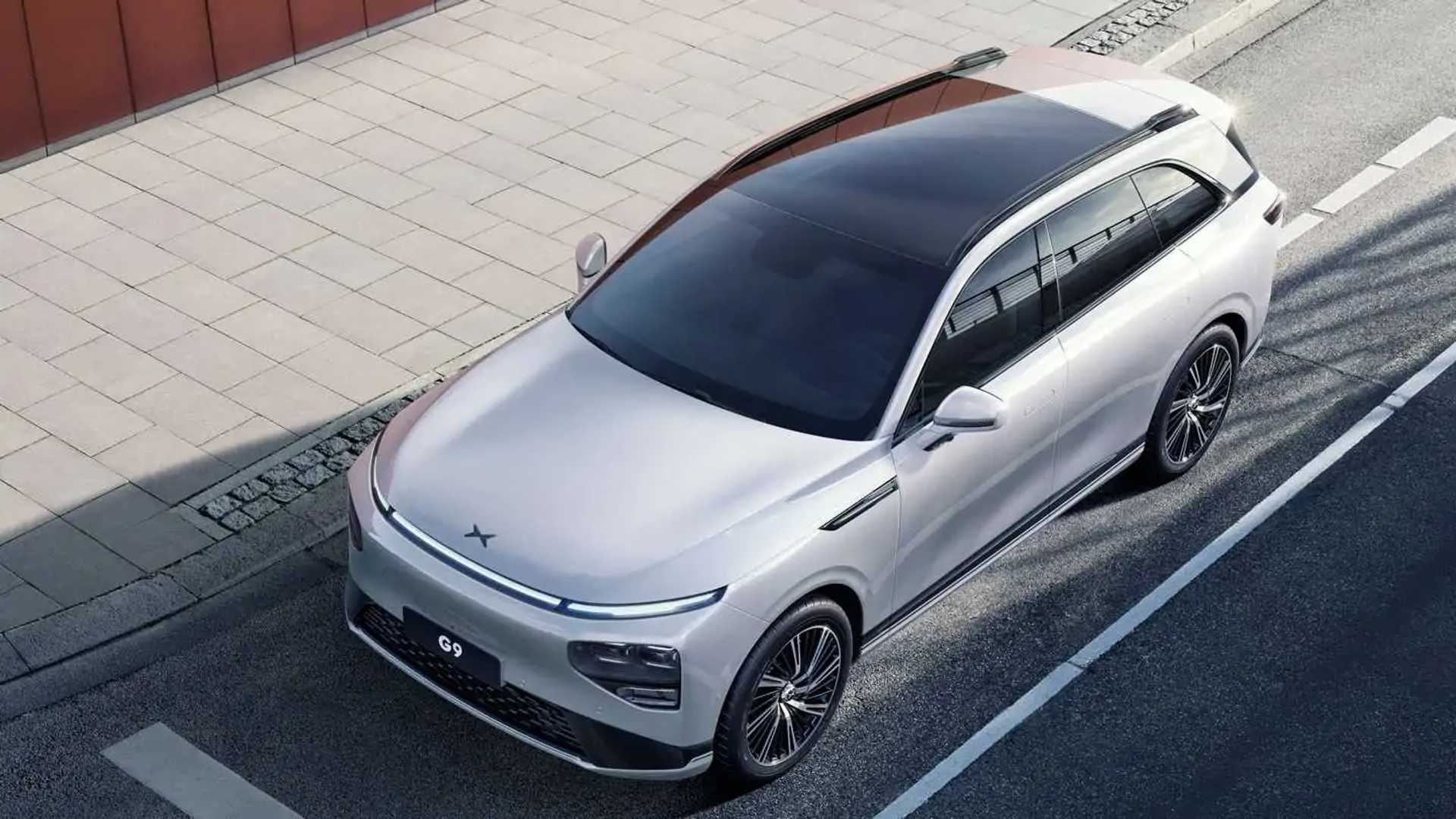
The Chinese EV That Made Volkswagen Call First
There is a version of the Xpeng G9 story where a Chinese startup builds a nice electric SUV and exports it to Norway. That version is boring and wrong. The real story involves a launch pricing disaster so severe the CEO issued a public apology within 48 hours, a charging system so fast it made the Porsche Taycan look like it was using an extension cord, and a moment when one of the five largest automakers in the world picked up the phone and said: we want your platform.
Volkswagen Group - the same company that has been building cars for 87 years, that employs 650,000 people, that makes Porsches and Audis and Lamborghinis - licensed the G9's architecture to build the ID. UNYX 08. That is not a paragraph buried in a press release. That is a seismic event in the history of the automotive industry. No Chinese EV startup had ever sold its platform technology to a top-five global automaker before. The G9 was first.
Who is the Xpeng G9 for? It is for the buyer who finds the Tesla Model Y's interior soulless and its charging network proprietary. It is for the engineer who wants to understand what 800V silicon carbide architecture actually feels like from the driver's seat. It is for the premium SUV buyer in Europe who has noticed that the brands charging EUR 75,000 for an electric crossover have been, shall we say, conservative with their software updates. It is for anyone who thinks that charging a car should take roughly as long as stopping for coffee.
"The question Xpeng wants you to ask is not how far it can go - but how fast it can recharge."
- Murray Scullion, Autocar UK, September 2025The Launch That Almost Wasn't
Before you admire the G9, you should know what it cost to get here. When Xpeng unveiled the production G9 on September 21, 2022, the pricing structure was a mess. Five trims, complex configurations, and a top price of CNY 469,900 - roughly USD 66,000 - that buyers found both confusing and expensive. Within hours of the launch event, reservations were being cancelled. Chinese social media, which is less forgiving than Western social media and approximately three times faster, turned hostile.
CEO He Xiaopeng - former Alibaba executive, one of the founders of the Chinese internet era, a man not known for public humility - issued a personal apology. Then Xpeng rebuilt the G9 lineup from scratch. New configurations. Lower prices. Simpler choices. In 48 hours. That is either chaos or responsiveness, depending on your perspective. Either way, it worked. The relaunched G9 attracted 23,000+ reservations in a single day.
The lesson from that episode is not that Xpeng made a mistake. Every car company makes mistakes. The lesson is what happened next: they listened, moved fast, and fixed it. That velocity - the willingness to iterate in public, to break from the sunk-cost dignity of a traditional automaker - is the cultural DNA that also explains how the G9 gets software updates that genuinely change how it drives.
The 800V Question
Most electric vehicles run on a 400V electrical architecture. That number governs how fast you can push electricity into a battery. The G9 runs on 800V silicon carbide. When it launched in 2022, that placed it alongside the Porsche Taycan and the Hyundai IONIQ 6 as one of the very few mass-production EVs to use this approach. The practical result: you can charge the G9 at peak rates of 530 kW. For context, a standard Level 2 home charger delivers about 7-11 kW. The G9 can, on a compatible charger, absorb electricity roughly 70 times faster than that.
The 2025 model took this further. 5C charging - meaning the battery accepts power at a rate five times its own capacity - means 10% to 80% in 12 minutes. Add 200 km of range in five minutes. These numbers would have sounded implausible in 2019. They are Xpeng's standard specification now. The engineering required to manage the heat, current, and battery chemistry at these rates is not trivial. Silicon carbide semiconductors run cooler and more efficiently than the silicon IGBT transistors they replace. The entire powertrain - motor, inverter, battery management - had to be rethought for 800V. Xpeng did not bolt a fast charger onto a standard car. They designed the car around the charger.
Why 5C Changes the Calculus
The persistent objection to electric vehicles is range anxiety. Not actual range - most people drive far less than any modern EV's range per day - but the psychological weight of knowing that if you run low, you're in trouble. Fast charging dissolves that objection. A 12-minute charge stop is not meaningfully different from a petrol fill-up. The G9, in 2025, crossed that threshold. Whether or not the charging infrastructure exists everywhere you might go is a separate question. The car itself is no longer the bottleneck.
What It's Like Inside
Xpeng designed the G9 to compete with German premium SUVs, not Chinese family cars. The interior reflects that ambition. Dual 14.96-inch landscape-mounted screens dominate the dashboard, supplemented by a 10.25-inch digital instrument cluster. None of this is especially unusual for a Chinese EV in 2025. What surprises reviewers consistently is the material quality: the soft-touch surfaces, the panel fit, the way the seat leather behaves in cold weather. Autocar, not a publication known for generosity toward Chinese brands, called the interior quality "upmarket" and noted it "rivals German competitors."
The audio system deserves a paragraph of its own. The Xopera system supports Dolby Atmos spatial audio. In a SUV. This is either an amusing luxury or genuinely useful, depending on whether you've ever sat in heavy traffic listening to a well-recorded classical piece wrap around you in three dimensions. Autocar's reviewer singled it out as "genuinely impressive." The frunk - a front trunk, the bonus storage space created by not having an engine up front - is practical and noted repeatedly by test drivers as something European competitors in this price range sometimes forget to include.
XNGP: The Autonomous Driving System That Evolves
Tesla's Full Self-Driving is the reference point everyone uses for Chinese ADAS comparisons, and Xpeng's XNGP - XPeng Navigation Guided Pilot - is the most credible Chinese challenger to it. The original G9 used two NVIDIA Drive Orin chips for 508 TOPS of processing power, plus a LiDAR sensor on the roof. The 2025 model dropped the LiDAR and moved to a pure-vision system: 11 cameras and three 4D millimetre-wave radars. The 2026 update went further: three in-house Turing AI chips delivering up to 2,250 TOPS - more than four times the original configuration.
The ambition is full autonomy on mapped Chinese roads. In 2022, the standard, unmodified G9 - not a prototype, not a specially modified fleet vehicle, but a production car you could buy at a dealership - became the first such vehicle approved for autonomous driving tests on public roads in China. That is a regulatory achievement as much as an engineering one. China's autonomous driving approval process is not casual. XNGP supports highway driving, urban navigation, and automated parking, with real-time map updates pushed over the air. The 2026 VLA (Vision Language Action) model fuses visual perception with language understanding and action generation - the kind of architecture that lets a driving system handle situations it has never specifically been trained on.
Whether you will actually use the autonomous driving features depends heavily on where you live. In major Chinese cities, XNGP covers most scenarios. In Europe, the capabilities are more limited pending regulatory approval. But the trajectory is clear, and the hardware in the 2026 G9 is already waiting for the software to catch up.
The VW Deal: What It Really Means
In 2023, Volkswagen Group announced a partnership with Xpeng that involved co-developing two new vehicles for the Chinese market. Then it emerged that those vehicles would use the G9's platform. This was not a joint venture in the traditional sense, where a Western brand provides brand recognition and a Chinese partner provides local market access. This was Xpeng, a 10-year-old startup from Guangzhou, licensing foundational EV technology to a company that has been engineering internal combustion engines since before most of its founders were born.
The resulting car, the Volkswagen ID. UNYX 08, uses the G9's 800V architecture, its battery integration approach, and elements of its ADAS platform. For Xpeng, the deal is validation that their technology is genuinely world-class. For the broader industry, it is a marker: the centre of EV innovation is not in Stuttgart or Detroit. For European buyers considering the G9, it is a quiet reassurance - Volkswagen Group looked at this platform and decided to bet money on it.
Range: Reading the Numbers Honestly
The G9's range claims require a brief translation guide. The 725 km figure on the 2025 model is a CLTC (China Light-duty Vehicle Test Cycle) number. CLTC is a relatively generous cycle - more forgiving than the EPA standard used in the US and somewhat more optimistic than the WLTP cycle used in Europe. The European-spec G9's WLTP range is listed at up to 541 km (336 miles), which is honest and useful. Real-world range in mixed driving is typically 80-85% of the WLTP figure, which puts a realistic number somewhere around 430-460 km per charge in temperate conditions. That is competitive with any premium EV SUV. Combined with the 12-minute charging time, range becomes much less relevant than it is for a slower-charging competitor.
Global Expansion: Where You Can Actually Buy One
The G9 is sold in Norway, Germany, Sweden, Spain, Portugal, the Netherlands, Poland, Estonia, Latvia, Lithuania, the UAE, Egypt, Thailand, and other markets. European-spec vehicles are assembled by Magna Steyr in Graz, Austria - a detail that simplifies EU homologation and sidesteps some of the import complexity that has affected other Chinese brands. Magna Steyr also builds the BMW 5 Series and the Jaguar I-Pace, so the manufacturing credentials are not in question.
What is notably absent from that list: the United States and the United Kingdom. The US faces high tariffs on Chinese EVs that currently make the G9 economically unviable for the American market. The UK situation is more straightforward - Xpeng has not confirmed a launch date. Autocar's September 2025 review noted this explicitly, and it is a genuine gap in the product's global story. If you are in the UK and want a G9, you are waiting. Electrek's first-drive reviewer, having driven the G9 in the Netherlands, called it "a winner" and expressed direct frustration that it is not sold in the US.
The Competitors: A Honest Comparison
The Tesla Model Y is the obvious reference point, and the G9 competes with it directly in every market where both are available. The Model Y wins on global charging infrastructure and resale value in Western markets. The G9 wins on interior quality, charging speed, and (in China) autonomous driving capability. NIO's ES7 and ES8 offer battery-swap technology as an alternative to fast charging - a different solution to the same problem. Li Auto's L9 targets the family buyer with a six-seat layout and extended range hybrid option. BMW's iX and the Audi Q8 e-tron compete on brand prestige and dealer network. None of them charge as fast as the 2025 G9.
Why to Buy
- Fastest charging in class - 12 min to 80%
- Interior quality rivals EUR 80,000 German SUVs
- Full OTA updates including powertrain
- 5-star Euro NCAP safety rating
- Dolby Atmos audio is genuinely excellent
- VW chose this platform - that's a peer review
- Frunk as standard
- 725 km range (CLTC), 541 km WLTP
Why to Pause
- Not available in USA or UK yet
- Styling plays it safe - no drama outside
- XNGP full capability limited outside China
- Charging network coverage varies by market
- Resale value unproven in Western markets
- Steering lacks tactile road feel (per Autocar)
- CLTC range figures need WLTP translation
The Buyer's Guide: Who Should Actually Consider This?
There is a type of buyer for whom the G9 is an obvious choice, and the profile is more specific than "person who wants an EV." It is the buyer who already knows what 800V means. Who has already dismissed the Tesla interior. Who lives in a city with good DC fast-charging infrastructure, or near one of Xpeng's S4 Superchargers in China. Who values over-the-air updates that actually change the car's behaviour. Who is comfortable buying a brand that Western neighbours may not recognise at a dinner party but which is listed on the New York Stock Exchange and partners with Volkswagen.
It is not the right car for the buyer who values established resale value certainty above all else. Or who needs to charge regularly in remote areas without 150 kW+ infrastructure. Or who lives in the US or UK. Or who wants the status signal of a German badge. The G9 does not pretend to be everything. What it does - charge extraordinarily fast, cover long distances, provide a genuinely premium interior, and update itself intelligently over time - it does at a price that undercuts its European equivalents significantly.
The Broader Significance
The Xpeng G9 is a product worth understanding because it represents something real about where the automotive industry is going. The companies that led the petrol era built their advantages in mechanical engineering - engine tolerances, transmission calibrations, the accumulated expertise of decades. Electric vehicles transfer that advantage toward software, battery technology, and semiconductor design. China invested heavily in those areas. The G9 is not a fluke. It is an expression of a strategic bet that paid off.
He Xiaopeng was an internet executive before he was an automotive CEO. His co-founders came from technology, not car manufacturing. The G9 was designed the way software is designed: iterate fast, ship often, learn from users, update continuously. The 48-hour pricing pivot at launch was embarrassing, but it was also culturally consistent - move fast, respond to feedback, fix it. The question for the next five years is whether that approach will hold up as the cars become more complex, as the ADAS systems take on more responsibility, and as the brand tries to build trust in markets where it is still largely unknown.
For now: the G9 charges in 12 minutes, covers 725 km on a charge, has Dolby Atmos and a frunk, scored five stars at Euro NCAP, and sold its platform to Volkswagen. If that description does not intrigue you, the car is probably not for you. If it does, there has never been a better time to pay attention.