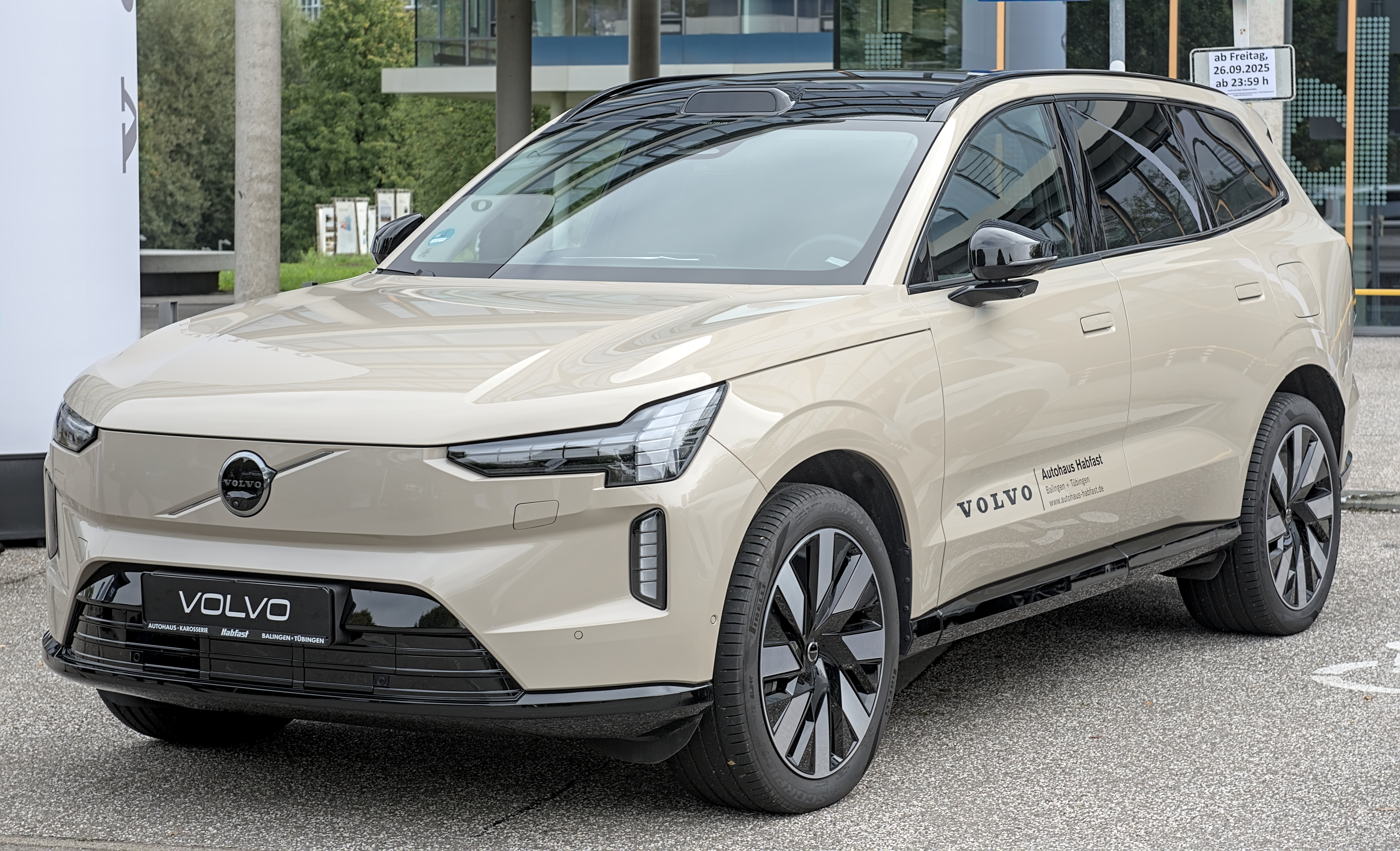
The Car for Parents Who Read Wired and Worry About Everything
A buying guide and editorial review
There is a specific kind of person Volvo built this car for. They have three kids, a dog, a ski rack, and a cabin two states away. They read product reviews obsessively, hold climate anxiety in one hand and a school schedule in the other, and refuse to choose between family utility and personal values. They wanted an electric SUV. They also needed it to seat seven, haul a trailer, survive a Midwestern winter, and - this is the key part - not kill anyone.
Volvo did not build the EX90 for speed enthusiasts or range-anxiety obsessives or people who wear Rivian trucker hats. They built it for the type of buyer who once read that Volvo invented the three-point seatbelt in 1959 and gave the patent away for free - and decided that this was a company they could trust with their family. The EX90 is designed to deserve that trust. Whether it earns it is a more complicated question.
This is the most technologically ambitious vehicle Volvo has ever produced. It is also, honestly, one of the most polarizing. Some reviewers call it Gothenburg's electric masterpiece. Others call it "Gothenburg's electric problem child." Both are right, for different reasons, at different moments in the same drive.
"Gothenburg's electric poster boy has quickly become its problem child."
- Autocar UK, First Drive Review
From Norse Mythology to South Carolina
Volvo revealed a concept in June 2021 called the "Concept Recharge." The design suggested a radical break from anything they had made before - a vast, clean slab of Scandinavian confidence on wheels, with a roofline that swept like a Nordic fjord. Rumors swirled that the production version would be named Embla, after the first woman in Norse mythology. A poetic choice. Volvo instead went with EX90. More search-friendly, less saga.
The official reveal came on November 9, 2022, in Stockholm. The room was full of press expecting a car. What they got was a safety manifesto with wheels attached. Volvo's CEO Håkan Samuelsson used phrases like "the next generation of safety" and "the most advanced Volvo ever made." The centerpiece was a LIDAR sensor mounted on the roof - a golf-ball-sized eye that could detect a pedestrian from 250 meters away in total darkness. The automotive world paid attention. Luminar Technologies, which supplies the LIDAR, saw its stock spike.
Then came the wait. US production finally began at Volvo's Ridgeville, South Carolina plant in May 2024. Deliveries to American customers started in January 2025. That is a 26-month gap between reveal and reality - long enough for the reservation list to grow and frustrations to mount. Electrek described "Ferrari-like wait times" from demand. The software, specifically the LIDAR-enabled autonomous features, kept getting delayed. The car arrived to customers before all of its promised capabilities were active.
This is the EX90's central contradiction: it is simultaneously one of the most ambitious vehicles on the road and a product that shipped incomplete. The hardware is extraordinary. The software is still catching up. For many buyers, that is acceptable. For the premium price they are paying, it is fair to ask why.
"The car arrived before its own features did."
The Sensor Suite That Changed the Conversation
What 26 sensors, an AI brain, and a Bowers & Wilkins speaker array can do
👁️
Luminar Iris LIDAR
Detects pedestrians at 250m, dark objects at 120m. Works in total darkness. One sensor that changes accident probability.
🧠
Driver Understanding System
AI cameras track eyes, head position, and body posture. If you go unresponsive, the car stops itself and calls 911.
⚡
800V Fast Charging (2026)
Add 155 miles of range in 10 minutes. 250 kW peak. The 2026 upgrade matches Porsche Taycan charging speeds.
🎵
Bowers & Wilkins 25-Speaker Audio
Optional Abbey Road Studios Mode simulates the acoustic environment of the world's most famous recording studio.
🔗
Blockchain Battery Passport
World's first. QR code traces battery origin, recycled content, and carbon footprint via Circulor blockchain. Required by EU in 2027 - Volvo did it in 2024.
🏠
Vehicle-to-Home Power
Bi-directional charging means the EX90 can power your house during an outage. 111 kWh is serious backup capacity.
What It Is Actually Like to Live With
Inside the EX90, the first thing you notice is the calm. Swedish designers went aggressively minimal - no knobs, no clutter, no apologetic fascia crammed with buttons nobody asked for. A 14.5-inch vertical touchscreen dominates the center console, running Google's Android Automotive OS. Google Maps is native. Google Assistant is voice-activated. You can install apps. Apple CarPlay works. Android Auto works. The system is genuinely capable.
It is also - and reviewers across publications note this consistently - somewhat overwhelming. The interface requires navigation through menus to reach functions that German luxury competitors put on physical buttons. Adjusting the heated seats requires more taps than it should. CarBuzz scored the infotainment a 7 out of 10, which is the weakest category in their EX90 review. This is the EX90's most persistent friction point: extraordinary hardware, user interface that needs another version cycle to match it.
The ride itself depends almost entirely on which driving mode you select. In Comfort, the EX90 floats over bad road in a way that seems physically improbable for a vehicle weighing over three tons. In Eco or Dynamic, the suspension firms considerably. Autocar's Matt Saunders found the transitions jarring - the car could feel "too soft or too firm" in quick succession, without an obvious middle ground. On a smooth motorway, this is irrelevant. On the kind of broken pavement that covers significant portions of American infrastructure, it is a real variable to account for when test driving.
Performance is not the point of this car, and yet: 4.5 seconds to 60 mph in Performance trim is genuinely, absurdly fast for a vehicle with three rows of seats. Pull onto a highway on-ramp and the EX90 accelerates with a composure that suggests it finds speed trivial. The family on-board never lurches. Nobody spills their coffee. The weight works in your favor here - the car settles into speed with mass and gravity rather than drama.
The third row is real. Not "real for a car" real, but actually useful for adults on shorter trips and perfectly comfortable for children on longer ones. The optional six-seat configuration with captain's chairs in the second row elevates the cabin experience meaningfully. The EX90 Excellence variant takes this further still - individual rear thrones, a refrigerated center console, and cabin insulation that competes with vehicles costing twice as much.
Then there is the safety hardware. The Driver Understanding System is worth its own paragraph. A camera watches you. Not in a surveillance state way - in a co-pilot way. It tracks eye position, head angle, face orientation, and body posture continuously. If you are distracted, it prompts you. If it cannot rouse you, it activates emergency stop protocols: autonomously navigates to the road shoulder (not just braking in lane), switches on hazard lights, unlocks all doors, and places an emergency call. This system won TIME's Best Invention award in 2024 for automotive. It is not a gimmick. It is a genuine, peer-reviewed advance in passive safety that works.
The LIDAR sensor on the roof of the 2025 model deserves its own conversation - and its own controversy. Luminar's Iris unit scans the road ahead in three dimensions, 20 times per second, detecting objects that cameras and radar can miss: a dark tire in the road, a pedestrian in a black coat at night, a deer at the edge of headlight range. Volvo claimed it could reduce serious injury accidents by 20%. Then, for the 2026 model, they removed it.
The LIDAR Controversy
The 2025 EX90 launched with LIDAR as its defining differentiator. Volvo marketed the Luminar Iris sensor heavily as the proof point for their safety claims. Then the 2026 model dropped it entirely.
Volvo's explanation: improved camera and radar software now delivers equivalent safety without LIDAR hardware. Critics called this a reversal of marketing promises. Luminar Technologies' stock dropped. The EV safety community had opinions. Volvo's position is defensible - software can improve, hardware cannot - but it raised legitimate questions about how much of the original pitch was product and how much was aspiration.
The LIDAR removal mirrors a wider debate in autonomous driving: Tesla's camera-only approach versus LIDAR-based systems. By dropping LIDAR for the 2026 model while adding superior computing (dual NVIDIA DRIVE AGX Orin chips, 500 TOPS) and retaining all cameras, radars, and ultrasonics, Volvo is betting that software will outperform hardware. This may prove correct. The 2026 EX90 without LIDAR may well be safer than the 2025 with it, by every measurable metric. But the optics of removing a feature that was central to your launch narrative are difficult to manage, and Volvo managed them imperfectly.
Range is 300 miles EPA for the 2025 model. Real-world figures in mixed driving tend to land around 260-280 miles - good, honest range for the vehicle class, though not class-leading. The BMW iX xDrive50 offers similar range. The Kia EV9 hits 304 miles. The Mercedes EQS SUV stretches past 340. For most buyers doing school runs, weekend trips, and occasional longer drives, 300 miles is entirely adequate. It becomes a friction point specifically on cross-country routes where charge stops become frequent. The 2026 upgrade to 800V architecture addresses this partly - not via more range, but via dramatically faster charging. Adding 155 miles in 10 minutes is a meaningful quality-of-life upgrade for road trip scenarios.
Towing capacity of 5,000 lbs is genuine and useful. Not every luxury electric SUV can say that. If you have a boat, a horse trailer, or a pop-up camper, the EX90 handles it. The weight penalty of towing on range is real - expect 40-50% range reduction under full tow, consistent with physics and with other EVs in this class.
THE VERDICT
The Volvo EX90 is the right car for a specific buyer: affluent, safety-conscious, design-aware, environmentally motivated, and in genuine need of three rows. It is not the right car for someone who tests the limits of its software promises on day one. Buy it for what it does today - which is considerable - not for what it will do when every promised feature is activated. For Volvo owners upgrading from an XC90, it is an obvious next chapter. For everyone else, it is a serious contender that requires a serious test drive.
What It Costs
2025 model year US pricing, before destination charges
Twin Motor Plus
$76,695
402 hp, 7-seat, standard AWD
Twin Motor Ultra
$81,045
402 hp, full tech package, panoramic roof
Performance Plus
$81,695
496 hp, sport-tuned suspension
Performance Ultra
$86,045
510 hp, all options, highest spec
Add $500 for the 6-seat captain's chair configuration on any trim. The 2026 model starts at $84,345 with the 800V upgrade. Costco Auto Program members have accessed up to $10,000 in negotiated discounts, making sub-$70k transactions possible on 2025 inventory. The EX90 Excellence (ultra-luxury 4-seat) surpasses $100,000 and enters Mercedes-Maybach EQS SUV territory.
There is a potential federal EV tax credit situation to evaluate - the EX90 is produced in South Carolina, which positions it well for US-made EV credits, but eligibility depends on income limits and battery sourcing rules. Consult a tax professional before assuming the credit applies to your purchase.
Who Else Is in the Room
BMW iX xDrive50
German rival
Mercedes EQS SUV
More range
Cadillac Escalade IQ
American flagship
The Kia EV9 is the EX90's most important competitor to understand, because they are not for the same buyer - but buyers compare them anyway. The EV9 is $20,000 less, achieves similar range, and seats seven with genuine comfort. It does not have a blockchain battery passport, a Driver Understanding System, or a LIDAR sensor (or former LIDAR sensor). It does not have Abbey Road Studios Mode. It does not cost $76,000. Buyers who are primarily solving a "three-row family EV" problem should evaluate both. Buyers who want the specific combination of Scandinavian design, safety prestige, and technology ambition that Volvo represents should start with the EX90.
Against the BMW iX and Mercedes EQS SUV, the EX90 is competitive and differentiated. Volvo's safety story is genuinely distinct - no German brand has anything comparable to the Driver Understanding System. The design is more restrained than BMW's polarizing iX aesthetics. The price is similar. This is the category where the EX90 earns its place most convincingly.
Ten Facts That Make the EX90 More Interesting
The EX90 was originally rumored to be named "Embla" - the first woman in Norse mythology. Volvo chose a product code instead. Marketing won. Mythology lost.
Volvo invented the three-point seatbelt in 1959 and gave the patent away for free. That decision is credited with saving over one million lives. The EX90 is that philosophy, electrified and sensor-saturated.
The Luminar LIDAR sensor on the roof scans 20 times per second and can detect a pedestrian from 250 meters - roughly 2.5 American football fields - in complete darkness.
The Driver Understanding System can autonomously navigate to the road shoulder, turn on hazard lights, unlock all doors, and call 911 if the driver becomes unresponsive. The car will not just stop - it will stop safely.
Each EX90 battery has a QR code that links to a blockchain record (via UK startup Circulor) tracing every material in the battery - origin, recycled content, carbon footprint. The EU required this by 2027. Volvo shipped it in 2024.
The Bowers & Wilkins audio system has an "Abbey Road Studios Mode" - named for the London studio where The Beatles recorded. It acoustically places you inside the room where Let It Be was made.
The EX90 and the Polestar 3 are built on the same SPA2 platform, in the same Ridgeville, South Carolina factory. Different brands, same bones, same shop floor.
The 2026 model's 800V system adds 155 miles of range in 10 minutes of charging. That is faster than most people use the bathroom on a road trip stop.
At nearly 6,200 pounds, the EX90 weighs as much as a full-size pickup truck. Yet it achieves a 0.29 drag coefficient - the aerodynamic performance of a sports car.
The 2026 EX90 dropped its LIDAR sensor entirely. The company that supplied that sensor, Luminar Technologies (LAZR on NASDAQ), saw its stock react accordingly. Volvo said software made it unnecessary. The debate continues.
The EX90 Timeline
JUNE 2021
Volvo reveals "Concept Recharge" - the design study that becomes the EX90. The interior is so minimal it barely looks like a car.
NOVEMBER 2022
Official global reveal in Stockholm. LIDAR takes center stage. The EX90 name is confirmed. Luminar stock rises.
APRIL 2023
EX90 Excellence unveiled: four-seat ultra-luxury variant with individual rear thrones and refrigerated console. Entering Maybach territory.
MAY 2024
Production begins at Ridgeville, South Carolina. The EX90 becomes the first Volvo built in the United States.
JANUARY 2025
US deliveries officially begin. Reservation holders who waited 26 months finally get their cars.
APRIL 2025
EX90 wins 2025 World Luxury Car of the Year at World Car Awards, New York International Auto Show.
SEPTEMBER 2025
2026 model announced: 800V architecture, dual NVIDIA chips (500 TOPS), electrochromic roof, Emergency Stop Assist. LIDAR dropped.
APRIL 2026
China-made EX90 and ES90 unveiled at Volvo's 100th anniversary event in Chengdu. Global production now spans three continents.
The Bigger Idea
The EX90 is not just a car. It is an argument. The argument is that safety, design, and electrification can coexist in a single vehicle without compromise - and that a Swedish brand with 99 years of heritage can make that case more convincingly than Silicon Valley startups or German incumbents.
Sometimes the argument is compelling. The Driver Understanding System is a genuine contribution to passenger safety. The blockchain battery passport is a quiet act of transparency that puts most of the industry to shame. The cabin - when you are on a smooth road with a good playlist on 25 speakers that have been tuned by engineers who have actually been to Abbey Road - is one of the most pleasant places to spend time on four wheels.
Other times the argument frays. The infotainment interface is a reminder that screen size is not the same as usability. The LIDAR reversal is a reminder that product roadmaps change, and early adopters sometimes pay for promises that evolve. The weight - over three tons - is a reminder that physics charges a toll on range and tire wear regardless of brand prestige.
But here is the thing about Volvo's argument: they have made it before, in simpler forms. They gave away the seatbelt patent. They were the first to mandate side curtain airbags. They funded pedestrian detection research when it was not required and before it was commercially standard. The EX90 is the latest chapter in a 65-year editorial position that safety is not a feature - it is an identity.
Whether the EX90 is the right car for you depends on your priorities. If you need three rows, appreciate Scandinavian design, and care about safety technology at a level most buyers do not, this is probably your car. If you are primarily optimizing for range per dollar, the Kia EV9 makes a stronger case. If you need more off-road capability, the Rivian R1S outclasses it on dirt.
What the EX90 does that none of its competitors does quite as well is tell a coherent story about what kind of company made it and why. That story is about a family in the third row, a driver the car keeps an eye on, a battery whose origins you can trace with your phone, and an industry tradition that believes the best technology is the kind that keeps humans alive.
Not every car has a philosophy. The EX90 has one. It costs $76,695 to live inside it.
"We're pleased to see the EX90 get the recognition it deserves. It was up against some tough competition, but this award proves that the EX90 appeals to some of the most demanding customers across the world."
- Håkan Samuelsson, Volvo CEO, on the 2025 World Luxury Car of the Year win