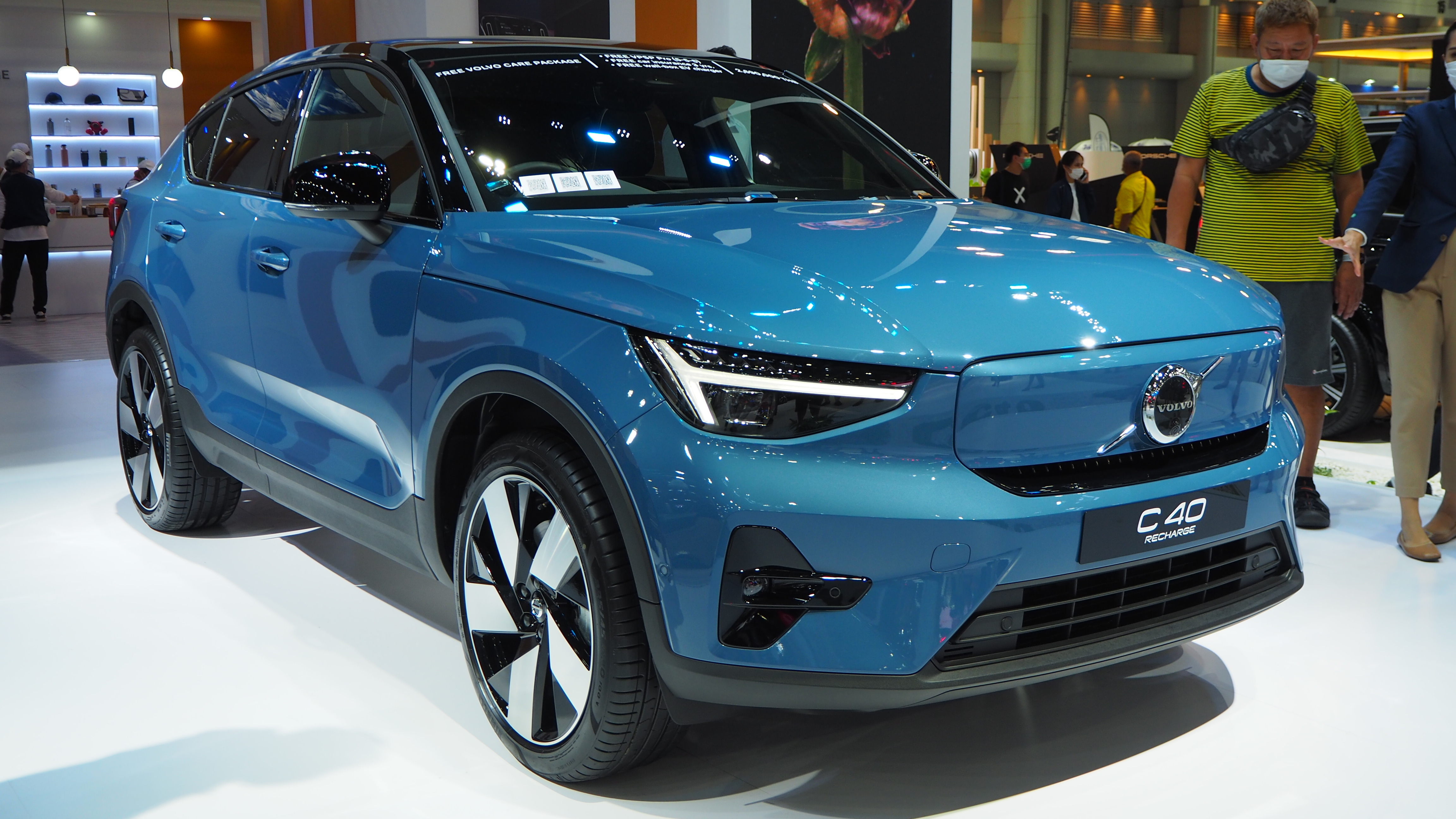
Most electric vehicles start as conventional cars. The engineers get the brief: take this platform, remove the fuel tank, add a battery, figure out what to do with the frunk space. The Volvo XC40 Recharge is that car. The C40 Recharge is something rarer.
When Volvo announced the C40 in 2021, they said something unusual for an automaker: this car would only ever be sold as a battery-electric vehicle. No diesel variant was coming. No hybrid. The C40 Recharge was, from the first sketches, conceived as a pure EV - with all the design decisions that follow from that premise.
The sloping roofline that gives the car its coupe silhouette wasn't forced by engineering constraints; it was a creative choice, inspired by Volvo's own 2018 360c autonomous concept - a futuristic vehicle that imagined a world where you slept in your car during long journeys. That concept never made it to production, but its design DNA lived on in the C40's profile: the closed front grille (electric cars don't need giant air intakes), the smooth aerodynamic contours, and the rear spoiler that pulls double duty as both visual identity and real downforce for range efficiency.
The blank front grille is a philosophical statement. No engine, no combustion, no gaping intake - just a smooth, closed face that says: we've moved on. Volvo calls it "honesty in design."
The interior decision was even more deliberate. In 2021, Volvo announced that all future pure electric Volvos would be entirely leather-free. Not "leather-optional" or "leather-reduced" - completely without animal leather across every trim level. The material that replaced it, Nordico, is one of the more interesting sustainability stories in the automotive industry: a textile made from recycled plastic bottles, bio-attributed materials sourced from sustainably certified Scandinavian forests, and cork recovered from wine bottle production. The result looks, feels, and wears like a premium material because it is one.
The Google integration went equally far. Rather than supporting Android Auto - the standard approach where your phone mirrors to the car's display - Volvo built Android Automotive OS natively into the C40. The car itself runs Google's operating system. Google Maps, Google Assistant, and the Google Play Store are built in, not mirrored. You can install apps. The car receives over-the-air software updates. Apple CarPlay is not available, which has irritated a non-trivial number of iPhone users, though the system's native integration is genuinely seamless in practice.
For 2024, the C40 got its most significant powertrain update. Volvo added a single-motor rear-wheel-drive configuration - and to do it, they designed a new permanent magnet rear motor themselves, manufactured in Sweden. It was the first time Volvo had built an electric motor in-house, and the first time the CMA platform had ever been configured for RWD. The physics favored it: with the battery pack sitting flat under the floor, the car's weight distributes naturally over the rear axle. The single-motor RWD model handles more precisely than the AWD, according to reviewers at Green Car Reports who drove both back-to-back in Sweden. It also gets 297 miles of EPA range, thanks to a new 82 kWh CATL prismatic cell battery.
There is no rear window wiper. Volvo's position: the steep coupe angle sheds water naturally. Reviewers' position: rear visibility was already limited by the roofline, and rain doesn't help. Both positions are correct.
The Thor's Hammer pixel LED headlights deserve their own paragraph. Each unit contains 84 individual LEDs. The system monitors traffic ahead and can selectively dim individual pixels around up to five detected vehicles simultaneously, keeping the full beam on the road without blinding anyone. In IIHS testing, the headlights earned a "Good" rating - the top score. They are also, objectively, beautiful in the dark.
US sales told a complicated story. The C40 peaked at roughly 4,173 monthly units in mid-2023 before a broader EV market slowdown - and a flood of discounted used EVs from Hertz's fleet liquidation - collapsed demand in 2024. A 2023 C40 that stickered at $62,715 was found selling on the used market with 36,000 miles for $24,188. For buyers who don't mind purchasing used, that represents extraordinary value. For Volvo, it represented a painful Q1 2024, when US EV sales fell 65% year-over-year.
The C40 Recharge closes its chapter after the 2024 model year. When it returns for 2026 as the EC40, it will be AWD-only, with an optional Performance Package pushing total output to 436 horsepower. The name changes. The philosophy doesn't.