Before Xing Su had a company to introduce, he had some homework to share. Nine courses’ worth, neatly arranged for anyone who wanted to follow along. The invitation was modest, almost disarmingly so: the notes could be improved, and visitors were welcome to help. Years before the chief executive title, there was a learner willing to leave his workings on the table.
It is a useful place to begin with the co-founder of Seen Health. A funding announcement can tell you that a venture has acquired money. A set of public notebooks tells you something about how a person approaches an unfamiliar subject. Xing’s career contains both. Between them runs a question that keeps returning: how do you take something complicated enough to overwhelm you and make it possible to work on?
His route has passed through Duke, New York consulting, San Francisco, Uber’s expansion work and a business founded with his twin brother, Yang. The geography is extensive. The recurring task is more compact: learn the system, understand its moving parts, then accept responsibility for making some of them move.
A notebook with the door left open
Xing graduated from Duke University in 2013. He spent 16 months working in consulting in New York, then moved to San Francisco to learn data science. His short account of that period ends with another change of scene: he would be launching new cities for Uber in China. It reads like a biography written before anyone had asked its owner to give a keynote.
The learning left a tangible record. His Data Science Specialization Course Notes project collected material for all nine courses in the Johns Hopkins program offered through Coursera. The pages offered HTML, PDF and R Markdown versions. The range ran from programming and data preparation to statistical inference, machine learning and developing data products.
There is something companionable about leaving a notebook open. Someone else can retrace the steps, find the place where an explanation loses them, or suggest a better example. A finished presentation asks to be admired. Working notes offer a chair beside the desk.
The project’s GitHub repository was created in March 2015. At the time of this profile’s research, it had 773 stars and 2,347 forks. Those are repository counts, rather than a census of students or a measure of educational outcomes. Still, the existence of so many copies gives this early piece of work a life beyond its author’s original purpose.
Much of a career disappears into meetings and documents that nobody outside an employer will ever see. Here, a small portion remains available to strangers. The dates have advanced; the invitation to work through something together is still there.
The education that came with a launch
At Uber, Xing worked on launches in China and on global expansion for Uber Freight. His experience there covered four years. These are assignments that put a person near the seam between an idea and its execution: a business may be understandable on a screen while remaining awkward to establish in a particular place.
His account of what he took from Uber is practical. Operational discipline. An affinity for data. The ability to explain a point of view to different audiences. The habit of dividing a problem into smaller pieces and continuing to solve it over time.
Each sounds ordinary until you try to do all four at once. Data can reveal a problem without persuading anybody to change a routine. A convincing explanation can win agreement while leaving the work untouched. Breaking a task down helps only if someone returns to the pieces after the excitement of the original plan has faded.
That is the appeal of Xing’s operating experience as a chapter in this story. It gives the later founder a history of working on implementation. The launch is the visible moment; the discipline concerns everything required to make the launch mean something the next day.
- DisciplineKeep the work measurable.
- TranslationExplain the view to different audiences.
- PatienceSolve smaller pieces over time.
Lessons described in Xing’s account of his Uber experience.
When discussing hiring, Xing and fellow founder Sai Alluri emphasized people who could work across the boundaries of a job description and remain curious enough to keep learning. It is a recognizable preference for someone whose own route involved moving between consulting, data study and expansion work. A title can be useful. It can also become an elaborate excuse to leave a task for somebody else.
Language also appears explicitly in his professional profile. Xing lists English and Chinese at native or bilingual proficiency, with Spanish at limited working proficiency. The distinction is precise, and useful to preserve. Being able to explain an idea to different audiences, one of his stated operating lessons, involves more than vocabulary. People bring different expectations to the same proposal. The work of getting an idea across includes recognizing those differences, even when everybody in the room appears to be speaking the same language.
The other founder had been there all along
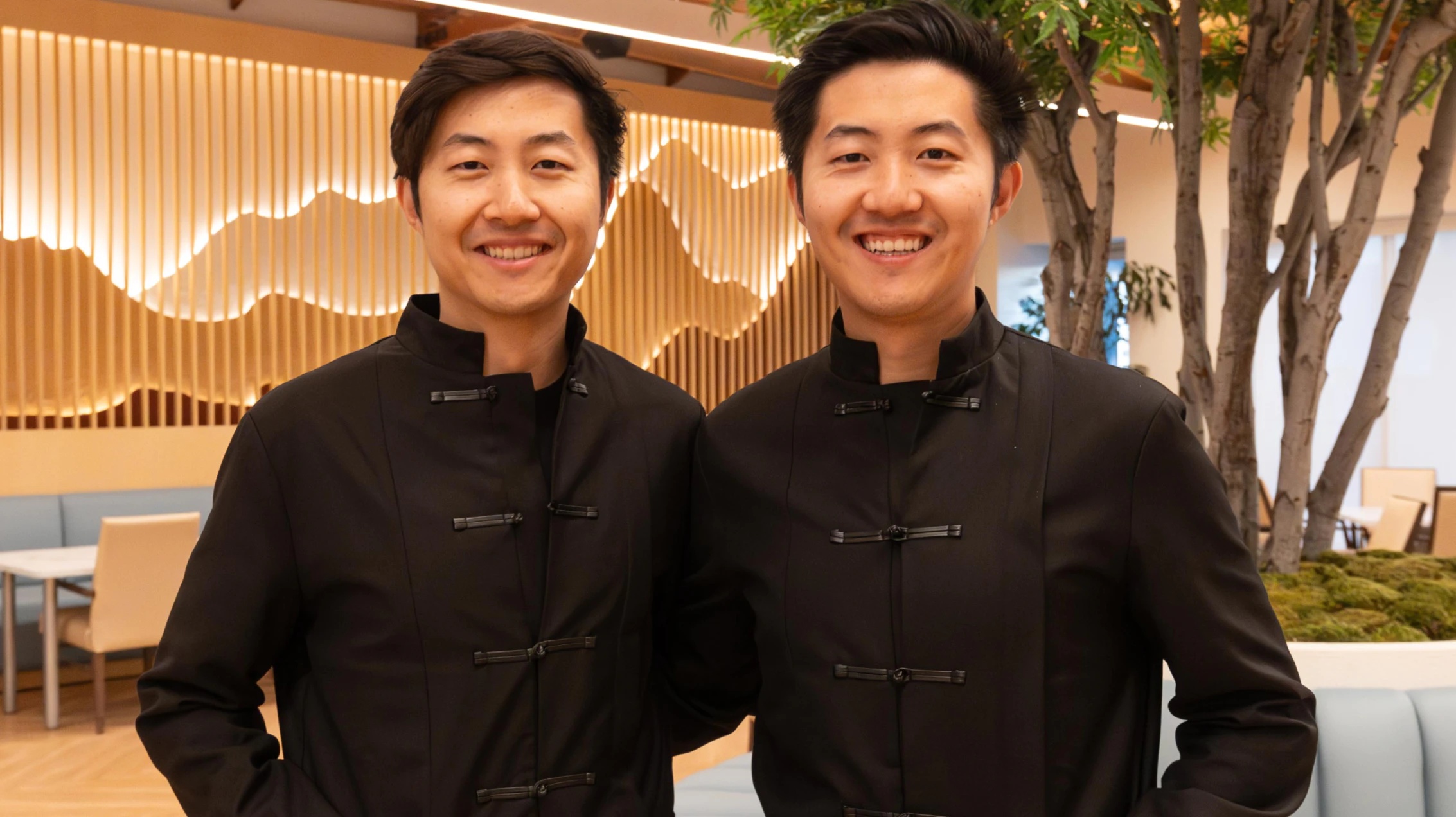
Xing’s next partnership reached further back than any professional network. He and Yang are twins. Their childhood began in Baotou, Inner Mongolia, with grandparents who helped raise them while their parents pursued further study and work. The brothers later moved to Texas at 12, initially expecting to spend a year learning English.
The planned year became a longer American chapter. In their telling, the school timetable helped the case for staying: the afternoons ended earlier. Some international moves are explained in terms of opportunity and ambition. Two boys can also appreciate getting out of school.
Their family story contains repeated departures and reunions. In the founders’ joint letter, Lunar New Year celebrations with their grandparents occupy a cherished place. Writing in 2024, they counted 20 years since the entire family had last gathered on New Year’s Eve. Weddings, dinners and red envelopes had been missed along the way.
That detail makes distance less abstract. Twenty years is a statistic. A dinner somebody missed is an empty chair. Red envelopes belong to an occasion, a gesture and a particular relationship. The brothers’ shared memories give the founding partnership a vocabulary that predates either person’s professional life.
Working with a sibling brings that history into the room. In Xing and Yang’s case, the family connection is explicit in how they introduce the company and themselves. Their joint signature closes the founders’ letter. The partnership has a personal starting point that a conventional account of colleagues meeting at work would miss.
A cheque, a building, and some termites
In November 2024, Seen Health publicly announced $22 million in funding. The round was led by 8VC, with Astrana Health, Primetime Partners, Basis Set Ventures and Virtue participating. For Xing, the learner and launcher had become a founder responsible for turning outside backing into an organization.
A financing total makes a tidy milestone. It arrives with a number and a date, suitable for placing in large type. Building an organization produces less cooperative material. Xing’s own account of the subsequent work included floods, fires and termites. The last item is a particularly effective interruption to the usual vocabulary of technology entrepreneurship. Nobody wants the bugs to be literal.
The interruption also brings the story down to a physical scale. A company occupies rooms, depends on people and encounters circumstances that cannot be dismissed by closing a browser tab. The chief executive’s work includes the awkward proximity of long plans and immediate problems. Xing has been willing to describe that untidiness publicly.
“My coach is a bright North Star in my complicated role as a leader.”
Xing Su, in a Titan coaching testimonial
His description of leadership as complicated is more revealing than a claim to have mastered it would be. A coach appears here as someone who helps him find direction. The comparison leaves room for judgment, uncertainty and another person’s perspective.
It also sits comfortably beside the old public notebooks. There is a difference between asking a technical question and asking for help with leadership, but both require acknowledging that useful knowledge may belong to someone else. Responsibility does not eliminate the need to learn. It makes the consequences of learning, or failing to, more immediate.
Returning to the working notes
Seen Health’s co-founder and CEO is now based in Los Angeles. His public identity includes the company, the partnership with Yang and the earlier work that remains accessible on GitHub. The pieces belong to different stages of a career, and their differences are part of the interest.
The student notes are bounded: nine courses, a list of topics, files another person can open. Expansion work changes the scale and the setting. A company brings the continuing obligation of leadership. What links those chapters is the repeated encounter with work too large to understand in one glance.
Looking back at the notebooks offers a useful way to read the founder without letting the job title consume the person. There was already a habit of organizing difficult material and inviting others into it. There was already a willingness to move somewhere new in order to learn. Those actions are visible before the funding round supplies the conventional milestone.
The old project remains an apt final image: a table of subjects, several ways to open each file, and room for somebody else to contribute. Even an ambitious career can begin with the fairly modest business of making the next page understandable.