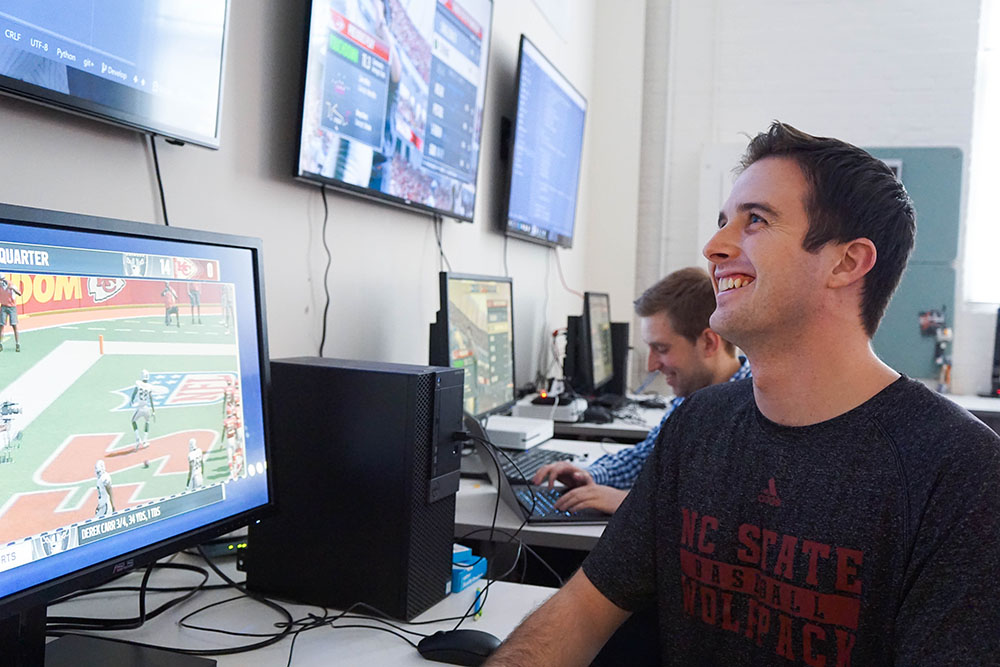
The football experiment needed more football than the researchers could reasonably obtain. Real games supplied a small, expensive record. So Laber Labs built an alternative: four Xboxes, four modified controllers, and Raspberry Pi computers pressing the buttons. Madden 17 kept playing. The researchers kept collecting data. A familiar living-room pastime had become a machine for asking what a coach should do next.
- Laber Labs develops statistical methods for decisions that unfold over time.
- Organizations can commission consulting or longer research partnerships.
- Its games, robots and teaching projects make those methods tangible.
First, build somewhere to experiment.
In his November 2017 account, researcher Nick Kapur described the bottleneck: labeling football data required expert labor, and a season offered too few observations. The team used optical character recognition to read the game state, fed that information into reinforcement-learning algorithms, then sent the chosen play back through the controllers. Four games could run continuously, collecting observations 24 hours a day.
The lab reported that its algorithms outperformed Madden’s built-in play-calling strategy. That benchmark mattered: it supplied something concrete to beat. The result established an improvement inside the simulated environment. Kapur framed the next possibility cautiously: combining simulation with real data might help evaluate football decisions. The experiment’s lesson is the machinery of comparison, with its limits still attached.
Automated Madden games turned scarce observations into a repeatable research environment.
A car for the carpet.
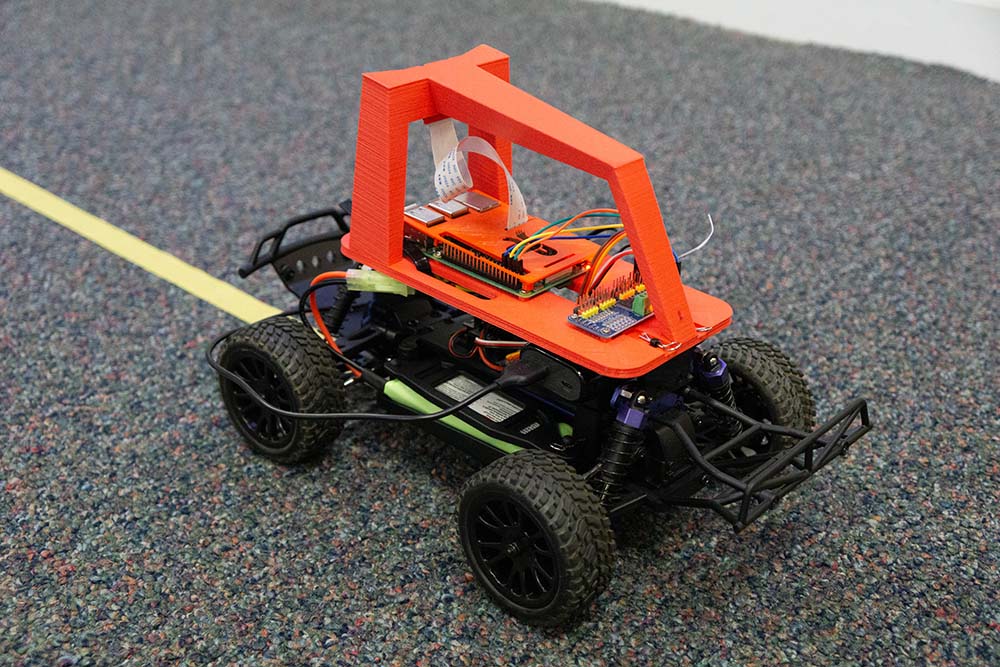
The same appetite for an observable, adjustable world appears in the Donkey Darlings project. Its self-driving research uses a small autonomous car, with reinforcement learning, forecasting and computer vision in the mix. The team’s stated ambition includes algorithms that can operate on limited hardware and adapt across environments. Accessibility is an engineering constraint here.
Look at the exposed electronics and the modest wheels. This is a useful place to see the lab’s personality: serious questions, approachable apparatus, very little concern for looking solemn. The project roster spans high school, undergraduate and graduate students. There is room to learn how the system works because the system is right there on the floor.
The decision after the prediction.
Laber Labs is led by Eric B. Laber, a Duke statistician whose interests include reinforcement learning, causal inference and optimization. Those fields meet at an awkward point in many organizations: a forecast arrives, but somebody still has to choose an action. That choice changes the situation, generates new information, and shapes the choices available later.
Laber’s route to those questions included a 12-year career as a professional magician. Duke’s account describes an undergraduate mathematician expecting to pursue differential geometry, until a friend suggested statistics. A research project with UCLA’s Mark Hansen helped open that door. The choice makes sense alongside the lab’s later work: an appetite for mathematics, coupled with a desire to use it on problems outside his own head.
A useful way to read the lab’s portfolio is as a collection of versions of that problem. A game supplies a next move. A treatment strategy supplies a next intervention. An infectious-disease model supplies choices about where limited resources should go. The methods differ across settings; the need to reason about consequences over time persists.
Each action changes the next decision. ↺
Two patients, separated by time.
The clinical-trial version is particularly revealing. In a 2020 explanation, lab researcher Peter Norwood asked how a trial should balance the welfare of enrolled patients with the information needed to treat future ones. Once evidence begins favoring a treatment, continuing to allocate patients exactly as before becomes a decision worth examining.
Adaptive randomization studies that tension. A choice can offer a better immediate outcome while teaching the researchers less. Another can supply more information at an immediate cost. Norwood describes developing strategies, studying their mathematical properties and repeatedly simulating their behavior so clinicians can understand the tradeoffs. There is no universal score that makes the competing interests disappear.
This also explains the lab’s emphasis on interpretable treatment strategies. A recommendation must be usable by the people making the decision. Duke’s faculty profile lists Laber’s involvement in a next-generation sequential cancer-treatment trial project running from 2023 to 2028, placing that methodological interest in an ongoing clinical research context.
Research has a different checkout.
For an organization, the entry points are consulting and sponsored research. The consulting menu includes predictive modeling, decision support, statistical auditing, large-scale simulation and training. Longer industry relationships typically run for at least a year and can produce papers, software, monographs or grant proposals. The commitment is to working through a research problem. That structure asks prospective partners to define the question carefully: what decision will change, what evidence can be collected, and who will use the resulting method when the research ends?
The lab’s website lists sports partnerships with the Philadelphia Eagles, Los Angeles Dodgers and Carolina Hurricanes. Its broader partner list includes Amazon Scholars, Riot Games and Delta Airlines. For a buyer weighing internal analysts, outside consultants or an academic collaboration, the distinction is practical: does the question require a new method, an investigation, or simply an established tool put to work?
“Pragmatist is maybe the word.”
Eric Laber, speaking to Duke Today in 2020
Let the cat teach.
The public-facing projects offer a smaller commitment: curiosity. Space Mice puts a laser-firing cat into a scrolling game that doubles as a reinforcement-learning environment. Mount Boredoom asks a goat to navigate rotating, pine-cone-firing trees, introducing dynamic programming through route planning. Ataristicians has pursued statistics and computing outreach since 2015; Doran’s Lab approaches statistics through League of Legends questions.
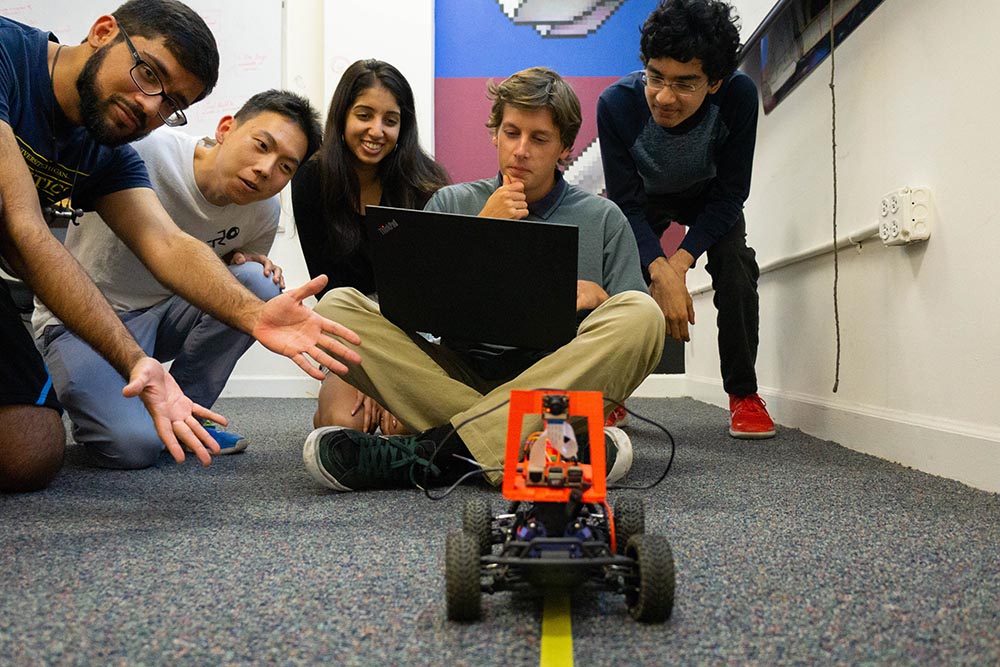
Ataristicians also earned outside recognition: first place in the Arts Venture category at the 2017 Lulu eGames, plus two third-place awards and a video prize. The teaching work has its own audience and its own outputs. It gives the lab a public doorway alongside the specialized research relationships.
There is something worth copying here even without a research budget. Pick a decision people recognize. Make its consequences visible. Establish a baseline. Then ask what would count as improvement. The teaching games turn that process into something a learner can inspect, rather than a conclusion they must accept.
The caution belongs inside the experiment. A simulated world can reward behavior that transfers poorly to reality. Missing observations can distort a treatment model. Objectives can compete. Laber Labs makes an interesting case for treating those complications as the work itself. Start with a question small enough to test, and keep watching what happens after the next move.