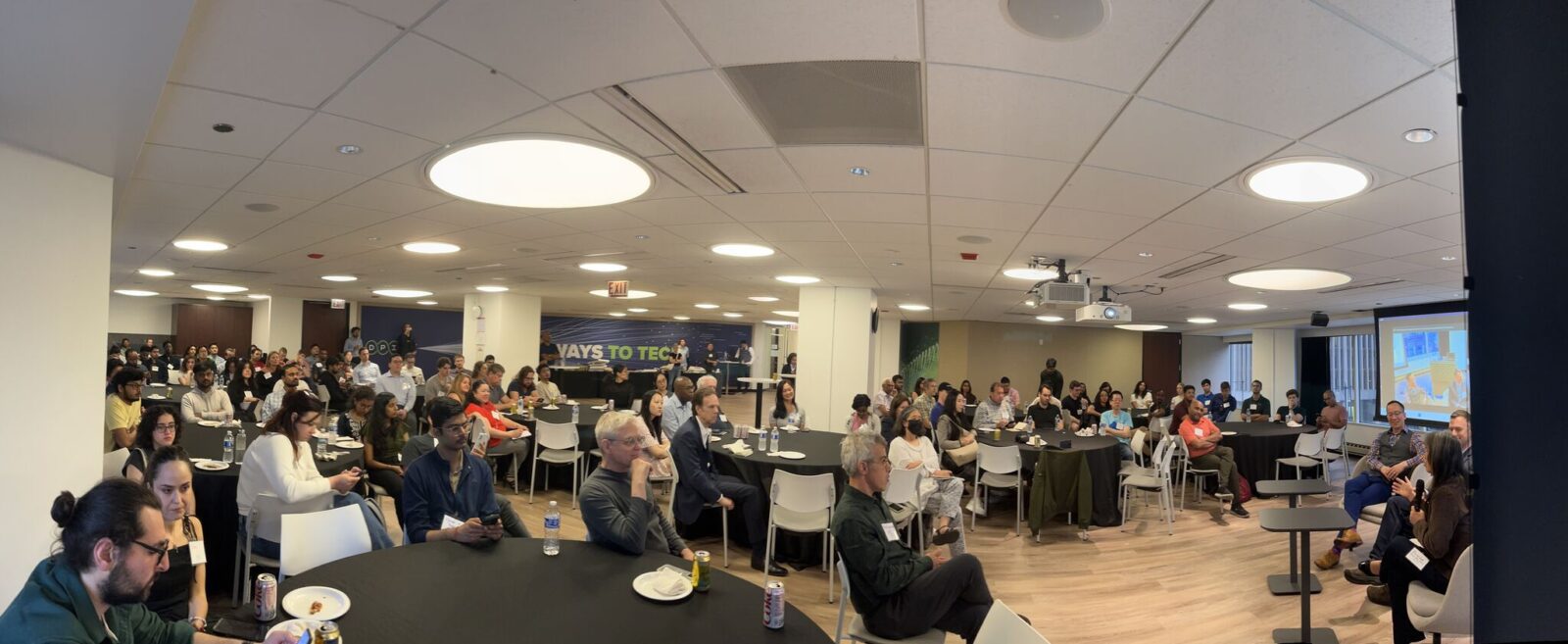
In June 2025, more than 150 people gathered at Chicago’s Discovery Partners Institute for an evening of AI research, introductions, and pizza. Xiaochen Zhang was hosting. His guests came from Nokia Bell Labs and Argonne National Laboratory; the discussion ranged from communications networks to energy use. Amid the technical possibilities, Zhang paused to explain the number in his organization’s name. 2030 expressed urgency, he said, rather than a hard deadline. Even a movement needs to explain its calendar.
It is a useful place to meet the founder and CEO of AI 2030. He brings researchers and a business audience into the same room, with enough explanation for newcomers to join the discussion.
Zhang’s career has passed through climate finance, international development, blockchain, cloud computing, and artificial intelligence. Those subjects can look like a procession of fashionable nouns. Look at the work beneath them, though, and a more consistent interest appears: getting useful ideas across the distance between technical possibility and ordinary adoption. That distance has room for misunderstanding, exclusion, and a considerable number of meetings.
Before the algorithms, the climate talks
Before he was organizing conversations about AI, Zhang was studying how the world fits together. His Erasmus Mundus master’s in Global Studies took him to Leipzig and Wrocław from 2006 to 2008. Reflecting on that education, he credited interdisciplinary methods and critical thinking with helping him work through complex problems alongside other stakeholders. It is an education suited to situations where everyone has expertise and nobody owns the whole answer.
His professional route brought him into climate policy, sustainable energy, and financing work at the World Bank and United Nations. By 2015, he was an associate director at BSR, leading the China strategy for its Business in a Climate-Constrained World initiative. The assignment involved getting companies engaged in climate action with partners in the We Mean Business coalition.
In December that year, he wrote about why the Paris climate talks differed from Copenhagen. The essay considered the conditions for collective action rather than treating a summit as a theatrical last chance. That earlier work gives his present interests some context. Finance, public commitments, and implementation were already part of his vocabulary before responsible AI became his central subject.
The continuity is worth keeping in view. A climate pledge needs institutions capable of acting on it. A technological promise needs people capable of putting it to use. Both invite the awkward question that tends to arrive after the applause: who will do the work?
An organic label gets cross-examined
Zhang dates the start of FinTech4Good to 2016 in his account of its origins. He wanted to apply emerging blockchain technology to international development. The venture-building approach was to identify a problem, bring resources around the people tackling it, and help them turn a possible solution into something that could reach a market.
At SMU’s Hunt Institute in February 2018, he made the idea accessible through a trip to the grocery store. Suppose a product calls itself organic. How does the shopper check? Zhang described a possible QR code linked to a blockchain record showing where food came from and how it travelled. The example moved a technical discussion toward the evidence behind an everyday claim.
A food label has excellent manners: it asks to be believed without starting an argument. Zhang’s example invited the argument. Where did this come from? What happened along the way? Can the buyer inspect the record? Those are useful questions even for someone with no desire to become acquainted with a distributed ledger.
His ambition at the time included finding ventures that could deliver social impact. The grocery illustration captures his habit of translating a large technology into a decision someone might actually face. It also exposes the practical burden of adoption. An impressive system still has to offer people a reason to use it.
THE QUESTIONS TRAVEL
An editorial reading of a career across development, finance, and technology.
The difficult space between a demo and a decision
His work also took him inside a large technology supplier. As Global Head of Innovation and Go-To-Market at Amazon Web Services, Zhang led technical and operational staff serving public-sector customers. His remit included digital assets, central-bank digital currency, green finance, and regulatory and supervisory technologies. These are settings where a working demonstration begins a longer conversation about institutions, responsibilities, and deployment.
The GBBC ambassador network now lists that AWS position as a former role. It is one connection among several in a professional life that moves between companies, investors, international institutions, and people building new ventures. Seen together, the roles suggest a career spent translating between groups whose interests overlap more readily than their language.
By 2023, Zhang had launched AI 2030. He saw AI’s effects on work and society as a reason to organize around responsible adoption early. His stated ambition was to make responsible AI mainstream by 2030. The initiative’s concerns include widening participation and applying AI to social and environmental problems, alongside managing its risks.
That gives the enterprise an unusually broad job description. It needs people who understand the systems, people who decide where those systems belong, and people who will encounter their consequences. Agreeing that AI should be responsible is an agreeable beginning. The next conversation has to make the word useful.
“It’s made me an impact person.”
Xiaochen Zhang, on working across emerging technologies, 2025
The microphone is part of the work
Zhang’s method includes a microphone. He hosts the AI 2030 Show, extending his work into public conversations with practitioners. Broadcasting fits the larger pattern: gather people who know different things, ask them to explain themselves, and give others a way into the discussion.
In an April 2024 conversation with intellectual-property lawyer Nikhil Pradhan, his questions were recognizable to an employer trying to keep up with employees. What happens when staff use different generative AI applications? Where are the gaps in a company’s understanding? How does buying an AI service differ from buying another application? These questions concern the life of an organization after the software arrives.
It is revealing that the conversation reached procurement. Buying software is seldom the glamorous part of a technology story; nobody puts the purchase order on the movie poster. Yet it is one place where promises acquire terms, responsibilities, and consequences. Zhang’s questions follow AI into those less photogenic corners of work.

From the meeting room to the public record
The work extends into formal contributions. Zhang was one of three named leads on AI 2030’s March 2025 response to the U.S. AI Action Plan consultation, alongside Daniela Muhaj and Sean Lee. The submission addressed access to resources, workforce preparation, accountability, and the barriers facing smaller enterprises. It placed participation and implementation in the same discussion as innovation.
He also appears among the founding members of the OWASP AI Vulnerability Scoring System project in its v0.5 publication. That is another setting in which a general desire for safer AI has to become something people can examine and discuss. A shared assessment framework gives a conversation more substance than a collection of assurances.
Learning is another recurring commitment. Zhang is a co-editor of the 2026 book Designing Inclusive Classrooms: Integrating Emerging Technologies. His public biography also describes him as a father of two. Together with his educational work, that personal detail places another generation within the frame of a career often expressed in the language of institutions.
He describes curiosity as a driver of his work, naming continuous learning among his guiding habits. His advice to people starting in responsible AI follows a practical sequence: learn deliberately, apply the knowledge, and find a community. He has also warned about the pressure to race ahead of competitors. The appetite to move quickly and the patience to ask questions have to coexist somewhere.
A date on the invitation, people in the room
By August 2026, AI 2030’s leadership announcement named Zhang as CEO and introduced David Lara as executive director. Lara’s appointment brought experience in government and company building into the organization’s leadership. Zhang emphasized that combination in welcoming him. The choice fits an initiative whose work crosses both settings.
In September, Zhang opened AI 2030’s New York summit during UN General Assembly week. The gathering also introduced the Open Physical Intelligence Coalition, taking the conversation toward AI systems that act in the physical world. His next listed engagement, as of October 27, is the October 28 Convergence Summit in Seattle, with opening remarks and a panel on enterprise AI infrastructure.
The invitations keep changing cities and subjects. The central problem remains recognizable from the grocery label: what makes a technological claim deserving of confidence? Zhang approaches it by putting builders, researchers, businesses, and public institutions into conversation. An invitation is a modest instrument for such a large task. It does, at least, give everyone a place to begin.
KEEP THE CONVERSATION GOING