The revealing detail in AI 2030’s professional pledge is the exit clause. A signatory who violates its principles, without an agreed reconciliation, promises to step back from the industry voluntarily. That is an unusually personal consequence to attach to an abstract phrase like “responsible AI.” It also poses the question running through the organization’s work: how do you get an ethical ambition to change somebody’s behavior?
- AI 2030 connects people who build AI, buy it, research it, and govern it.
- Its tools include leadership courses, fellowships, startup support, and industry gatherings.
- The useful distinction: joining a network, earning a credential, and proving a product works are separate jobs.
Consider the gap between a product demonstration and a purchasing decision. A founder sees a working model. A bank sees questions about data, accountability, and risk. A policymaker sees consequences beyond either organization. All three can agree that AI should be fair. Agreement alone does surprisingly little to move the purchase forward.
First, find the people who say yes
Xiaochen Zhang launched the AI 2030 initiative in 2023. Its early programming had a distinctly financial accent: FinTech4Good listed August roundtables on enterprise adoption, banking, and fair development in finance. These are settings where a useful technology still has to answer to institutions with obligations, budgets, and people whose job is to ask awkward questions.

That background helps explain the organization’s shape. AI 2030 operates as a nonprofit initiative and think tank, combining education, research, professional connections, and startup support. Its mission is to mainstream responsible AI by 2030. The six principles in its published framework include transparency, fairness, accountability, privacy preservation, sustainability, and security. The interesting work begins when those words meet an actual decision.
The organization’s own July 2024 commentary identified a snag: responsible-AI frameworks could be broad and short on specifics. For regulated businesses, that leaves a difficult translation job. Someone must turn a principle into a procurement question, a design choice, or a rule that colleagues can follow. Read that way, AI 2030 is addressing a coordination problem as much as a knowledge problem.
The classroom leads to the purchasing desk
Its Certified Responsible AI Leader curriculum shows the intended translation. The published 2025 course moves through enterprise strategy, risk management, operational implementation, and leadership discussion, ending with a capstone. Procurement appears alongside design and deployment. That is a telling choice: the executive approving a system may influence its consequences without writing a line of code.
For an organization sending a leader, the attraction is a shared vocabulary for decisions across departments. For the individual, it is structured practice and contact with experienced practitioners. Training still has to travel back into the workplace. A capstone becomes useful when somebody can apply it to a real project, secure cooperation, and change how a decision gets made.
A conference with work to do
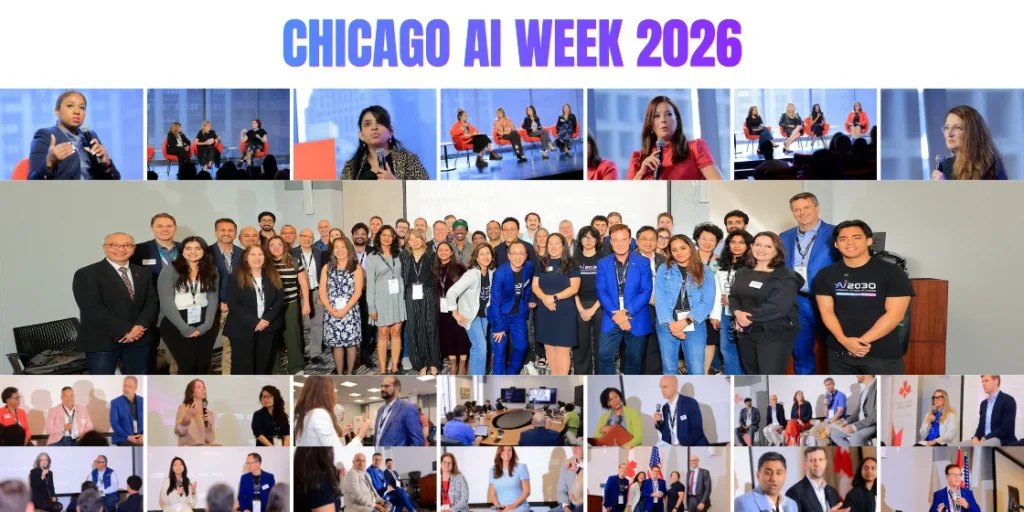
AI 2030 also assembles the people who might otherwise encounter one another through a contract dispute or a regulatory question. Its Global Fellow Program reports selecting more than 50 fellows from 10 countries in 2024, spanning policy, research, entrepreneurship, and corporate leadership. The fellowship is a route into collaborative work and professional exposure, with selection distinct from ordinary affiliation.
The banking connection remains concrete. In June 2025, Banking Exchange announced that Zhang would lead a panel during its national conference, with more than 50 banks expected to be represented. That number describes the conference audience, not AI 2030’s customers. It does, however, show why the room matters: people responsible for adoption can compare questions with people building the technology.
Help the founder survive the next meeting
The startup programs extend that logic. The 2025 Catalyst Portfolio offer asked applicants to have a prototype or minimum viable product, and preferred evidence of customers or active users. It advertised mentorship, validation, market support, and $25,000 in AWS credits. Credits pay for eligible infrastructure; they are not a cash investment or proof that a buyer will sign.
The advertised 2026-2027 accelerator cycle focuses on finance, legal technology, and healthcare. It offers buyer introductions, fundraising support, and responsible-AI readiness work, with technology benefits subject to provider terms. Its positioning is understandable: in regulated markets, a clever demonstration has to be accompanied by evidence that other people can inspect.
A founder can copy the sequence: establish a working product, learn what a buyer must verify, then prepare that evidence before seeking a wider audience. The approach depends on access to suitable buyers and enough time to act on their feedback. Introductions will do little for a team whose product cannot yet answer the customer’s basic problem.
Even belonging needs a definition
AI 2030’s revised membership structure targets an October 2026 launch. Annual individual dues are $25 for students, $45 for emerging leaders, and $95 for professionals. Core benefits are shared; events and training may cost extra. The redesign also separates community participation, membership, fellowship, and the free pledge. An affiliation badge does not certify expertise.
In August 2026, AI 2030 appointed David Lara executive director, identifying Zhang as CEO. Lara’s background includes founding AI companies and senior government roles in New York. Giving someone with that combination responsibility for strategy and operations fits the organization’s central task: helping technical ambition work inside institutions.
“Data is the lifeblood of AI”
Xiaochen Zhang · Data Challenge announcement, January 2025
The wider agenda includes a G20 regulation index announced at Davos and a Data Challenge addressing inclusion, explainability, traceability, sustainability, and skills. These projects make the same wager at different scales. People need ways to compare practices, find collaborators, and test an idea against somebody else’s constraints. For a reader considering AI 2030, the practical starting point is specific: arrive with a decision you need to make, then choose the program or conversation that can help you make it.
AI 2030 website ↗ Membership ↗ Accelerator ↗ News & ideas ↗ LinkedIn ↗ X ↗ Instagram / FinTech4Good ↗ Facebook / FinTech4Good ↗ Watch: AI 2030 Show interviews ↗ YouTube channel ↗