Consider the departure board at an airport. Every destination is a small logistical promise: an aircraft, a crew, a route, a time. Somewhere beneath those promises sits a less glamorous requirement. The right fuel must reach the right place. Somebody has to find it, arrange delivery, extend credit and sort out the paperwork. World Kinect built a business inside that somebody.
- It buys and distributes fuel, then handles the complications around it.
- Its customers move aircraft, ships and trucks, or run other fuel-dependent operations.
- After a costly reset, it returned to the World Fuel commercial brand in April 2026.
The name deserves a moment. In June 2023, World Fuel Services became World Kinect, an identity meant to reflect a broader energy company. Less than three years later, the company brought World Fuel back for substantially all internal and external purposes. World Kinect survived as the legal name. WKC survived as the stock ticker. The ambition had become more specific.
The business between the refinery and the runway
Think of World Fuel as a coordinator with a balance sheet. A customer needs fuel; a producer or supplier has it. Between them lie delivery schedules, local infrastructure, price movements and payment terms. World Fuel sources and distributes the product, drawing on an integrated supply and logistics network across more than 200 countries and territories. Its expertise lives in those connections.
The customers explain the breadth. Commercial airlines need dependable supply. Business aviation departments need fuel and help arranging international flights. Shipping operators need bunkers, the industry’s term for marine fuel. Fleets and retailers buy gasoline and diesel. Government and defense operations have their own requirements. In the United States, the company also markets natural gas and related solutions.
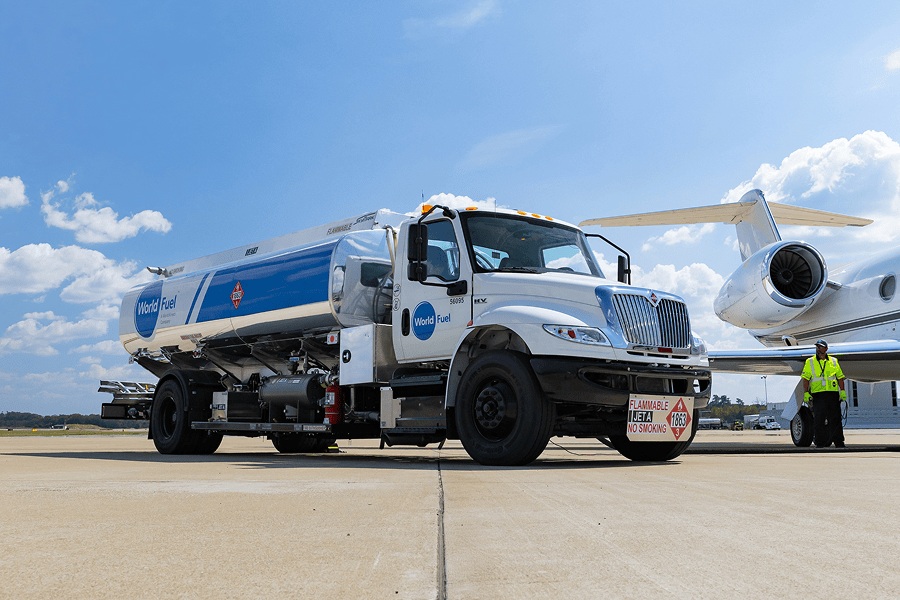
This is a distribution and services business, with revenue generated largely by fuel sales. Most fuel revenue is recorded at the full selling price because the company controls the product before delivery. That makes sales a noisy guide to economic value: expensive fuel can enlarge revenue without a corresponding improvement in the underlying operation. Gross profit and cash requirements deserve attention alongside gallons.
A buyer could instead deal directly with suppliers or assemble regional distributors and specialist service providers. World Fuel’s proposition is to reduce that coordination burden. Its digital tools extend the same idea: myWorld Marine puts purchasing activity and reporting together; other portals handle orders, invoices and energy data. The software supports a physical transaction. The aircraft still needs its tanker.
The bill for getting smaller
There are two histories underneath this business. International Recovery, the corporate predecessor incorporated in 1984, began in used-oil recycling. Marine brokerage Trans-Tec, co-founded by Michael Kasbar and Paul Stebbins, joined through acquisition in 1995. The combination became World Fuel Services. Acquisitions subsequently added capabilities around the fuel sale, from aviation distribution to flight support.
Expansion also brought a question: which activities deserved to stay? By the fourth quarter of 2025, the company was exiting additional businesses, principally within Land, that it said missed return thresholds or did not fit its strategy. The public explanation points to disappointing economics and strategic fit. It does not establish which problem appeared first inside the company.
Different categories. An impairment reduces recorded asset value; it is not a new cash payment of the same amount.
At the same time, World Kinect bought more aviation capability. The announced price for Universal Weather and Aviation’s Trip Support Services division was approximately $220 million: $160 million cash at closing, with $60 million payable over four years. Completed in November 2025, the deal added expertise in flight planning, overflight permits and ground support. Those are recognizable neighbors to an existing fuel relationship.
“This is a return to our roots and what we do best”
Ira M. Birns, CEO · April 2026
Ira Birns became CEO on January 1, 2026. In April, explaining the brand reversal, he emphasized the name customers and suppliers already knew. Read alongside the exits and aviation acquisition, the choice suggests a narrower organizing principle: keep activities close to the transportation customer’s actual job. That is an interpretation of the decisions, rather than evidence of an unreported boardroom conversion.
A familiar network, a different fuel
A tighter focus still leaves room for lower-carbon products. In February 2026, Neste and World Fuel announced a five-year agreement to expand Neste-supplied sustainable aviation fuel availability at more than 100 UK and European airports. Neste brings production and supply capability. World Fuel brings established distribution and airport infrastructure. The arrangement also supports customers facing European and UK SAF requirements.
That distinction matters to anyone trying to understand the company’s place in the energy transition. Here, its contribution is connecting a fuel producer to aircraft operators through a working network. A new fuel needs a practical route to the aircraft, with delivery and documentation alongside the purchase. Existing relationships can help turn a different product into an ordinary operational choice.
A recovery with a tailwind
The second quarter of 2026 offered encouraging evidence: $365 million in gross profit and $48 million in GAAP net income. Aviation supplied $208 million of gross profit, marine $80 million and Land $77 million. Management credited a streamlined portfolio, the acquired trip-support business and favorable conditions. In aviation and marine, elevated fuel-price volatility helped profitability. The market deserves part of the credit.
The useful lesson is a test for adjacent businesses: does this service make the customer’s existing operation easier, and does it justify the capital committed? The limit is equally practical. Coordination cannot guarantee supplier performance, customer payment or uninterrupted local delivery. Nor should a volatile quarter become a permanent earnings assumption. World Kinect’s reset is interesting because its promise is becoming easier to judge: can World Fuel make the next journey work?