Somewhere between a trader agreeing to buy a cargo and an accountant closing the books, the barrel develops a complicated social life. It acquires freight, taxes, storage fees, credit exposure, a hedge, an invoice and perhaps a change of destination. One desk calls it inventory. Another calls it risk. A third has it in a spreadsheet whose author is on holiday.
Inatech makes the system intended to end that argument. The London company builds cloud software for physical energy trading and marine-fuel management. Its job is to make the front office, risk desk, operations team and finance department look at the same trade - and see the same profit or loss - while something can still be done about it.
That sounds like ordinary enterprise software until the physical world arrives. Oil moves by vessel, pipeline, barge, rail and truck. Ships need the right grade of fuel at the right port, from a supplier with acceptable credit, without wrecking the voyage plan. Regulations add sulphur limits and carbon instruments. Prices move while the paperwork catches up. Inatech occupies this narrow, expensive seam between financial trading and actual molecules.
A trading house taught it the awkward bits
Founded in 2002, Inatech did not approach energy as a generic software market. It grew with access to the operating knowledge of Glencore, one of the world's largest commodity traders, and eventually sat within Glencore's oil division. That heritage matters less as a pedigree than as a product specification. Physical traders do not merely capture a price and quantity. They need provisional pricing, quality adjustments, transport schedules, inventory costing, letters of credit, derivatives and final settlement to remain attached to the same economic event.
Techoil is Inatech's answer for crude, refined products, biofuels and environmental credits. It combines energy trading and risk management - ETRM in the industry's alphabet soup - with enterprise-resource-planning functions. Trades pass from deal capture through exposure, logistics and invoicing. The platform can calculate live P&L, manage FIFO or moving-average inventory, reconcile bills of lading and connect to an existing ERP when a customer prefers to keep one.
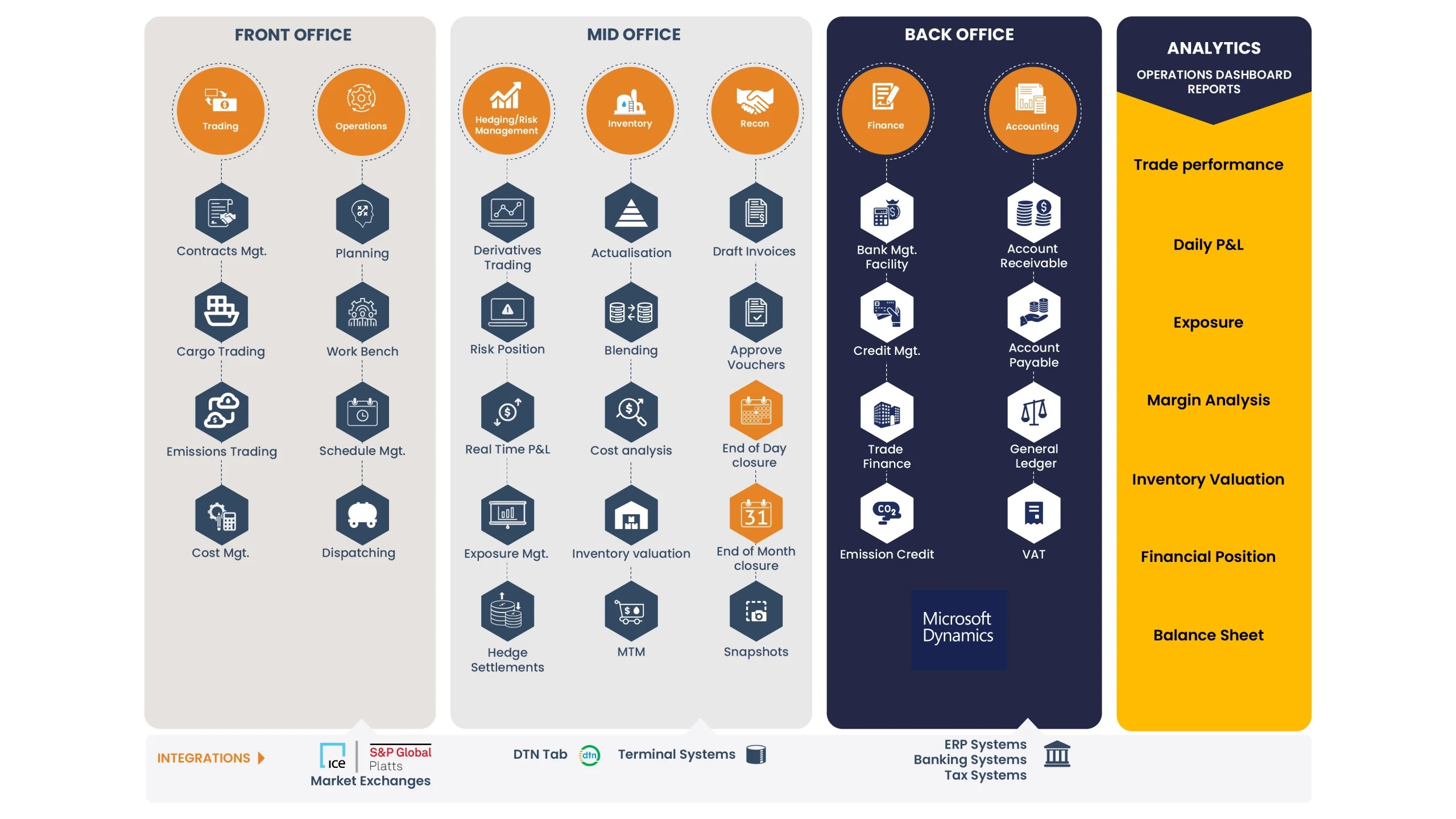
Shiptech looks at the same energy market from a vessel operator's chair. It manages schedules, requests for quotation, negotiations, contracts, bunker delivery notes, laboratory results, invoices and claims. Smart Trader, its pre-deal module, combines fleet position and onboard inventory with supplier records and market information across more than 350 ports. The lowest quote is not automatically the best buy; calorific value, fuel compatibility, credit and a detour can all change the arithmetic.
Bunkertech serves the other side of that transaction: physical bunker suppliers and back-to-back traders. Its particular obsessions are credit lines, cash flow, negative or virtual inventory, taxation and a real-time view of which trades have priced. Techoil Dispatch extends the family onto the road, handling driver hours, freight billing, inventory and hazardous-material workflows for fuel distributors.
What fails first is rarely the trade
Inatech's case studies reveal a recurring failure pattern. A global lubricants blender could not get an accurate daily inventory position, calculate all overhead and freight on a transaction, or see exact P&L through a trade's life. A bunker trader operating in more than 100 countries stored data in different systems and locations; reporting became slow, credit exposure uncertain and account reconciliation painful. The first crack was information latency. The business had moved faster than the handoffs between its systems.
The repair was not a clever prediction model. In both cases Inatech joined trading, operations and corporate accounts in one cloud-hosted system, paired with Microsoft Navision ERP, and trained users to leave spreadsheet-led workflows. The copyable lesson is prosaic: establish one transaction record, make each department enrich it, and automate the handoffs before buying exotic analytics. A value-at-risk number is not much use if yesterday's delivery is missing.
“We needed a solution that could be configured to our way of working and Techoil provided that to us.”Clint Werth, Atlas Oil
Atlas Oil supplies more than a billion gallons annually and makes over 100,000 deliveries from more than 1,000 US terminals. Its scale changed the software decision. After reviewing the market, Atlas picked Techoil for configurability, breadth, service and total cost of ownership. Inatech implemented it in under three months during pandemic travel disruption. Emad Energy went live remotely in under four weeks. Arte Bunkering used Bunkertech to unite offices from Tallinn and Hamburg to Greece, Singapore and the United States.
These are the conditions behind the speed claims: a cloud product, a bounded implementation, committed teams and a willingness to adopt consistent workflows. A company seeking to preserve every local spreadsheet ritual, heavily customize every screen or reconcile poor master data only after launch should expect a slower trip. Specialist software reduces configuration work; it does not repeal organizational physics.
The old operating picture
- Trades copied between desks
- Inventory appears after reconciliation
- Credit checked in a separate system
- P&L arrives after costs catch up
Inatech's wager
- One trade record from deal to invoice
- Positions and P&L update in real time
- Credit, risk and logistics share context
- Exceptions surface before close
Carnival outgrew yesterday's fuel desk
The clearest recent test is Carnival Corporation. Its fuel buyers support eight cruise lines and more than 90 ships. The company said that operational scale and complexity had begun to outpace a legacy bunker-procurement application. It selected Shiptech to standardize enterprise data, provide fleetwide information and put the bunker-procurement lifecycle on one cloud platform. Full deployment was announced in April 2026.
This is what changed the buyer's mind: not a failed fuel order, but a capable old system becoming too small for the organization wrapped around it. In enterprise software, obsolescence often arrives as a queue. More ships, more users, more fuels and more exceptions wait for a workflow designed for a simpler fleet.
The product roadmap follows that multiplying complexity. Shiptech supports conventional marine fuels as well as methanol, LNG, hydrogen and ammonia. Techoil can manage US renewable-fuel credits, European emissions instruments and UK renewable transport certificates. A 2022 partnership with cQuant.io added scenario analysis, hedge-effectiveness tools, stress testing and value-at-risk models. S&P Global Platts data supplies pricing and market context to Smart Trader.
The positioning is deliberate. Broad commodity platforms offer multi-asset reach; general ERPs excel at corporate accounting; maritime systems often begin with the vessel. Inatech begins with physical energy and stretches from front office to back. Its alternative is often not one rival product but an architecture: a legacy ETRM connected to an ERP, surrounded by spreadsheets and email. Inatech's sales argument is that one specialist cloud workflow costs less to own and changes faster. Prices are negotiated rather than published, so prospective buyers must test that claim against integration scope, migration effort and support terms.
The owner changed; the niche did not
Valsoft acquired 100 percent of Inatech from Glencore in June 2022 for an undisclosed sum. The Montreal company buys and holds vertical-market software businesses, and Inatech became its platform acquisition for a new energy vertical. The deal moved Inatech from a commodity producer's orbit to a permanent-software portfolio while preserving the industry's accumulated know-how.
Leadership has since turned over. Jean-Hervé Jenn, identified by Inatech as founder and chief executive and CEO from 2012, led the cloud-product expansion. Fred Bendle followed. In August 2025, Floris Bos became CEO with a brief to push international growth, product development and client success.
Inatech says its systems are used by 450 people across 15 locations, touch 44 million metric tonnes of oil and support 3,100 ships. Those figures describe a mid-sized software company sitting under very large physical operations. Its roughly 280 employees are not trying to digitize “energy” in the abstract. They are trying to make sure a delivery note, a hedge and an invoice still recognize one another after the ship has sailed.
That specificity is the useful part. A customer can copy Inatech's sequence without buying its product: map the trade from commitment to cash; identify where data is re-keyed; choose a master record; standardize exception handling; then add analytics. It works where processes repeat and management is prepared to trade local improvisation for shared visibility. It works poorly when the business is genuinely one-off, data ownership is unresolved, or the implementation becomes an excuse to automate every historical quirk.
The company belongs to an unfashionable but consequential class of software: systems people notice mainly when the numbers disagree. In a market adding new fuels, carbon credits and regulation without removing crude oil, disagreement is getting easier. Inatech's bet is that the winning screen is the one everyone trusts before the close of business.