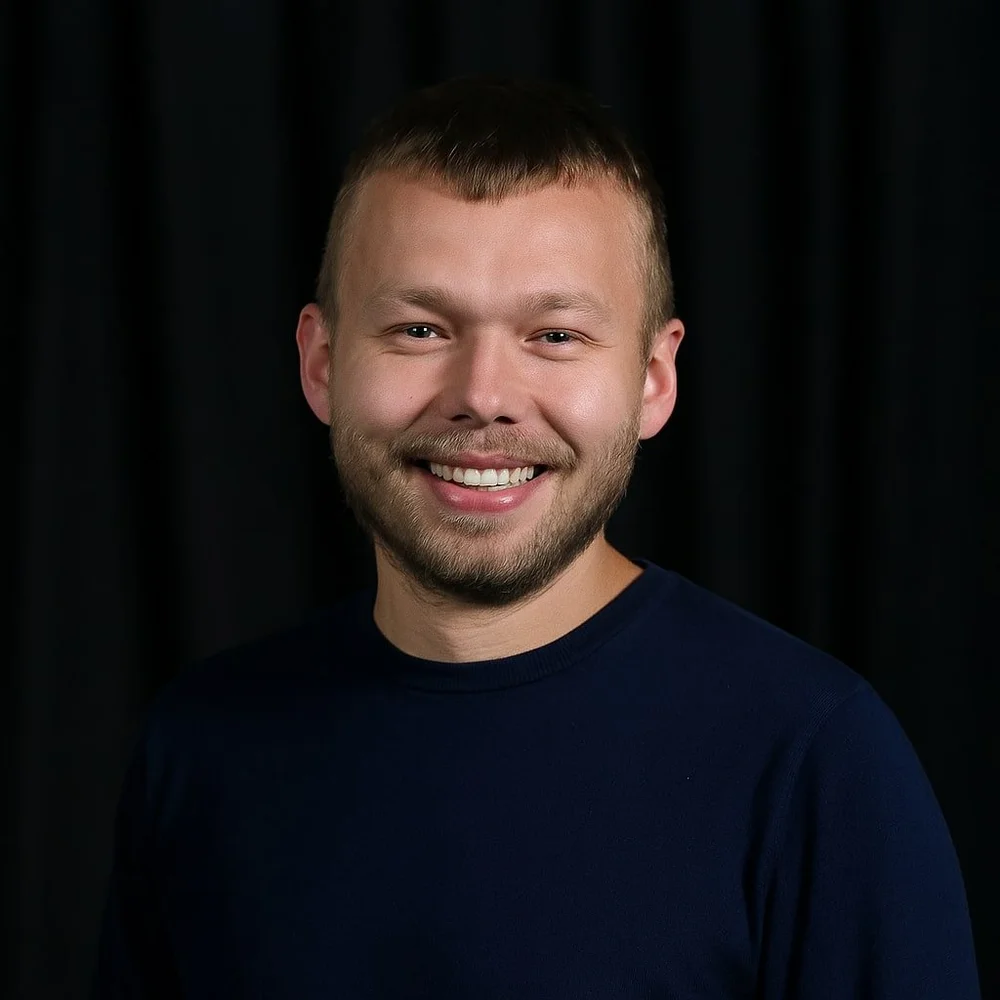
The Man Who Built the Mind, Then the Guardrails
In 2007, an 18-year-old from Kluczbork - a Polish city most people outside Poland have never heard of - flew to Hanoi, Vietnam, to compete against the best teenage mathematicians on Earth. He came back with a silver medal. It was the International Mathematical Olympiad, and Wojciech Zaremba had just announced himself to exactly nobody outside of competitive math circles. Which, in retrospect, is very on brand.
Seventeen years later, the models his team built are running on 300 million devices. The GitHub Copilot in your IDE - that's Codex, which his team shipped. The reason ChatGPT doesn't output instructions for making nerve agents when you ask nicely - that's RLHF, and his team built the human feedback pipeline that made it work. The robot hand that solved a Rubik's Cube in 2019, before anyone thought physical manipulation at that level of dexterity was remotely possible - that was his robotics team. Zaremba doesn't seek the spotlight. The spotlight finds his work eventually, usually about three years after he's moved on to something else.
"Artificial intelligence has the potential to change practically every aspect of our lives, similar to electricity. Before its invention, it was hard to imagine its applications."
- Wojciech Zaremba, OpenAI Co-FounderHe is, by most accounts, the quietest of OpenAI's original co-founders - and the one with the most uninterrupted tenure. Sam Altman runs the company. Elon Musk sued it. Ilya Sutskever left. Greg Brockman took a sabbatical. Zaremba kept shipping. He is the constant in an organization that has experienced more drama per square foot than a Broadway season.
From Kluczbork to Two Countries at Once
Kluczbork sits in the Opole Voivodeship of southern Poland. Population: roughly 25,000. It is not a city that appears on lists of tech industry origin stories. And yet it produced a kid who by the time he was 22 was simultaneously studying at the University of Warsaw and Ecole Polytechnique in Paris - two master's degrees, two countries, two curricula, running in parallel.
That dual enrollment wasn't a gap year or a flex for a resume. It reflects something about how Zaremba approaches difficulty. He describes personal growth almost as a reinforcement learning problem: "You start with something you have a decent chance at succeeding in, and then you try something twice as hard, and then you double it and double it." The math olympiad was a node in that sequence. The dual master's was the next doubling. The NYU PhD - under Yann LeCun, one of three Turing Award winners for deep learning - was the doubling after that.
Yann LeCun later became Meta's VP and Chief AI Scientist, and is widely regarded as one of the founding fathers of deep learning. Getting him as a PhD supervisor in 2013 was the equivalent of getting Feynman to supervise your physics thesis in 1965.
At NYU he didn't just take classes. He split his PhD between research internships at Google Brain and Facebook AI Research, co-authoring papers that would shape fields that didn't fully exist yet. His work on adversarial examples - inputs crafted to fool neural networks into misclassifying them - helped launch an entire subdiscipline of AI security. His dropout regularization research for recurrent neural networks is cited thousands of times. He finished the PhD in 2016, which was also the year he was already a co-founder of OpenAI.
The Founding
OpenAI was announced in December 2015, funded by $1 billion in commitments from Sam Altman, Elon Musk, Peter Thiel, Reid Hoffman, Jessica Livingston, and others. The founding researchers included Ilya Sutskever, Greg Brockman, Andrej Karpathy, John Schulman - and Wojciech Zaremba. Eleven names in total. The mission, stated in the announcement: "advance digital intelligence in the way that is most likely to benefit humanity as a whole."
Zaremba's first major domain at OpenAI was robotics. From 2016 to 2020 he ran the team, working on a project that seemed almost stubbornly ambitious: training a robotic hand to manipulate physical objects using reinforcement learning, trained entirely in simulation, with the skills then transferred to real hardware. The technique they developed - Automatic Domain Randomization, where the simulation parameters are varied so wildly that the real world just looks like one more version of the sim - was the key insight.
"You start with something you have a decent chance at succeeding in, and then you try something twice as hard, and then you double it and double it. You must also learn to be at peace with the fact that the challenge is part of the journey."
- Wojciech ZarembaIn October 2019, the Dactyl robotic hand solved a Rubik's Cube, one-handed, from scratch, using learned dexterity. It wasn't smooth. The hand dropped the cube 20 out of 60 attempts. But it solved it. Every major news outlet ran the story. Zaremba's team had demonstrated something that roboticists had theorized about for decades: that policy learned in simulation could transfer to physical manipulation of real objects in the messy real world.
The Pivot: Machines That Write Code
When OpenAI dissolved the robotics team in 2020, Zaremba moved to lead the language and code generation work. The timing was fortuitous or strategic or both - GPT-3 had just shipped, and it was immediately obvious that fine-tuning it on code could produce something extraordinary.
In 2021, OpenAI released Codex. The model had been trained on 54 million public GitHub repositories. It could write Python from an English description, complete functions, translate between programming languages, and explain its own outputs. GitHub Copilot, launched in partnership with Microsoft and GitHub, put Codex in the hands of developers worldwide. By 2023 it had tens of millions of active users. By 2024 it was embedded in every major IDE. The shift from "AI can write boilerplate" to "AI pair programming is real" happened largely because Zaremba's team built the model underneath it.
The same simulation-to-reality transfer thinking that drove Dactyl applied to Codex: train on a massive, messy dataset (GitHub code, in all its inconsistency and variety), and let the model learn to generalize. The philosophical through-line between the robot hand and the coding model is not accidental.
Making ChatGPT Behave
GPT-3 was impressive and untamed. You could get it to write hate speech, make up citations, or produce harmful content with varying degrees of ease. The transition from GPT-3 to ChatGPT - the version that 100 million people signed up for in the first two months - required a fundamental change in how the model was shaped. That change was Reinforcement Learning from Human Feedback (RLHF).
Zaremba ran the Human Data team - the operation that managed the contractors who rated outputs, the researchers who designed the feedback methodology, and the infrastructure that fed those ratings back into the training loop. RLHF is the reason ChatGPT tries to be helpful rather than dangerous, stays on topic rather than meandering, and refuses to assist with certain requests rather than complying with everything. It is arguably the single most important technique in modern AI alignment. Zaremba built the machinery that made it work at OpenAI's scale.
The Crisis, The Loyalty, and the Philosophy
In November 2023, OpenAI's board fired Sam Altman. Within hours, several hundred OpenAI employees signed an open letter demanding the board resign. Zaremba posted on X: "It's been sad for me to see @sama and @gdb go. I love and respect them much. Despite all of these, the mission of the OpenAI is bigger than any of us and stays the same - build safe AGI to benefit humanity."
Five days later, Altman was reinstated. It was the most chaotic week in OpenAI's history, and Zaremba threaded the needle between loyalty to colleagues and loyalty to mission with precision. When key leaders departed in September 2024, he reached for an unusual metaphor: "Their departures made me think about the hardships parents faced in the Middle Ages when 6 out of 8 children would die." Dark, philosophical, slightly alarming - and entirely in character.
Because Zaremba is, underneath the engineering rigor, a genuine philosopher. On the Lex Fridman podcast he speculated at length about consciousness, the Fermi Paradox, and the nature of intelligence. He practices meditation seriously, describing it as "adjusting the hyperparameters of your own simulation" - treating inner exploration with the same systematic curiosity he brings to training neural networks. He believes intelligence and consciousness may be "intertwined and continuous, not binary properties." These are not idle musings from someone who thinks code is the whole story.
What Comes Next
In a 2025 OpenAI livestream alongside Altman and Chief Scientist Jakub Pachocki, Zaremba laid out a specific roadmap: an AI research intern by September 2026, and a fully autonomous AI researcher by March 2028. The timelines are audacious. They are probably not jokes.
In September 2025, he signed the Global Call for AI Red Lines at the UN General Assembly - a petition by 200+ experts including Nobel laureates, calling for binding international prohibitions against existential AI risks. He co-built the most powerful AI systems in history. He also wants guardrails on them. Both things are true. Both have been true for a decade.
He remains, as of 2026, one of the last original OpenAI co-founders still at the company. Most have departed - to other ventures, to academia, to lawsuits. Zaremba keeps showing up. From the Rubik's Cube to Codex to RLHF to whatever comes next. The Kluczbork kid who nobody outside competitive math circles noticed in 2007 has now helped build the technology that might reshape how humans work, create, and think. He's probably already moved on to the next doubling.