The work of making a film is famously visible. Cameras, actors, trailers and red carpets all make agreeable witnesses. The work of paying for a film is more discreet. It lives in timecards, purchase orders, expense approvals, payroll calculations and the urgent little question that visits every production sooner or later: do we have the money? William Hays has chosen this backstage machinery as his present subject. As chief marketing officer of GreenSlate, he has the curious assignment of making production finance comprehensible without pretending it is show business. The trick is to find the drama already inside it. A crew member needs to be paid. A producer needs to see the numbers. A finance team needs to keep moving when the set cannot. These are modest sentences with expensive consequences.
Hays came to this world by way of pictures. He studied computer graphics at Pratt Institute from 1993 to 1997, then built a career across creative direction, design and brand strategy. His public résumé includes Prism Marketing and Communications and, more consequentially, AllianceBernstein. There he served in senior brand and design work before becoming known publicly as the firm's global brand director. The progression is tidy only in hindsight. A computer-graphics graduate ending up in entertainment payroll sounds like a wrong turn until one notices that both fields are exercises in hierarchy. What must be seen first? What can disappear? Where does confusion enter?
Nineteen letters walk into a brand meeting
At AllianceBernstein, the confusion had a name. It was AllianceBernstein. The asset manager had changed since the financial crisis, broadening beyond its old reputation, but customers still carried an earlier picture of the company. The long name also traveled poorly. Different logos appeared in different markets, and the identity became cumbersome in parts of Europe and Asia. Hays and his collaborators found the useful answer hiding in plain sight: AB.
The shorter name was merely the visible edge of a much larger piece of work. Beginning in 2013, the team reviewed client research and brand-awareness studies, interviewed employees and executives, examined competitors and audited the company's communications. Hays described the exercise as holding up a mirror. That phrase is revealing. A weak rebrand applies makeup. A serious one must first survive fluorescent lighting.
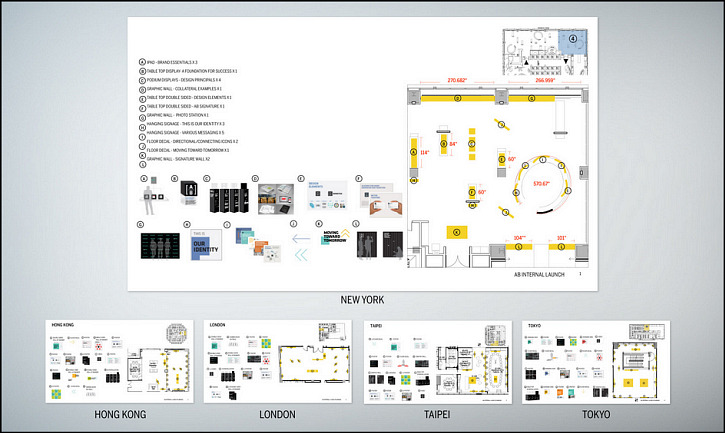
The internal rollout was unusually physical. Before customers met the new AB, employees in major offices walked through immersive gallery experiences. Plans called for video, messaging, floor graphics, three-dimensional displays and explanations of the new identity. Workshops helped leaders connect the brand promise, “Ahead of Tomorrow,” with their ordinary work. Committees carried the identity across businesses and geographies. Business cards and giveaways mattered because, in Hays's view, small touchpoints could give employees evidence that the change was real.
The public launch followed with a new mobile-ready website and a coordinated B2B campaign spanning print, digital display, email, public relations, events and advertising. The reported numbers moved. Average digital ad clickthrough rose from about 0.08 percent to about 0.13 percent. Engagement, previously around 3 to 4 percent, averaged roughly 20 percent after the relaunch, with some publications reaching 50 percent. A contemporaneous case study also noted a 5.5 percent rise in AB's stock price after launch, though a brand campaign cannot by itself claim credit for a public company's market movement.
Hays was proud of a quieter measure. When employees were asked what they loved about working at AB, some spontaneously mentioned the brand and its focus. It was not a brand question. That made the answer more valuable. Advertising can purchase an encounter; unprompted pride must be earned.
“People want to be proud of the firm that they work for.”William Hays, during the AB relaunch
From two letters to one login
Hays joined GreenSlate as chief marketing officer in May 2016. The industry changed, but the communication problem rhymed. GreenSlate serves film and television productions with payroll, accounting and related finance tools. Each individual function is easy enough to name. Together they form a thicket: cast and crew onboarding, timecards, accounts payable, purchase orders, expenses, approvals, tax incentives, reports and the permissions deciding who can see what. Competitors and production teams have historically assembled workflows from separate systems. GreenSlate's marketing proposition is that the pieces should live together.
In 2021, the company completed the migration of its desktop production-accounting software to a fully web-based platform connecting payroll and accounting in one application and one database. Hays framed the release around timing without pretending the idea had appeared overnight. Productions needed remote access during the pandemic, but GreenSlate's paperless ambition predated the emergency. “Our platform was built for the way the industry needs to work now,” he said.
The statement does more than announce software. It turns technical architecture into a human promise. One login means fewer borders between tasks. A web application means access without hauling a particular machine or virtualization setup into the conversation. Digital approval histories mean less mystery about where a form went. Connected data means a studio can monitor several productions without assembling the truth by hand. The product language may be enterprise software, but its emotional vocabulary is relief.
The paper chase gets a rewrite
In March 2022, GreenSlate extended the argument with its “One App Is Better” campaign. It appeared on Los Angeles billboards and around the Producers Guild Awards nominees breakfast, an amusingly glamorous neighborhood for a message about eliminating storage and mailed paperwork. Hays connected digital efficiency to environmental economy: less equipment, less physical storage, less mailing and less paper. The footprint of the back office could shrink while the production continued to grow.
He also emphasized continuity. If a production had to shut down because of an emergency, its finance team could pick up laptops and continue. The crew could still be paid. That is the precise point where a software feature becomes a duty of care. “Remote capability” sounds like a specification. Payroll arriving on time sounds like civilization.
A crew does not experience “integrated workflow” as architecture. It experiences the result when the money arrives.
There is an elegant recurrence here. At AB, Hays tried to replace a collection of names and identities with one coherent global brand. At GreenSlate, the pitch replaces a collection of disconnected tools with one connected operational environment. In both cases, simplification works only if the complicated substance behind it has already been joined. Two letters cannot fix a fractured culture. One login cannot fix disconnected data. The slogan is the receipt, not the purchase.
The setting also changed the audience Hays needed to persuade. Asset management sells an abstract promise in a heavily regulated room. Production finance sells an operational promise to people living by call sheets and deadlines. Yet neither audience is impressed for long by ornament. Both want evidence that the company understands the stakes. Hays's language at GreenSlate keeps returning to the concrete: a laptop that can travel, a workflow that does not require a bundle of improvised applications, a payment that does not wait for paper to catch up. It is marketing built from consequences. The message works because it starts where the user feels the snag.
A designer's kind of operator
Former colleagues describe Hays as both a creative director and a change-minded brand strategist. One recommendation from his AB years praises his ability to articulate the value of brand work to senior leadership; another remembers an advocate who built devoted internal and external teams during difficult market conditions. Those observations fit the documented methods. Hays's projects make room for audits, research, workshops and committees before they make room for applause.
That patience may be the most practical inheritance of design school. The novice wants to add. The experienced designer becomes interested in relationships. Hays's career moves from pixels to institutions to workflows, but the central question remains stable: how can many moving parts present themselves as one intelligible thing?
GreenSlate's current management page still lists him as chief marketing officer, a decade after he joined. Its platform has expanded across production accounting, cast and crew payroll, dashboards and incentives management. Hays does not occupy the public stage as a celebrity executive. His footprint is instead visible in a small number of unusually detailed case studies and statements about how organizations change. They reveal someone less interested in novelty than alignment: words matching systems, external claims matching internal culture, and a cleaner interface matching cleaner work.
The entertainment business will always reserve its brightest light for what appears on screen. Fair enough. But the set runs on a second script, written in hours, approvals and payments. William Hays's work is to make that script readable. When he succeeds, nobody mistakes a timecard for cinema. They simply notice that the production keeps moving, the numbers make sense and the crew gets paid. For the back office, that is a very good ending.