How many HDMI ports should a television have? In December 2020, Bill Baxter offered a method that sounded admirably cheap: toss some coins and count the heads. He was joking. As VIZIO’s chief technology officer, he knew the answer involved surveying customers, choosing a price and deciding which connections people would actually use. Still, the joke did useful work. It punctured the idea that the back of a television had been handed down on a stone tablet.
Someone had made those decisions. Behind an object bought for an evening’s entertainment stood a succession of arguments about cost, convenience and engineering. Baxter had spent much of his career inside arguments like these, working on the parts of computing that become conspicuous when they fail and almost invisible when they work.
His companies changed. So did the size of the screens. There were handheld devices at Bsquare, radio recordings at Snaptune, television discovery at BuddyTV and, eventually, the connected living room at VIZIO. Read together, those jobs suggest a recurring interest: the distance between what a machine can do and what a person can conveniently get out of it.
Metal shop meets the debating society
Baxter was born in Oklahoma City in 1963 and spent much of his youth in Casper, Wyoming. His childhood interests included building things and amateur radio. At school, two activities stood out: metal shop and cross-examination debate. “I like to say I had two majors in high school,” he recalled.
Debate helped him secure a scholarship to the University of Wyoming. He considered welding as another possible path. Computers eventually drew him toward a different kind of construction, one in which an argument could become a program. He earned his bachelor’s degree in computer science in 1987 and his master’s in 1988.
It is a pleasingly untidy beginning for a technology executive. The workshop and the debating room offer different tests of an idea. One asks whether it holds together. The other asks whether it survives someone trying to take it apart. Software gives both questions plenty of employment.
The small-device wager
Baxter’s early professional work involved compilers, the software that translates programs into instructions a processor can execute. He worked at Intergraph and Digital Equipment Corporation before co-founding Bsquare with Elizabeth Baxter in 1994. The company became associated with the engineering needed to put operating systems and applications onto devices beyond the conventional desktop.
That kind of business rewards work few customers will ever see. A useful interface depends on layers underneath it: development tools, software adapted to hardware, and all the agreements that let different companies’ products cooperate. The small screen gets the attention. The tools that make it possible seldom make the family photograph.
Bsquare went public in 1999. Its later recruiting account of Baxter’s tenure described a business that had grown from three people to more than 500 employees and annual revenue above $60 million. It also recorded an extensive roster of commercial relationships, including Microsoft, Intel and consumer-electronics manufacturers. Those relationships placed the company between software ambitions and the practical requirements of making devices.
- 1994BsquareTools & embedded devices
- 2006SnaptuneRadio & music discovery
- 2010BuddyTVWhat to watch next
- 2018VIZIO CTOTVs, software & services
Growth did not spare Bsquare a difficult period. On July 24, 2003, Baxter stepped down as chairman and CEO. He nominated Brian Crowley, then vice president of product development, to succeed him. Baxter remained a director and became CTO, concentrating on the Power Handheld reference-design business.
He described the preceding years as challenging and said he had felt an obligation to stay through the effort to adapt the organization and business model. Now he believed a handover was appropriate. In January 2004, he announced his departure from the CTO position and the board as well. The founding chapter had acquired an ending, though the company would continue.
First the song, then the show
By 2006, Baxter was working on Snaptune, a small, self-funded company addressing a familiar irritation: hearing music on the radio and losing track of what it was. Its software recorded broadcasts on a computer and organized individual songs. The radio could keep moving. A listener could return later.
There is something wonderfully specific about that problem. Nobody needs a lecture on digital transformation while trying to remember a tune. They need the name of the record. Snaptune aimed at the interval between hearing something and being able to find it again.
The product also had a technical life beyond the individual listener. It became the basis for distributed broadcast monitoring, collecting information about music being played. A listening convenience and a way of observing radio activity could emerge from the same underlying work. Making the recording was the beginning; making sense of it created other possibilities.
Baxter subsequently served as CTO and vice president of engineering at Cozi, then joined BuddyTV in 2010 as CTO and executive vice president of products. BuddyTV brought the discovery problem into television. Viewers had more channels and more ways to receive programs, along with a growing collection of interfaces through which to hunt for them.
Its mobile work with AT&T’s U-verse service sought to make that search more coherent. A phone or tablet could help viewers find programming and interact with television. The second screen already occupied a place beside the sofa; BuddyTV wanted to give it a useful assignment.
That is a modest ambition when expressed from the viewer’s side: spend less of the evening deciding how to spend the evening. Express it from the engineering side and it becomes a problem involving devices, catalogs, recommendations and services that have to agree with one another.
The living room becomes a system
VIZIO acquired BuddyTV, bringing Baxter into its engineering organization in January 2015. He became CTO of its operating company in January 2018, and later held the same title at VIZIO Holding Corp. His responsibilities had moved closer to the television itself while extending well beyond its frame.
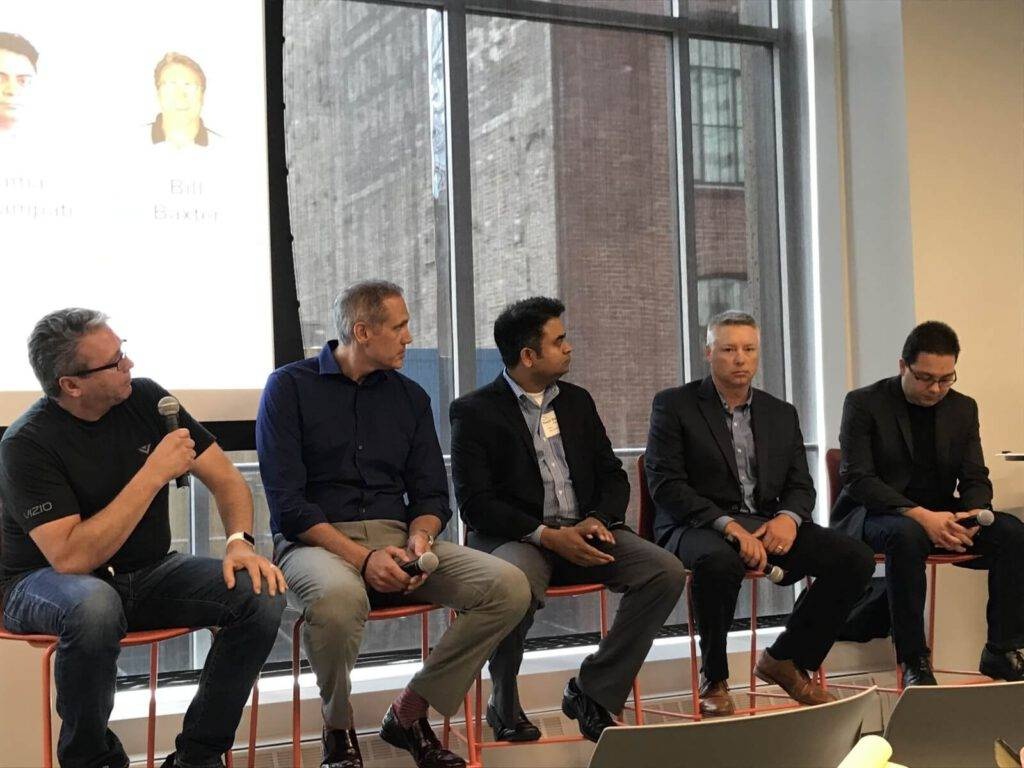
At an AWS connected-home event in San Francisco in July 2018, Baxter appeared alongside executives working in cloud services and connected products. The discussion ranged across platforms and the continuing difficulty of connectivity. Putting a device in a house did not ensure that every system around it would cooperate.
By 2020, his remit included TV and audio development, embedded software, web and mobile applications, and cloud operations supporting more than ten million televisions and smart speakers. The consumer bought an object. The engineering organization maintained a collection of relationships around it.
TVs and smart speakers supported by the cloud operations in Baxter’s stated remit.
He also took part in a panel about developing connected products with distributed teams. The topic suited a job that crossed hardware, applications and services. An engineering leader had to account for the people building each layer as well as the layers themselves. A smooth demonstration contained a great deal of coordination that an audience had no reason to applaud separately.
An AWS account of VIZIO’s connected-device work described the ability to add features and troubleshoot televisions already in customers’ homes. That shifts the meaning of completion. Shipping the hardware becomes one milestone in an ongoing obligation to operate software and support the experience people expected when they bought it.
The second price tag
At CES in 2019, Baxter discussed VIZIO’s economics with Nilay Patel: keeping the initial price competitive while earning revenue through the television’s continuing use. Advertising and entertainment transactions belonged to that picture, as did data. His explanation made a connection shoppers could easily miss between the price on a shelf and the business operating behind a screen.
His technical answers also acknowledged limits. Better backlighting had to fit a budget and a thermal design. Features had to reach the market at prices people would pay. An engineer could imagine a more elaborate television; a product organization still had to decide whether it made sense to build it.
The product work continued into Baxter’s final year at VIZIO. The lineup announced in June 2021 included a voice remote and gaming features, with capabilities differing across models. That variation is the mundane substance of product strategy. A shopper sees a row of televisions. Inside the company, each combination has to justify its components, software and price.
These are useful details to keep beside the coin-toss joke. The sockets, the remote and the menus can all look inevitable once manufactured. Before manufacture, they are choices. Baxter’s public conversations let some of that provisional work show through.
A different use for the calendar
Baxter left all VIZIO positions on December 31, 2021. His farewell thanked colleagues and friends, and explained that he had opted to retire. He gave his next priority a concise name: “Quality Time Remaining.” After years of helping machines use resources, he was talking about his own allocation of time.
“Quality Time Remaining”
Bill Baxter, on his retirement priorities, January 2022
The professional connections continued. The University of Wyoming lists him on its electrical engineering and computer science advisory board, returning the story to the institution where he earned both degrees. Advice offers another way to put experience to work, with a different relationship to the daily demands of an executive title.
Bsquare had its own later chapter. Kontron acquired it in December 2023, almost twenty years after Baxter’s departure. The business now associated with Kontron belongs to a longer corporate history than any one founder’s tenure. Keeping those dates straight makes room for the people who carried it forward.
Baxter’s career leaves a series of ordinary objects worth looking at again: a handheld computer, a radio, a phone beside a sofa, the ports behind a television. Each conceals negotiations between usefulness and complexity. He worked in those negotiations for decades. Eventually, he chose to give the calendar a different job.
Keep the conversation going
Conversations, career records and the companies along the way.
- Bill Baxter on LinkedIn
- Bsquare company website
- University of Wyoming advisory board
- Listen: CES conversation, 2019
- Watch: developing connected products remotely
- Read the 2002 oral history
- The Bsquare leadership handover
- Snaptune’s radio experiment
- BuddyTV and television discovery
- The HDMI holiday conversation
- Baxter’s retirement announcement
- Bsquare’s subsequent Kontron chapter