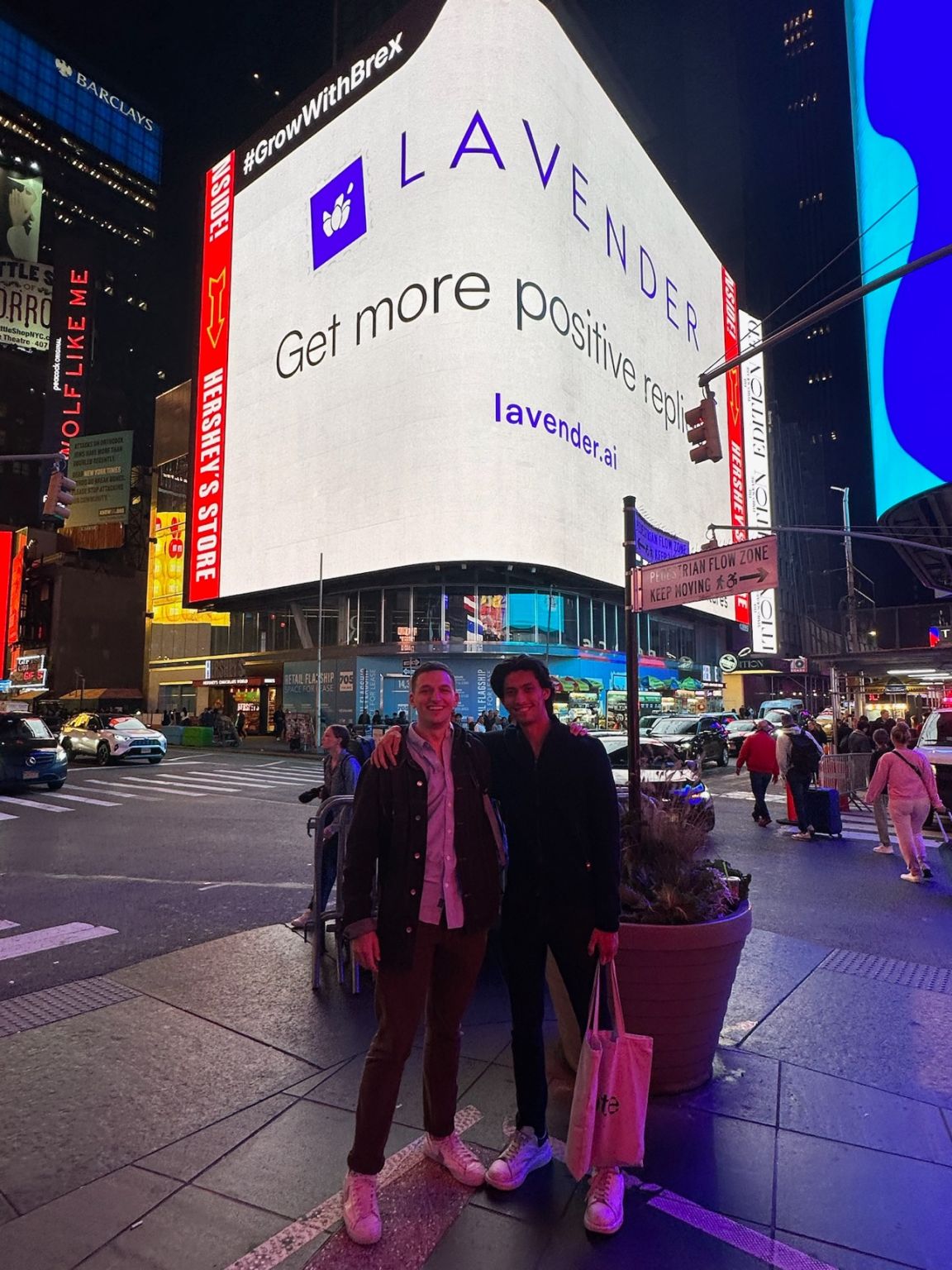
The photograph is almost comically literal. Two people stand beneath a Lavender billboard in Times Square, while the company’s promise about getting replies towers above the traffic. In October 2023, William Ballance paired the picture with a small piece of financial history: he had sold his car in 2018 to keep the business alive.
A car is an unusually concrete unit of startup funding. It has seats, a registration and somewhere to put the groceries. Once sold, it becomes a little more time. The billboard makes a handsome ending for that transaction. Ballance’s career becomes more interesting when you resist jumping straight from one to the other.
Before the email software, there was a sales job. Before the sales email coach, there was an alumni app and a personality-based marketing product. There was also a college he had never attended, whose threatened closure pulled him into a campaign that would change what he wanted to build. The connections arrived in an order that a tidy business plan would struggle to predict.
“In 2018 I sold my car to keep us alive.”
William Ballance / October 2023
The college he did not attend
In 2015, Sweet Briar College in Virginia announced that it would close. Ballance, a 2011 graduate of nearby Hampden-Sydney College, was working in sales at Springbot. He created HSC for SBC, gathering support from a community whose friendships and college lives overlapped with Sweet Briar’s.
His fundraising included virtual roses. A donor could buy one and dedicate it to a student or alumna. When a generous contributor left the dedication blank, Ballance followed up. Their conversation introduced him to work on thinking preferences and decision-making. He would later connect that encounter to the ideas behind Sorter and Lavender.
Helping the school also suggested a more immediate product. Alum was an app for alumni communication and donations; Sweet Briar’s March 2016 newsletter described the connection between the rescue effort and Ballance’s new venture. He could see a practical problem in keeping graduates connected to their institutions, and he wanted to work on it.
That background gives his later software a less obvious starting point. An alumni network needs people to notice one another, respond and participate. Those are demanding tasks for any interface. A college’s graduates may share years of memories, yet persuading them to act still requires more than adding another button.
A seat in the row ahead
Ballance had begun designing software as a schoolboy, but his academic interests were government and economics. His senior thesis examined microfinance and economic development. His route into products ran through selling them: first at an early ecommerce business, then at Springbot, and eventually through his own app.
In August 2016, he left Springbot to pursue Alum. Selling to educational institutions proved harder than selling marketing software to entrepreneurs. The difference sharpened his interest in how buyers make decisions. The same offer could meet very different levels of enthusiasm, depending on the person receiving it.
In 2018, he registered for Techstars Startup Weekend Atlanta just 15 minutes before it began. Will Allred was sitting in the row ahead. They joined forces around Sorter, a product intended to help marketers adapt messages to audiences. Their team won the competition.
It is an excellent argument for occasionally looking up from your laptop. Allred brought experience in marketing strategy and execution; Ballance brought a problem he had encountered while trying to sell his own software. The partnership began with a shared interest in making communication more relevant to the person receiving it.
- AlumKeep graduates connected
- SorterUnderstand the audience
- LavenderImprove the message
- OraPut research into action
How do you make another person want to respond?
The inbox was still open
By 2020, Sorter’s market had changed abruptly. Marketing budgets froze, and the team adapted its technology to email. Lavender put assistance into the inbox, where a user could work on an actual message rather than study an abstract description of an audience.
The early product worked in Chrome and Gmail, evaluated writing and supplied context about recipients. Earlier work on marketing had exposed a difficulty: useful ideas about communication could be cumbersome to apply. A product had to make those ideas available during the work itself.
The personal cost of reaching that point was considerable. He has discussed tight finances, trouble covering ordinary expenses and the investment that arrived when payroll was approaching. The car sale belonged to those earlier years of finding ways to continue. Software can look weightless once it appears in a browser; building it still involves very ordinary bills.
His own approach to editing is easier to see in a real example. In a 2022 email workshop, he revised an outreach message that assumed the recipient ran a recruitment firm. His version opened with an observed fact about a software tool the company used, then asked about tracking calls. The sprawling setup became a specific, answerable question.
The improvement involved judgment as much as brevity. An assumption gives the recipient something to correct. A relevant observation gives them a reason to continue. The person doing the writing still has to decide what is true and useful enough to mention.
“Make communication as simple as possible.”
William Ballance, in conversation with Gerardo Kerik
At a Dublin event in 2023, Ballance offered a related piece of advice: think about the phone on which a buyer may skim the message. He pays attention to preview text when deciding what to open. A familiar pleasantry can occupy the most visible space without giving the reader any useful information.
His interest in salespeople is similarly practical. When interviewing candidates, he asks about the extra effort they made to win a deal. He wants an example of someone finding a way forward: a different approach, a useful visit, a message that earns attention. The principle is recognizable from his product work. Details matter because somebody has to respond to them.
A little less corporate beige
Lavender’s public personality became another expression of that interest in attention. The company made comedy videos featuring Lavender Joe, published sales lessons and put energy into LinkedIn. Its marketing gave a piece of workplace software a cast of characters and a willingness to be silly.
At SaaStr in 2022, the team carried branded suitcases, distributed merchandise and handed out CDs of its song as party invitations. The gathering took place in an Irish pub. For a business built around written communication, it was a cheerfully noisy way to introduce itself.
The joke had an audience. At least one user even got a Lavender tattoo. Business software rarely asks for permanent space on someone’s skin; a recurring subscription is usually sufficient. The company’s public following suggested that users could develop an attachment beyond the daily task of editing emails.
Ballance appears capable of enjoying that enthusiasm while finding it faintly peculiar. When future employee Sarah Szweda told him she was obsessed with Lavender, she recalled him asking whether being obsessed with a software company was a little weird. It is a reasonable question. It is also the sort of question a rather pleased founder might ask.
The company’s humor sat beside a recurring offer of practical help. Job seekers became early users, and Lavender continued offering access to people looking for work. Free educational content made another introduction. Someone could encounter the company while trying to improve a message, without arriving as a buyer with a purchasing process.
Money buys room to build
In February 2023, Lavender announced $13.2 million across two rounds: an $11 million Series A led by Norwest Venture Partners and a $2.2 million seed round led by Signia Venture Partners. The announcement gave the team resources to expand and introduce more features.
Ballance built Lavender with Allred and chief technology officer Casey Corvino, alongside an expanding team. He continued to focus on improving the product. Building an assistant inside an existing workflow meant small choices about timing and presentation could affect whether anyone used the advice.
His working life had also become geographically flexible. He spent a year and a half working remotely in Mexico, where much of Lavender was built. In a March 2023 conversation, he discussed travel through Portugal, Finland and Poland while attending events, meeting investors and coordinating with colleagues.
Movement makes an attractive backdrop for a founder’s biography. The less photogenic part is the coordination. He was discussing hiring for product and engineering, a backlog of releases and the relationship between community and revenue. More money created room for that work, along with more decisions about what should happen next.
The keyboard changes hands
The next product chapter expanded the job description. Lavender’s email coach helps a person work on a draft. Ora, the company’s newer AI sales agent, researches prospects, writes messages and can send them. Ballance’s long interest in communication now extends into a system that performs more of the outreach itself.
In January 2025, he promoted Lavender’s free Email Wizard Course alongside Ora. He argued that sellers still needed to understand the principles of effective email. That is a useful expectation to carry into agent software: handing over a task leaves people with the job of judging its purpose and its results.
By September 2025, Ballance was describing a concrete internal use. Lavender had largely sold software to other software companies. He wanted to explore other markets without moving human sellers away from segments that were already working. Ora offered a way to run those experiments with different audiences, messages and geographies.
The idea brings his career back to an old difficulty. Selling Alum taught him that a different audience could require a different approach. Sorter tried to make audience differences actionable. Lavender brought feedback into the draft. Ora makes it possible to test an approach with less manual prospecting work.
For Ballance, the next question remains familiar: will somebody answer? The car, the alumni app, the conference CDs and the billboard belong to different stages of his working life. Each involved trying to make a connection that might lead somewhere. The photograph captures a very large sign. The work still begins with a person at the other end of a message.