A truck with smoke coming out of its tailpipe gives its owner a fairly persuasive reason to pay attention. Will Foiles uses that example. The smoke might become an environmental discussion, but the driver has a more immediate concern: the engine is doing something it should not. Waiting could make the eventual repair rather more expensive. In Foiles’s telling, a methane plume deserves the same sort of attention. Something valuable is escaping, and the equipment may be asking for help.
It is a revealing choice of analogy for the co-founder and chief executive of Project Canary. There are grander ways to talk about climate technology. Foiles chooses a malfunctioning truck. His argument starts where a working operator’s day starts, with an asset, a cost, and a decision. A leak has consequences in the atmosphere; it also has consequences for the person responsible for keeping a facility running.
Foiles is based in Denver. His company brings methane measurements together with operational information for energy businesses. The personal story behind that work runs through financial research, investment banking, and an unusually varied education. Across those changes, the question becomes more concrete: what is a number worth if it cannot help somebody decide what to do?
A balance sheet with something escaping
Before Project Canary, Foiles worked in research at Bloomberg and as an investment banking associate at Goldman Sachs. That background places him in the business of understanding assets and the information attached to them. Financial analysis is an education in consequences: a change in production, a change in costs, a change in what a buyer might be willing to pay. The energy business gives those abstractions plenty of physical company.
His academic route began with a BBA in real estate at the University of Georgia’s Terry College of Business and included an MS in finance at Villanova. At Stanford, he combined an MBA with an MS in environment and resources, completing the joint program in 2019. He is also a CFA charterholder. There is enough framed paper in that résumé to make a small wall surrender.
The more interesting detail is the subject of his Stanford project: energy cooperatives in Puerto Rico. Listed under the title Democratizing Electricity, it concerned how energy is organized as well as how it is produced. That is a useful early glimpse of the territory his career occupies: infrastructure has technical properties, but it also has owners, institutions, and people whose decisions determine how it works.
Stanford’s social machinery appears in his record too. Foiles was a GSB peer tutor, earned a certificate in public management and social innovation, and listed the Epicureans and Wine Circle among his clubs. Those are modest details, but they restore a little ordinary life to the procession of qualifications. His education record includes teaching fellow students as well as joining clubs devoted to food and wine.
“Treat leaks like work orders, not headlines.”
Will Foiles, August 2025
The sensor grows up
Project Canary launched its integrated hardware and software in 2019. Sensors gave operators measurements at their facilities; software gave those measurements somewhere to go. The company’s subsequent development has widened the job. Between 2022 and 2024, it expanded toward a platform able to combine information from different sensor vendors, aerial surveys, and satellites.
That progression matters for Foiles’s story because it changes what the business asks of its founder. A device must perform its measurement task. A platform has to make several kinds of information useful together, and useful to people with different responsibilities. An engineering problem acquires an operating problem beside it. Neither politely waits for the other to finish.
In February 2022, Project Canary announced a $111 million Series B led by Insight Partners, with investors including Brookfield Growth and CPP Investments. Foiles was then its chief operating officer. The investment backed the expansion of the company’s solutions and its move into additional sectors. It also put the company in conversation with institutions that assess environmental performance as part of the value and risk of an asset.
The leadership story has had several turns. In September 2023, Foiles and Tim Romer were reported as becoming co-CEOs, while Chris Romer moved toward the chairman’s role. Scott Lang was appointed CEO and chairman in March 2024. By the July 2025 interview with Hardware to Save a Planet, Foiles was identified as CEO. Today, the role brings together product, operations, partnerships, and long-term data work.
The leak has a timetable of its own
In February 2026, Project Canary released an analysis of 24.7 million fifteen-minute rate estimates from 940 upstream facilities across seven U.S. basins. The company reported that about four percent of measured periods were in an event state, yet those periods accounted for about 41 percent of total estimated emissions. About 75 percent of event-related emissions came from events lasting three days or less.
These figures describe that monitored dataset. They make timing part of the operating problem: an inspection can encounter an event or arrive after it has ended. “Operators need methane data that reflects how emissions behave in the real world,” Foiles said. The company planned further technical publication when it announced the findings.
A reading has a date attached to it. Operationally, that date is part of its meaning. The little timestamp in the corner of a screen can be doing quite a lot of work.
Proof needs colleagues
There is also the question of how well measurements become estimates of emissions. In October 2025, researchers at Project Canary published an evaluation of multi-source methane quantification models. They compared approaches to atmospheric dispersion and methods for estimating emissions from concentration and wind data, using controlled releases. The results showed that model choice and the frequency of wind measurements affected performance.
That is an important distinction for a business selling information. Detecting elevated methane, estimating where it came from, and estimating how much was emitted are related tasks with different demands. The published work gives those demands names and methods. It also makes the researchers visible: David Ball, Umair Ismail, Nathan Eichenlaub, Noah Metzger, and Ali Lashgari.
Foiles had already joined Ball for a company podcast explaining ADED testing metrics in late 2024. The subject is hardly cocktail-party ammunition, even for Stanford’s Wine Circle. Yet it belongs to the founder’s job. If customers are going to rely on a measurement, someone has to explain what the testing actually establishes.
His public conversations show a similar willingness to spend time on particulars. In February 2024, he joined Dan Pickering and Josh Lowrey on Energy in Transition to discuss monitoring and quantification. That September, journalist Herman K. Trabish interviewed him for the United States Energy Association’s Power Sector Podcast about methane leakage, tools, metrics, and policy. The audience changes; the measurement problem follows him.
Even artificial intelligence gets an electricity bill
Foiles’s December 2025 writing on AI returns to the economics around technology. He forecast constraints from capital, electricity, and the cost of running models. Those were predictions about the coming year, not results already achieved. They are revealing because he places the operating conditions around a model alongside its capabilities.
His proposed starting point was a defined workflow with clear inputs and outputs, an owner, and a way to track changes in cost, time, quality, or risk. He expected more focused models and more selective use of expensive computation. The recommendation is recognizably financial: examine the cost of the tool and the value of the work it performs.
There is a pleasingly physical quality to this argument. Even software arrives with bills attached. The person discussing a model’s possibilities still has to reckon with power, equipment, and capital. Foiles’s finance and environmental education meet again here, around a technology whose usefulness must survive contact with an operating budget.
The next useful question
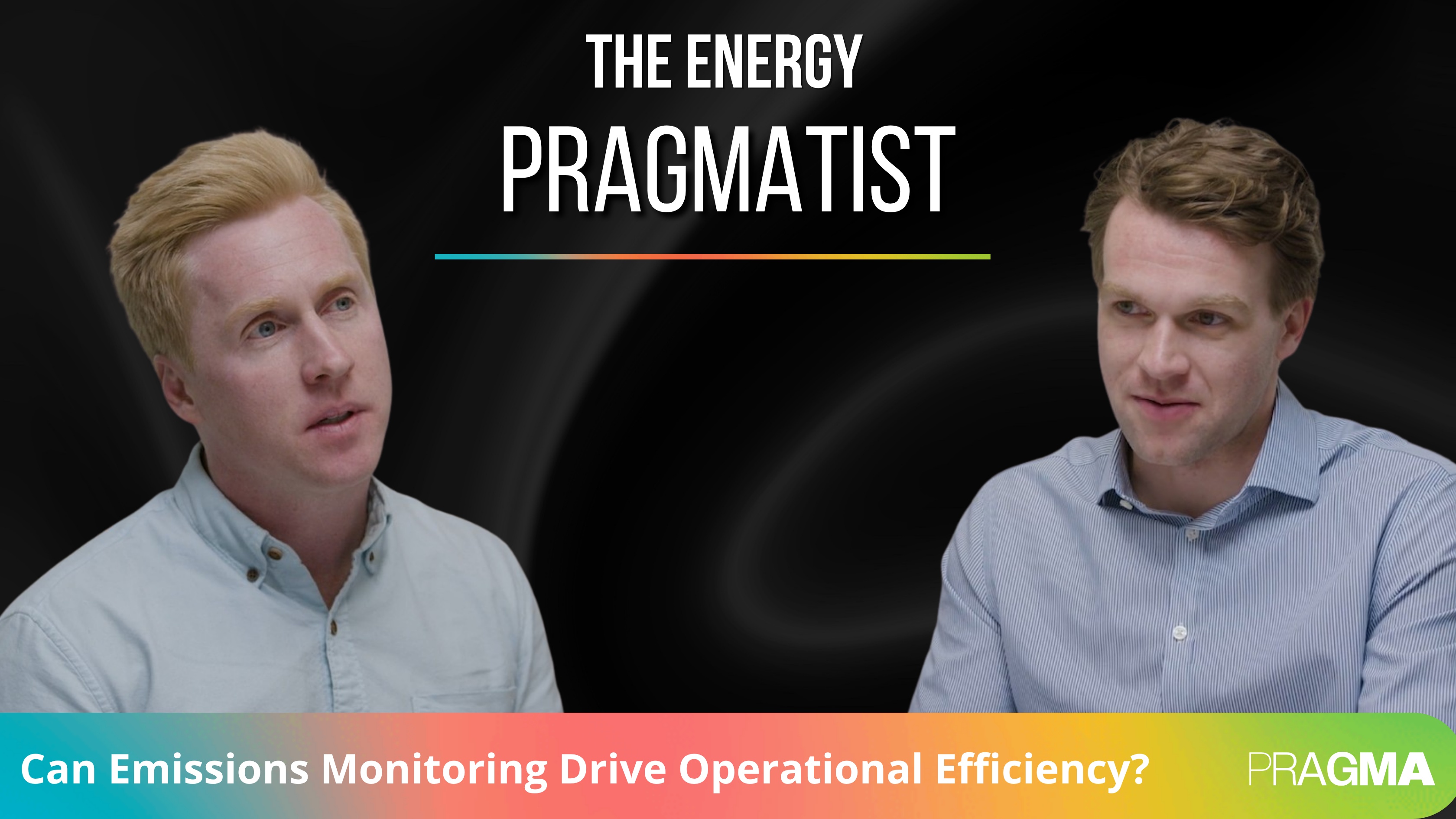
In June 2026, Foiles joined Ben West on The Energy Pragmatist. Their discussion covered combinations of monitoring technologies, changing regulatory priorities, more disciplined spending, and the possible value of better emissions data to investors and asset buyers. The company’s software ambitions had become a conversation about how an operator spends money and understands a facility.
That gives the career a coherent shape without requiring a dramatic moment of revelation. Real estate, financial research, banking, environmental study, and methane technology all involve assets whose behavior has to be understood. Foiles has moved closer to the readings themselves, then back toward the decisions they can inform.
The aspiration is practical enough to test. Does the information help people choose their next action? Does it let them examine what changed? A missing molecule makes a rather small protagonist. Following it has given Will Foiles a substantial job.
Follow the conversation
- Watch: The Energy Pragmatist / June 2026 ↗
- Listen: Hardware to Save a Planet / July 2025 ↗
- Listen: USEA Power Sector Podcast / September 2024 ↗
- Watch: Energy in Transition / February 2024 ↗
- Will Foiles on LinkedIn ↗
- Project Canary: official biography ↗
- Stanford: joint-degree alumni projects ↗
- Career background ↗
- Project Canary: company timeline ↗
- The 2022 Series B announcement ↗
- The 2023 leadership change ↗
- The 2024 CEO appointment ↗
- Foiles: Methane Is an Operations Problem First ↗
- Foiles: AI predictions for 2026 ↗
- The February 2026 temporal analysis ↗
- Methane quantification model study ↗
- The 2024 testing podcast and company review ↗