The early headquarters of Chris Romer’s methane business had an unusually short commute. Members of the team worked around a shared table in his home. One person installed and calibrated the devices in the field. It was 2019, and Project Canary was attempting to turn something people could not see into information they could use.
Romer later described that beginning as a native Coloradan and a grandfather who wanted to preserve the landscape for future generations. The domestic setting gives the ambition a useful scale. A planetary problem had arrived at a household table. The table could accommodate a few people. The problem would require engineers, customers, capital, and plenty of arguments.
He had spent years moving between public finance, education, and elected office. Methane monitoring added another occupation to a résumé already resistant to a single business card. Yet the move had a familiar shape: find an institution with a reason to change, then make the change practical enough to buy.
Denver taught him to count
Romer was born in Denver in 1959, attended East High School, and studied economics at Stanford. His father, Roy Romer, served as Colorado’s governor. His brother Paul became a Nobel laureate in economics. In this family, an interest in public policy hardly needed an introduction.
Chris’s own work took him into public finance. He spent roughly a quarter-century developing infrastructure and public-private partnerships at investment banks, including JPMorgan and Citibank. Roads, airports, schools, and energy infrastructure offered a particular education in how an idea becomes something people can actually use.
During his 2010 campaign for Denver mayor, he pointed to his experience with city budgets and the financing of public projects. He also wanted to accelerate work on Union Station and rail connections. A budget, in that account, was a way to put people to work. It was less glamorous than a campaign promise and considerably harder to ignore when the numbers failed to add up.
That background helps explain his later interest in environmental data. Finance puts a price on risk. An emissions business must first establish what the risk consists of. Romer brought experience with the people who write the checks, even when the measuring itself belonged to scientists and engineers.
- Public financeInfrastructure & institutional partnerships
- 2007Colorado Senate
- 2015Guild Education
- 2019Project Canary
The school door swings both ways
Education ran through his career well before Project Canary. He helped found the Colorado I Have a Dream Foundation, established in 1988 to provide sustained support for young people in economically disadvantaged neighborhoods. Mentoring, academic assistance, and help with further education demanded a longer commitment than an evening of fundraising.
There is a revealing moment from the 2011 mayoral campaign. At a debate about schools, Michael Hancock praised Romer’s foundation work. Romer, in turn, praised Hancock’s involvement in a controversial school turnaround plan. The candidates were competing for the same job, but each could recognize work the other had done.
A school door, Hancock observed, connects the classroom to the city outside it. The exchange fits Romer’s recurring interest in the agreements surrounding a public goal: who participates, who contributes, and who keeps showing up after the announcement. Good intentions have a rather generous attendance policy. Institutions need something stricter.
Romer also became president of the Denver KIPP charter-school network in 2008. His involvement in education included both the support offered to individual students and the management of organizations. The question kept changing scale, from a young person’s prospects to the structure that might improve them.
A benefit hiding in plain sight
In 2015, Romer joined his daughter Rachel Romer and Brittany Stich in founding Guild Education. The company connected employers, working adults, and education providers. Chris served as senior vice president of university partnerships, bringing another set of institutions into the same conversation.
The arrangement gave education a place inside an employer’s benefits offering. Employees could pursue learning through participating programs; employers had reasons to invest in the skills and prospects of their workforce. Romer’s contribution sat at the junction between universities and the businesses seeking those relationships.
It is easy to describe a career like this as a sequence of reinventions. There is also continuity. Public finance requires agreement between institutions with different obligations. An education-benefits company requires employers and schools to see value in working together. Neither arrangement runs on enthusiasm alone. Somebody has to make the partnership function.
By the time Romer turned to Project Canary, he had experience with an awkward but useful proposition: a business can pursue a public purpose if the customer has a concrete reason to participate. For methane, that reason would involve both the gas escaping into the air and the commercial consequences of knowing about it.
The smoke-detector proposition
In its early days, Romer compared Project Canary’s monitoring stations to smoke detectors. The comparison took a technical proposition and gave it a familiar job: keep watch and alert someone when there is a problem. Nobody buys a smoke detector for its conversational gifts.
At an oil or gas site, continuous monitoring could reveal a release that a periodic visit might miss. Measurements could then help an operator investigate and address the problem. The original pitch included making that monitoring affordable enough for companies to adopt across working sites.
Romer also wanted environmental performance to influence the market for natural gas. Project Canary’s certification work assessed facilities and supplied information intended to distinguish producers. Buyers would have more to consider than the commodity’s price. His public-finance instincts had found a new object: the environmental attributes attached to a product.
He carried the argument into international industry discussions. At Gastech in 2022, he spoke about European energy needs, environmental requirements, and the company’s work with Kellas Midstream. The local problem of a leaking site had become part of a conversation about cross-border trade. A small white box in a field could lead to a surprisingly crowded negotiating table.
Collect methane signals at a working site.
Use data to identify a problem worth investigating.
Send people to assess and address it.
A birdhouse at the funding party
In April 2021, Project Canary announced a $10 million Series A. Its staff had grown from eight people the previous November to 21. Those were the numbers of a company moving beyond the improvisation of its first rooms and into the obligations of hiring and serving customers.
A much larger financing followed in February 2022: $111 million in Series B funding, led by Insight Partners. Brookfield Growth and the Canada Pension Plan Investment Board were among the participants. Romer’s argument was that environmental claims needed precise, verified measurements. “You can’t get to net-zero using estimates,” he said.
The celebration produced a photograph worth lingering over. At a Denver team meeting, Romer holds a monitoring device with a wooden, birdhouse-like exterior. Colleagues appear on the projection behind him. Venture funding is usually illustrated with handshakes or an office window. Here the object at the center of attention looks ready for a garden fence.
The picture gives the business a physical presence. The money financed a company whose proposition still depended on equipment working outside and information reaching somebody able to act. A financing announcement could mark the start of that work. It could not stand in for the result.
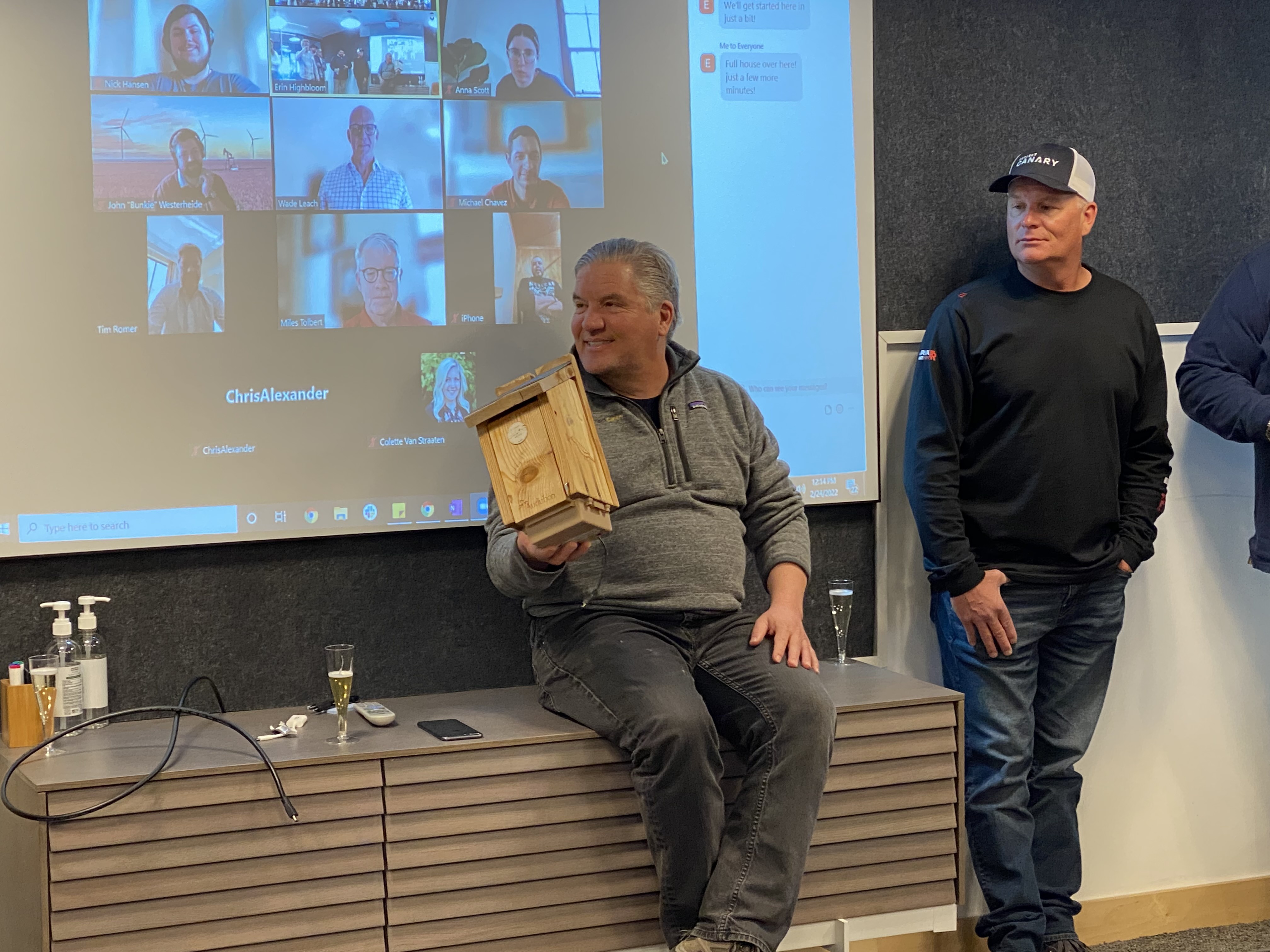
Project Canary financing, led by Insight Partners. A historical funding figure, not a company valuation.
A label is an invitation to argue
Romer’s position on natural gas put him in a disputed space. He argued that producers could have different environmental footprints, and that buyers should be able to distinguish between them. “Just because it’s fossil fuel doesn’t mean it’s all the same carbon footprint,” he said in 2021.
Environmental critics worried that calling gas responsibly sourced would help prolong fossil-fuel use. Romer’s answer was that production would continue in the near term, making better practices worthwhile. The disagreement concerned the destination as well as the route: whether improving a gas operation advances a transition or gives the existing system another reason to endure.
Certification raised another question. If customers selected the sites to be assessed, could they present their better operations while leaving the rest outside the picture? Romer acknowledged that concern in a 2023 interview: “This is a legitimate criticism of Project Canary: Can companies just cherry-pick their best pads?”
That admission matters to the portrait. He was selling a way to establish trust while recognizing a limit on what the business could compel customers to do. An accurate measurement at one site cannot describe every other site. The boundary around a claim deserves as much attention as the claim itself. For someone who wanted numbers to settle arguments, this was an argument the numbers alone could not settle.
“You can’t get to net-zero using estimates.”
Chris Romer, February 2022
Leaving the CEO chair
Romer had already experienced a public handover of sorts. Elected to Colorado’s Senate in 2006, he took office in January 2007 and later left to run for Denver mayor. He reached the 2011 runoff, then lost to Michael Hancock. A recognizable name and a substantial résumé still had to pass through the ballot box.
In August 2023, he stepped aside as Project Canary’s CEO and moved into a chairman role. His brother Tim Romer and co-founder Will Foiles became co-CEOs. The company was seeking leadership that could develop its measurement science and manage daily execution as the business moved beyond its startup phase.
In March 2024, Romer publicly welcomed Scott Lang’s appointment as CEO and chairman. Project Canary’s current leadership page lists Foiles as CEO. These changes belong in the story because a founder’s career and a company’s development do not proceed at identical speeds. A founder can establish the initial argument; running the resulting organization becomes a succession of different assignments.
What happens after the number arrives
Project Canary’s later evolution has emphasized a software platform that brings together sensor, aerial, and satellite data. It expanded into utilities in May 2025 and described a further move toward operational intelligence that October. The stated task is to help teams prioritize work and turn methane signals into decisions.
That emphasis returns the story to a practical question. Once information exists, what happens next? Somebody must interpret it, decide which problem deserves attention, and carry out the work. The measuring device can expose a gap between a promise and performance. Closing that gap requires people.
Romer’s career offers several versions of that problem: financing public infrastructure, supporting students, connecting universities with employers, and persuading energy businesses to measure emissions. The settings differ. In each, participation has to survive beyond the attractive idea.
The shared table in his home makes an apt starting point because it leaves the scale of the job visible. A handful of people could begin collecting data. They could build a business around it. What followed was the harder task of making institutions respond. Methane may be invisible. The choices made after measuring it are much easier to see.
Keep the conversation going
- Project Canary
- Chris Romer on LinkedIn
- Romer’s Medium profile
- Gastech video interview · 2022
- The Green Insider · audio interview
- Project Canary on YouTube · company channel
- Colorado funding story · 2022
- The gas-certification debate · 2021
- Inside the certification market · 2023
- The 2023 leadership handover
- Project Canary’s current leadership
- Guild’s founding story
- Romer’s 2010 mayoral interview
- The 2011 education debate
- Project Canary’s 2022 sustainability report
- Chris Romer · biographical background