A carbon credit is an exceptionally odd product. You cannot hold the tonne, kick its tires or send it back when the atmosphere looks unchanged. The buyer pays for a claim: somewhere, by some method, carbon dioxide left the air and entered storage. Between the physical event and the corporate climate report sits a thicket of meters, soil samples, lab results, models, spreadsheets and judgment calls. Isometric’s job is to make that thicket inspectable.
The London company calls itself a certification platform for the industrial economy. It began more narrowly in 2022, with founder Eamon Jubbawy studying why carbon markets had lost credibility. Projects were often paying the registries that assessed them. Evidence could disappear into enormous PDFs. Verification happened slowly, sometimes yearly, while a young removal company waited for credits and the cash attached to them. The old system’s first failure was not chemistry. It was incentive design.
The referee gets paid by the skeptical side
Isometric’s pivotal choice sounds almost boring: the buyer pays. The supplier whose project is being examined does not. The company charges a pathway-specific fee per tonne, due on delivery, regardless of the market price of the credit. That severs the most uncomfortable link in the conventional registry model - the auditor earning more when the party it audits receives more credits.
The public price tag
Per tonne, depending on removal pathway and annual volume. Biomass certification starts at $10 for the first 25,000 annual certificates and falls to $3 above 500,000. Some more verification-heavy pathways start at $30. The published price includes the independent validation and verification body, with no account, retirement or secondary transaction fee.
This is what it cost in the literal sense. In the strategic sense, it cost Isometric an easy customer: the supplier. Refusing supplier fees means the company must persuade climate-conscious corporations that credible verification is worth buying as its own service. Microsoft, JPMorganChase, Boeing, Anglo American, Shopify and Stripe appear among companies relying on its certifications or receiving credits it has issued. That customer list is as much reputational insurance as climate procurement.
“Trust isn’t built behind closed doors.”Isometric, announcing its original registry principles
A tonne goes through three rooms
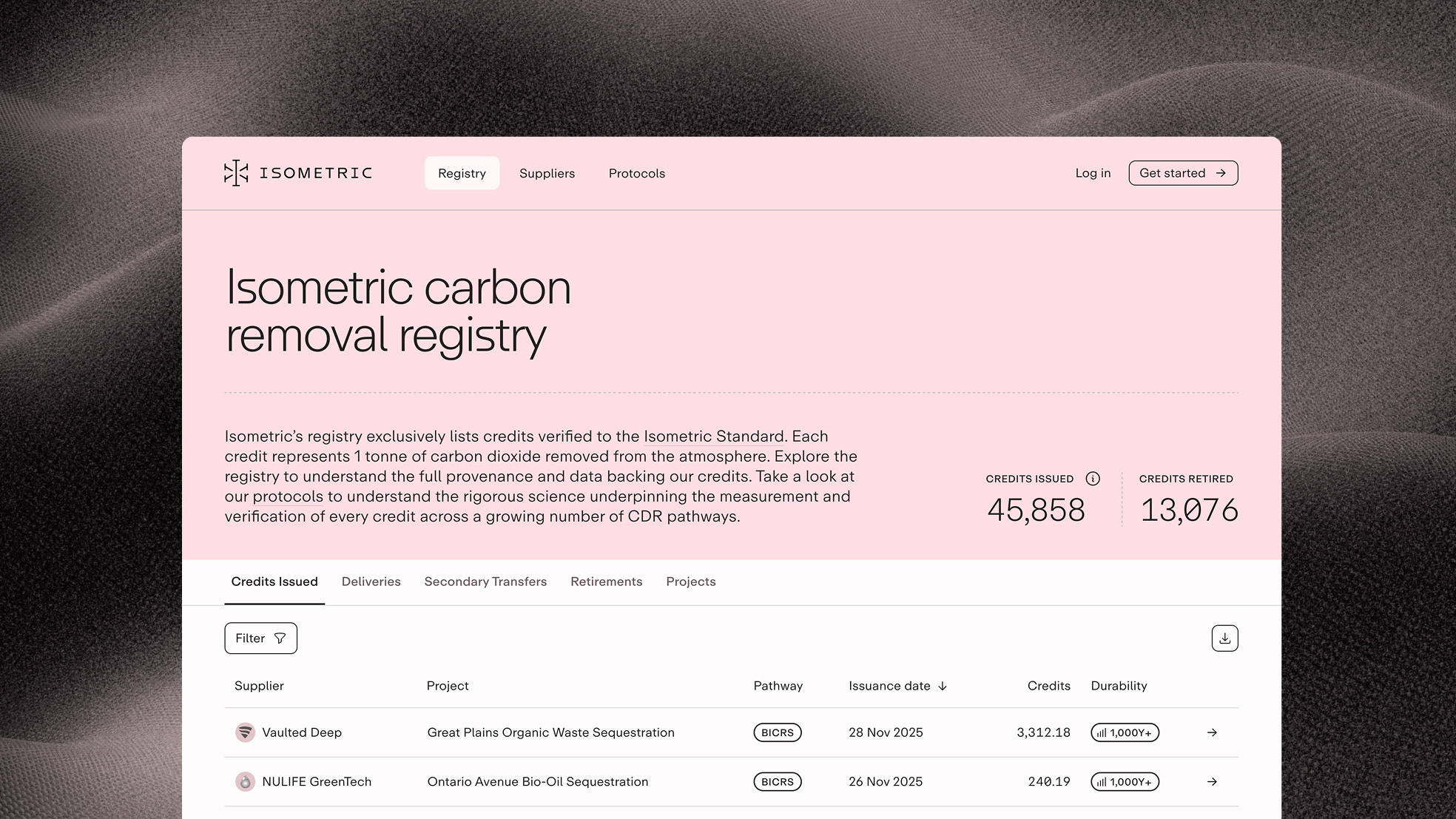
The product is really three connected products. Protocols turn evolving science into rules for a particular pathway: direct air capture, biochar, enhanced weathering, reforestation, ocean processes and others. Certify is the working room where suppliers submit project designs, life-cycle data and evidence, and where independent Validation and Verification Bodies review them. The Registry is the public room, recording the certificate and its journey through delivery, transfer and retirement.
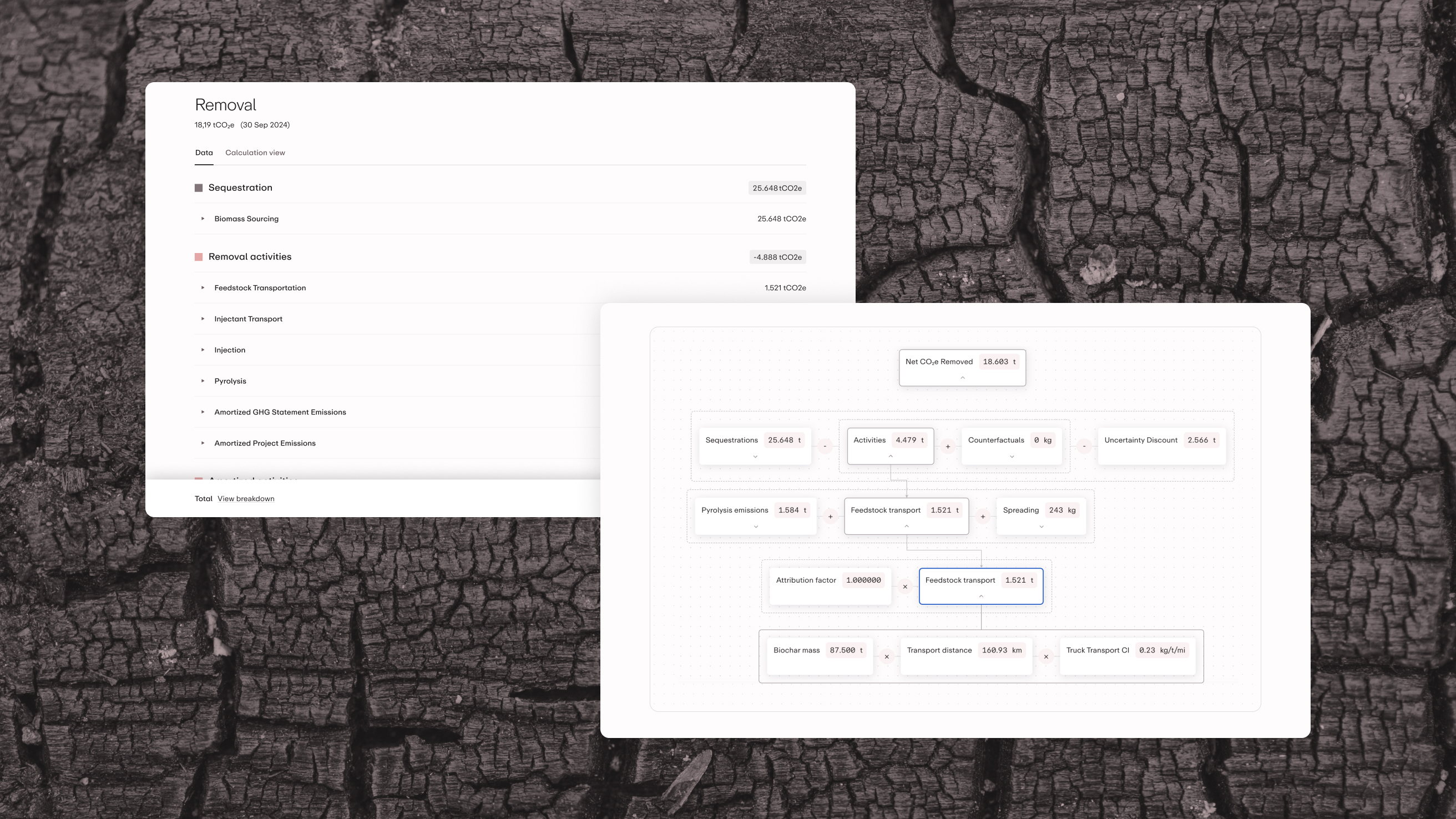
The arithmetic matters. A project does not simply report gross carbon captured. Isometric’s calculation trees subtract operating emissions, transport, counterfactuals and uncertainty discounts to reach net removal. Every protocol is versioned like software and major changes go through expert review and public consultation. One certificate represents one verified net tonne, not a hopeful tonne rounded up for morale.
Independent verifiers still sit in the chain. Isometric approves specialist Validation and Verification Bodies, while its own science team maintains the standard and protocols. Outside researchers add pressure through the Science Network. The company also joined two U.S. Department of Energy-funded research efforts led by the National Renewable Energy Laboratory, contributing practical MRV knowledge to questions such as biomass-storage durability and measurement. Its claim to rigor therefore rests on an institution, not a single clever formula.
The public layer has commercial plumbing beneath it. Registry and MRV APIs let a field system stream readings, a marketplace deliver a certificate and a buyer retire it without rekeying the same data through a chain of vendors. Isometric has announced integrations or distribution partnerships with Patch, Watershed, Supercritical, Milkywire, Carbonplace, Wren, CEEZER and others. The ambition is mundane in the best way: make trustworthy carbon data move like ordinary business data.
The spreadsheet is the first thing Remi attacks
Certify launched in March 2025 with a promise that eligible suppliers could get an initial compliance answer within a week and issue monthly rather than annually. Later that year, AI-assisted validation began checking submissions for absent evidence and incomplete requirements before a verifier opened the project. In April 2026, Isometric released Remi, an in-product agent available to more than 150 suppliers. It comments while a submission is being built, much as a vigilant colleague might hover beside the keyboard.
The boundary is important. Remi does not decide whether a geochemical model is scientifically defensible or whether a reversal risk deserves a particular buffer. It finds gaps, cross-checks responses and summarizes evidence. Humans keep the decisions where context and accountability matter. One early user, Nellie Technologies, said expert oversight remained critical for complex work even while Remi improved the routine work’s speed and consistency. That is a more useful claim than the usual promise to sprinkle AI over a profession and dismiss everyone by Thursday.
| Old verification habit | Isometric’s move | Practical effect |
|---|---|---|
| Supplier pays registry | Buyer pays on delivery | Approval volume does not directly lift the fee |
| Annual issuance | Monthly workflow | Suppliers can receive credit revenue sooner |
| Evidence in long PDFs | Calculation trees and public data | Buyers can inspect a claim without archaeological tools |
| Human spot checks | AI pre-checks, human judgment | Routine gaps surface before expert review |
The founder changed the size of the answer

Jubbawy had already spent a decade on trust infrastructure as a co-founder of identity-verification company Onfido. In 2020 he decided to work on climate, explored several ideas, then spent late 2021 and early 2022 studying carbon markets. A six-page thesis sent to Lowercarbon Capital became the seed of Isometric.
He did not begin certain that a new registry was necessary. He considered building tools for incumbents. He also debated whether the institution should be nonprofit. Going deeper changed his mind: carbon removal was a parallel market young enough to build from scratch, and a for-profit competitor could invest in the science and software needed to raise the standard. Lowercarbon and Plural co-led a $25 million seed round in 2023. In June 2026, AVP led a $40 million Series A, with existing backers returning and AXA as anchor investor.
By then the bet had widened. Isometric said it was contracted to certify more than 16 million tonnes across over 200 industrial projects. Its menus now extend beyond carbon removal to superpollutants, industrial emissions, clean power, low-carbon fuels, materials and data-center lifecycle claims. The common problem is proof: a tonne of green steel looks like a tonne of ordinary steel, and a clean-energy claim must travel through a supply chain without shedding its evidence.
Where it sits - and what can be copied
Isometric competes with established standards and registries including Verra, Gold Standard and American Carbon Registry, and more directly with removal-focused Puro.earth. It also competes with the do-it-yourself stack: an MRV vendor, an auditor, a registry, a ratings company and a determined procurement team holding the pieces together. Isometric’s pitch is integration without secrecy. APIs let marketplaces and dMRV systems connect; public records let outsiders see the result.
The copyable lesson is not “add a registry.” It is to map every incentive around a trust product. Charge the party carrying the reputational risk. Publish the workings, not merely the verdict. Automate completeness before automating judgment. Give standards version numbers and changelogs. Shorten the interval between good work and payment. None of these ideas requires a carbon molecule.
The conditions attached
This model works when a claim produces abundant, legible evidence and a sophisticated buyer values rigor enough to pay for it. It strains when field data are sparse, models outrun measurements, projects cannot disclose key inputs, or low-cost buyers treat every credit as interchangeable. Newer pathways can also lack scientific consensus. Isometric’s 2026 enhanced-weathering proposal explicitly kept field sampling underneath models and said no project yet met its model-based bar. Speed depends on good data arriving in a form that software can check.
There is a larger risk in Isometric’s expansion. Carbon removal is a focused domain with a tight community of scientists and early corporate buyers. “The industrial economy” is vastly broader, fragmented across regulators, geographies and old certification institutions. The same platform architecture may travel; the credibility must be earned category by category. Accreditation from ICVCM, ICROA and CORSIA helps in carbon markets, but it is not a universal passport for steel, fuels or data centers.
Still, Isometric has made a sharp observation into a real business: an invisible product needs unusually visible proof. The company’s most consequential invention may not be an AI agent or a handsome registry. It may be the refusal to let revenue rise with a generous verdict. In a market built on measuring what nobody can see, knowing whom the referee works for is a useful place to start.
Keep digging
Explore the working products and the company’s own running record of protocol, product and policy changes.