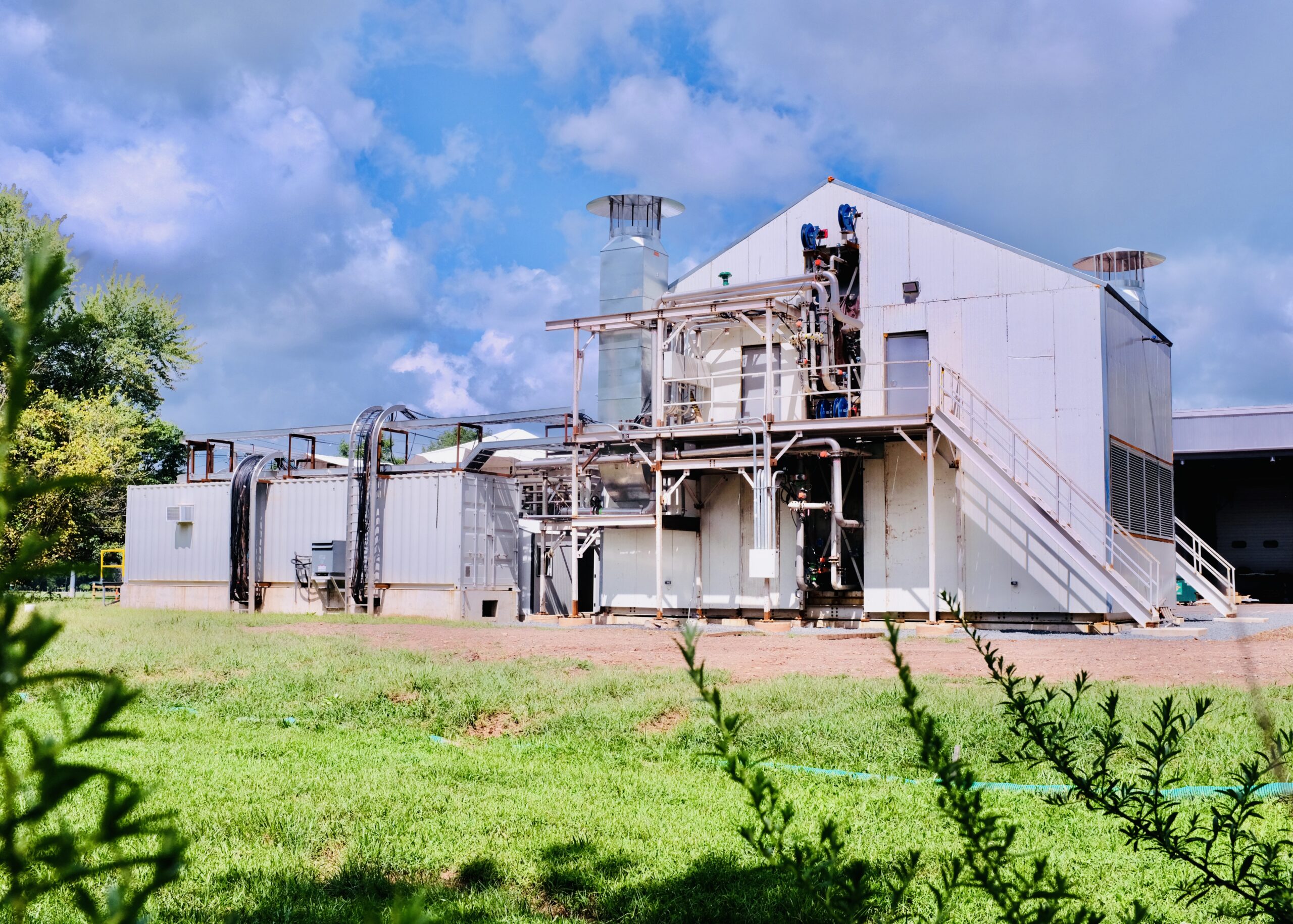
At Avnos’s first pilot near Bakersfield, California, the interesting output was water. A machine built to extract carbon dioxide from the atmosphere was also designed to produce five tons of distilled water for every ton of CO₂ captured. That changes the conversation. In a place where water is valuable, a carbon machine can arrive with something useful to offer before anyone starts discussing a carbon credit.
- Two outputs: atmospheric CO₂ and clean water from one system.
- Real hardware: the Brighton demonstration entered operations in September 2026.
- Next test: factory-built modules and a larger plant called Cedar.
Founded in 2020, Avnos calls this Hybrid Direct Air Capture, or HDAC. The hybrid is the pairing of water capture with carbon capture. Its proposition is easy to understand and difficult to engineer: make the removal of one atmospheric ingredient help with the removal of another. Then find customers who care about both.
01 / The trick is in the humidity
Imagine the system as a carefully managed change in weather. Incoming air first meets a material that takes out moisture. The drier air reaches a second material that holds CO₂. Changing the humidity then helps release the carbon dioxide. Some harvested water goes back into the process; water also emerges as a usable product.
Safran, an investor with an obvious interest in aviation fuels, describes the release step as a “moisture swing.” Many competing approaches use heat to regenerate their capture materials. Avnos’s distinction starts with how it separates those molecules, and extends to what the operator gets at the other end.
- 01Catch moisturePrepare the air
- 02Bind the CO₂Solid capture material
- 03Change humidityRelease captured CO₂
Conceptual sequence. Water is also reused within the process.
That does not mean the equipment runs on good intentions. It needs energy. Although Avnos describes its core process as requiring no external heat input, its newer data-center configuration is designed to put available low-grade waste heat to work. The useful distinction is between requiring dedicated heat and exploiting heat a facility already has.
02 / First, make the parts agree
The idea grew from research involving Pacific Northwest National Laboratory. Translating it into equipment required collaborators including SoCalGas, which reports contributing $650,000 in matching funds and helping secure the pilot site. The Bakersfield project cost $3.2 million, according to reporting by Canary Media, with the Department of Energy providing most of the support.
What resisted the team first? In SoCalGas’s annual report, founder and CEO Will Kain identified the difficult part: getting the CO₂ and water-removal subsystems integrated. Two useful processes still have to behave as one machine. Timing, humidity and the handoff between materials matter as much as the chemistry on its own.
“The most significant challenge we faced was integration of the CO₂ and water removal subsystems.”
Will Kain · SoCalGas RD&D annual report
The early pilot also exposed a distinction that carbon-capture announcements can blur. In February 2024, Kain told Canary Media that the pilot released captured carbon back into the air because the site lacked a suitable storage route. It was proving the process. Permanent removal requires another destination for the gas.
03 / The buyer changes the equation
Kain’s background helps explain the commercial emphasis. Before Avnos, he worked in investment banking, helped launch Rusheen Capital Management and handled corporate development at desalination company NanoH₂O. He arrived with experience in water and capital, two subjects industrial climate projects eventually have to confront.
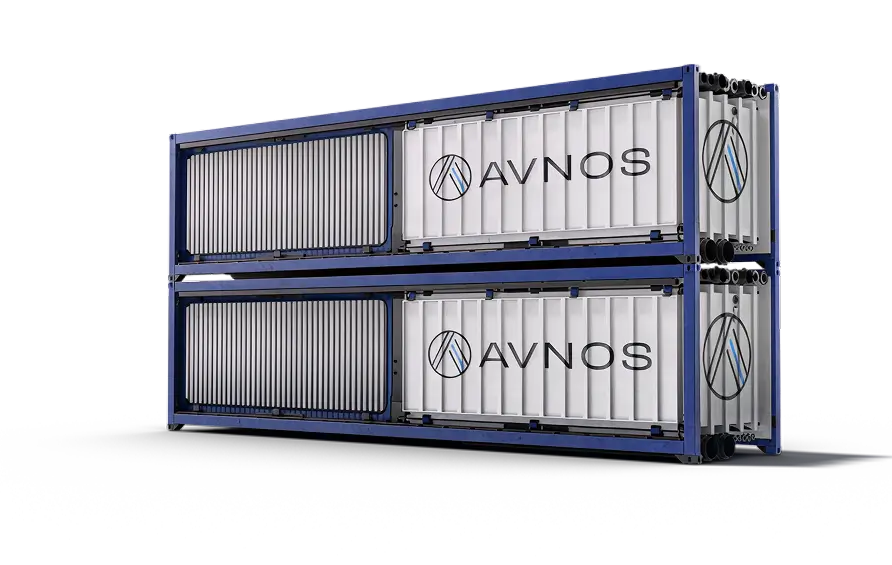
Avnos’s public business model has included licensing technology to project developers. Its September 2026 product launch adds a standardized hardware family with three applications: data centers, carbon storage and eFuels. The same underlying platform serves different buyers because each buyer values a different combination of outputs.
A storage developer wants a CO₂ stream that can be sent underground. A synthetic-fuel producer wants atmospheric carbon and water as feedstocks. A data-center operator may care first about water for cooling and the opportunity to use waste heat. Avnos is selling into industrial purchasing decisions with budgets and engineering requirements attached.
Its published data-center modeling suggests up to 70% lower facility water consumption and up to 10% more available compute capacity. Those are illustrative estimates for a modeled campus, with actual results varying by site. They explain the sales pitch; they do not establish what a particular customer has achieved.
04 / Four modules, one expensive question
Capital has arrived in several forms. Avnos closed a $36 million Series A in February 2024, led by NextEra Energy Resources. In November 2025, Shell and Mitsubishi agreed to provide up to $17 million in phased project financing for Cedar. Equity funding and a project-finance commitment buy different things; neither figure is a price per ton of carbon removed.
Annual CO₂ design capacity, tonnes. Capacity is not measured annual output. Company figures, September 2026.
Brighton entered operations in September 2026, designed to capture up to 450 tonnes annually and produce about 475,000 gallons of water. Cedar is planned around four modules, with annual design capacity of 3,000 tonnes of CO₂ and more than 6,000 tonnes of water. Completion is targeted for the end of 2026.
05 / Make it useful before making it huge
Avnos competes in a market with very different machines, including Heirloom’s limestone-based approach. Its own wager is that water production and repeatable manufacturing can improve the economics. At its Scale IV platform, engineers recreate temperature and humidity conditions rather than waiting for the seasons to provide an experiment.
The lesson other builders can copy is practical: test the handoffs, find buyers for useful co-products, and make deployment repeatable. The conditions still matter. Electricity, climate, utilization and a destination for CO₂ determine whether the system earns its keep. Carbon used in fuel returns to the air when burned. Durable removal needs storage. Avnos’s clever starting point is making water valuable along the way.