Stuart Rowland has settled on an unusual animal to explain his company: the platypus. For a founder trying to persuade people to trust carbon credits, it is a pleasingly awkward choice. The creature requires a little explanation. So does an organisation in which foresters, former investment bankers, ecologists and artificial intelligence specialists are expected to solve the same problem. Rowland seems comfortable with the resemblance.
In January 2025, he gave the comparison a home in a short essay titled “Revalue is a Platypus”. His list of ingredients paired nature with engineering and data scientists with creative storytellers. He was describing the practical arrangement behind Revalue, the carbon-credit business he founded in 2022. The company depends on people who arrive with different vocabularies and different ideas about what counts as convincing evidence.
The comparison also offers a way into Rowland’s career. He studied physics at Oxford, entered the startup world through Entrepreneur First in London, and worked at McKinsey and SYSTEMIQ. By the time he started Revalue, he was looking at the relationship between nature and money from Indonesia. The question had become quite concrete: how could protecting a forest attract the capital needed to keep it standing?
Oxford, then a different sort of fieldwork
Physics gave Rowland an academic starting point; entrepreneurship and consulting supplied the next chapters. His work later took him into natural solutions and the task of building organisations around them. He served as South East Asia director for a £120 million incubator facility and helped expand SYSTEMIQ’s Indonesian office from four people to more than 100. Those are useful experiences for someone whose eventual business would have to connect scientific work with financing and delivery.
The incubator work involved backing businesses that protected or regenerated nature. It placed him close to a difficulty that can disappear inside a climate presentation: an ecological benefit needs an economic arrangement capable of sustaining it. A forest can matter enormously while struggling to compete for investment. Carbon credits offered a possible route, allowing money to follow a claimed reduction or removal of emissions.
Rowland’s founding decision came with a reservation about the market he was entering. He believed the quality of early credits was inadequate and that confidence would eventually break. Revalue emerged from that concern. Its premise was to help project operators develop credits with stronger evidence behind them. Starting a business on the expectation that customers will become more sceptical is an interesting sales strategy. It puts a considerable burden on the product.
- OxfordPhysics
- LondonEntrepreneur First · McKinsey
- IndonesiaSYSTEMIQ · nature ventures
- RevalueFounded 2022
A round of funding, a longer examination
In August 2023, Revalue announced a $10 million Series A co-led by Ecosystem Integrity Fund and SJF Ventures. The money was intended to expand the company’s tools, partnerships and project pipeline. Its offering already extended across the project lifecycle, including assessment, financing, monitoring and the eventual issuance of credits. The work demanded continuity between the initial proposition and the evidence collected later.
SJF’s account of its decision is revealing. The investment followed a year-long evaluation of nature-based solutions. The investor singled out difficult calculations involving baselines, additionality, leakage and permanence: respectively, questions about what would have happened anyway, whether a project makes a difference, whether damage moves elsewhere and how long a benefit lasts. These are awkward details for a sales brochure. They are central to whether a credit deserves its price.
For Rowland, financing the company meant finding investors willing to take those details seriously. SJF described spending an unusually long time checking its initial view of Revalue. It ultimately pointed to analytical discipline, alignment between commercial objectives and integrity, and enduring partnerships. The resulting investment was a business milestone. The examination behind it explains more about the business he was attempting to build.
Co-led by Ecosystem Integrity Fund and SJF Ventures.
Why a tonne needs a backstory
Rowland’s public argument about carbon credits begins with a deceptively tidy idea. A tonne of carbon dioxide sounds like a standard unit, so a credit representing one tonne seems suited to commodity trading. Yet the projects behind credits differ in their risks, durability, measurement and ecological effects. A shared unit can conceal a great deal of variation in how that unit was earned.
He has argued for treating credits as differentiated products, with room for specifications and improvement beyond certification. In that view, a certificate establishes a minimum; it cannot do all the work of describing quality. The change would require buyers to ask more detailed questions and developers to explain more of their methods. It would also make the distance between the project and the purchasing decision harder to ignore.
In August 2025, Rowland took that argument into a long conversation on This Week in Carbon. The episode focused on why credits should be judged by rigour, outcomes and integrity, and how ecosystem-based projects might grow responsibly. It is a useful expression of his commercial problem: a company promising better evidence needs customers who care enough to distinguish between competing kinds of evidence. The explanation is part of the work.

The platypus has colleagues
An interdisciplinary company sounds attractive until the disciplines actually meet. Rowland has identified combining organisational cultures as a major challenge. Revalue’s team makes the issue tangible: its work brings carbon methodologies, software, forestry, geospatial analysis, investment and community expertise into the same organisation. Each field has its own habits of precision. Agreeing on a deliverable does not automatically mean agreeing on how to reach it.
The people around him give those disciplines names. Nicolas Loncle is chief data scientist. Charlotte Wheeler leads forestry. Alex Grais is science director. Rumi Naito leads social and behavioural science. Their responsibilities suggest why Rowland’s animal analogy has lasted: the technical product depends on knowledge that cannot be supplied by a single professional tribe, however impressive its slide deck.
Revalue’s stated cultural principle is “Mission over Ego.” Its recruitment material seeks people who enjoy difficult work and can make it happen. Rowland’s March 2025 conversation with Alexa Mangeant on Conversations in Cleantech explored hiring beyond obvious résumés as well as LiDAR and carbon-market trust. The pairing of those subjects is apt. The quality of a measurement system depends partly on the organisation capable of building, questioning and using it.
“I’ve started describing Revalue as a platypus.”
Stuart Rowland · January 2025
A forest has neighbours
One practical example sits in Tanzania’s Ruvuma region, where Revalue works with Carbon Tanzania. In October 2024, the partners carried out a baseline survey involving 2,078 respondents across 39 Wildlife Management Area member villages. Carbon Tanzania recruited and trained 78 local young people to conduct the surveys within their communities. The project called them Carbon Champions.
The survey used smartphones with offline capability, location tracking and structured questions. Its sampling sought to include different ages, genders and locations, rather than relying solely on household heads. Afterwards, the team returned to share the findings with the villages. This was work led by the project partners and specialists, including Naito, rather than a personal fieldwork claim for Rowland. It shows the kind of evidence his company has chosen to make part of its approach.
The distinction matters. A forest-carbon project operates among people with livelihoods, expectations and opinions about how land should be managed. Revalue’s current description of Ruvuma includes community governance, conservation finance and monitoring alongside biomass measurement. Its Model R targets 1.2 tonnes of avoided carbon dioxide per credit to provide a buffer against over-crediting. That number is a design target, with the burden of demonstration still attached.
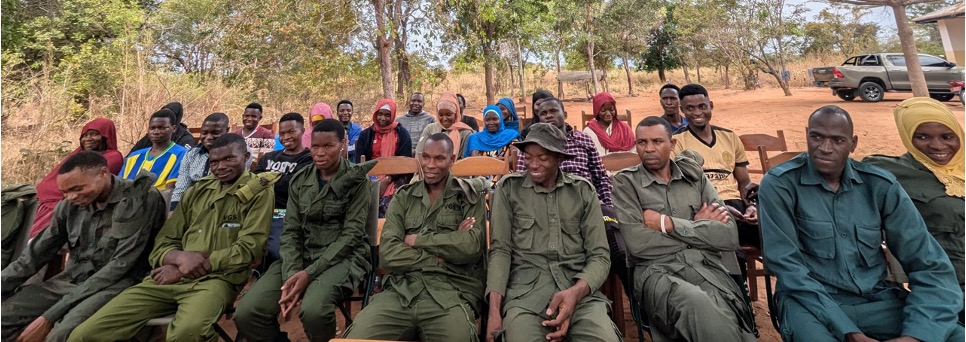
Community interviews informed the baseline. These figures describe the survey, rather than carbon outcomes.
The argument reaches Japan
By January 2026, Rowland had another financing announcement to discuss. Japan Energy Fund and K8 Capital joined a strategic investment round alongside existing backers Ecosystem Integrity Fund and SJF Ventures. Japan Energy Fund described plans to help Revalue build relationships with Japanese corporations, utilities and financial institutions. Rowland emphasised the opening of commercial relationships and options for financing projects.
The development makes his job look broader than the familiar founder task of raising money for a company. Revalue also needs capital to reach projects, project operators able to put plans into practice, and buyers willing to pay for the results. The new relationships were intended to connect more of those participants. They added another geography to a business whose chief executive remains based in Indonesia while the company is headquartered in London.
In September 2026, Revalue was named among the first developers committing projects to Isometric’s forthcoming avoided-deforestation protocol. Isometric described Revalue as transitioning future portfolio projects to its system. Public consultation was planned by November, with finalisation and certification to follow. Rowland welcomed the prospect of stronger scientific requirements combined with speed and assurance. The protocol was still upcoming; his endorsement expressed a direction of travel.
Room for the odd duck
Rowland’s personal account of life in Bali contains a smaller version of the same appetite for learning. He described setting aside time to practise Indonesian before beginning concentrated work. Away from the business, he spends time with his partner, Hollie, and their two dogs, Albie and Ada. These are ordinary details, and welcome ones in a career whose public vocabulary can otherwise become crowded with methodologies and models.
His company now presents three approaches: avoiding emissions, removing carbon through reforestation, and combining nature with engineering for durable storage. Its Verse platform brings assessment and ongoing monitoring into the proposition. Each approach creates more questions for the mixed team to answer. How should a landscape be measured? How should uncertainty change a claim? Who needs to understand the result before money changes hands?
Those questions make the platypus more than an amusing piece of founder language. Rowland has chosen a business in which ecological knowledge, local relationships, software and financial judgment remain dependent on one another. His ambition is to protect and regenerate nature at a scale that matters. Getting there will require the unusual combination to function in practice, through changing standards and repeated scrutiny. For now, the odd duck has plenty of work to do.