Matt Golden kept the sign. Years after Sustainable Spaces had become part of his professional past, its old office shingle was still behind him during a video interview. The business had changed names; his work had moved into software and electricity markets. Yet there was the reminder of where it began. Before a saved kilowatt could become something to trade, somebody had to climb into a house and work out where the energy was going.
Golden calls himself “a contractor at heart.” It is a useful introduction to a founder whose career otherwise requires a small glossary. Energy auditing. Investor-ready retrofits. CalTRACK. Virtual power plants. Behind those terms sits a practical concern: doing useful work should be worth doing well. His career has repeatedly brought him up against the awkward distance between installing something and proving its value.
The house before the spreadsheet
He graduated from Georgetown University in 1997 with a degree in international relations. His early career included management consulting at Ernst & Young, an internet travel technology company called Travelkey.com, and designing and selling solar projects. This was a varied preparation for a life in building performance. It also put him within reach of several parts of the problem: business, technology, customers and energy.
In 2004, he founded Sustainable Spaces. Having worked in solar, he wanted to look at the entire building. A roof could carry panels while the rooms below continued to waste energy. Insulation and air sealing were less conspicuous purchases, but they deserved a place in the conversation. A homeowner needed someone who could examine the house as a system, then carry out the improvements.
The business became the first Recurve. Its software helped contractors turn an audit into a scope of work and a proposal, using tablet computers and cloud simulations. Golden’s concern with scale was already explicit. “My goal was always about achieving scale,” he wrote. A business could do careful work house by house and still struggle to spread that work widely enough.
The first company also had an unromantic encounter with the economy. Recurve shifted its construction group to Advanced Home Energy in 2011 and concentrated on software. In February 2012, Tendril acquired that software. A founder’s story is often tidied into a series of inspired decisions. Here, construction conditions, financing constraints and the difficulty of getting improvements purchased belong in the picture too.
A tool belt in Washington
Golden was also thinking about people who knew how to build and suddenly had less work. In March 2010, he and Bracken Hendricks published Taking on the Tool Belt Recession. Their argument connected home energy improvements with idle construction workers, manufacturers and local suppliers. An existing house could be a place to put skills back to work.
The memo looked beyond the person arriving in a truck. A retrofit also meant materials, distribution and retail spending. The authors drew attention to small businesses and self-employed tradespeople whose losses could be obscured in payroll statistics. Their proposed response included Home Star, a federal incentive program intended to stimulate household investment in efficiency. Golden’s policy work placed the contractor within a much larger economic chain.
That was a natural extension of his industry organizing. He helped establish Efficiency First and served as its founding chairman. In 2009, the Building Performance Institute recognized him with its Tony Woods Award. The subjects of his work were expanding, but the people doing installations remained central. A market that could sustain their businesses would matter long after a particular incentive came and went.
Making a retrofit bankable
By 2013, Golden was stating the difficulty in the language of finance: “It is a financial issue.” His work with Environmental Defense Fund’s Investor Confidence Project approached an energy upgrade from the investor’s side of the table. Someone proposing to lend money needed a way to evaluate what a project promised and how confidently those savings could be expected.
That year, an EDF effort with the Clean Energy Finance Center began bringing together loan-performance and energy-savings data. The ambition was to make lending decisions better informed by the experience of completed projects. An upgrade could sound persuasive in a presentation. A collection of comparable results would give its financial promises something firmer to stand on.
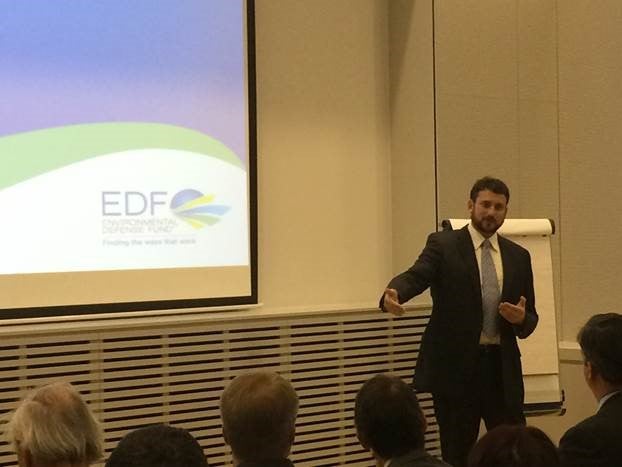
The work crossed the Atlantic. Golden participated in the Investor Confidence Project Europe launch in Brussels in 2014. The European initiative sought a common approach to developing and measuring renovation projects, drawing on existing technical standards. Buildings would keep their individual quirks. The documentation around improving them could become more consistent, helping investors compare opportunities without rebuilding the entire appraisal process each time.
In 2015, the project completed a credentialing system that included independent quality-assurance providers. In May 2016, EDF launched Investor Ready Energy Efficiency certification for commercial and multifamily building upgrades in the United States and Europe. Golden was the project director. The label covered a process extending from project inception to measurement and verification, making a retrofit’s preparation legible to people expected to finance it.
By October 2021, he was writing about the Canada Infrastructure Bank’s use of that certification in connection with its $2 billion energy-efficiency initiative. That figure describes the bank’s investment allocation, rather than money raised by Golden or Recurve. It gives the financing chapter its proper scale: standards developed around individual building projects could become relevant to an institution allocating capital across many of them.
Who gets to do the arithmetic?
The financing problem had a companion. Even people willing to pay for savings needed to agree on what had been saved. An electricity bill records consumption. Establishing the effect of an upgrade requires a comparison with what the building would otherwise have used. Weather complicates that comparison. So do the choices made by the analyst.
OpenEE, formed in 2015, made transparent measurement central to its business. In regulatory testimony filed in Colorado in December 2017, Golden described an open-source engine alongside a hosted enterprise platform. The model allowed common calculations to be available publicly while a company sold the services needed to apply them. It brought the measurement closer to a shared piece of commercial infrastructure.
CalTRACK supplied detailed methods; OpenEEmeter supplied code to carry them out. The development involved utilities, regulators and technical participants, including California’s energy agencies. Public methods gave the parties something to examine together. A calculation affecting payment could be checked against an agreed procedure, rather than accepted simply because it came out of a vendor’s software.
- 01ObserveRead the building’s meter data.
- 02CompareApply agreed methods to estimate the baseline.
- 03ValueCalculate the change and its grid value.
- 04SettlePay for verified performance under the contract.
In 2019, Recurve joined the Linux Foundation Energy community and contributed OpenEEmeter. The organizational choice fitted the commercial argument. If several parties must rely on the same calculation, its long-term home matters. Shared code also creates room for technical disagreement to become visible work: a proposed improvement can be tested, discussed and incorporated.
The effort continued after that contribution. LF Energy’s 2022 CalTRACK working-group relaunch described the methods’ use in dozens of efficiency programs and in settling performance-based demand-flexibility markets. Such work is patient and rather allergic to ribbon-cuttings. The useful milestone is agreement detailed enough to survive an actual transaction.
The hour matters
Golden’s thinking also followed the electricity grid as its supply changed. In his March 2022 TEDxSonomaCounty talk, he explained why decarbonization requires more than adding solar panels. Electricity supply and demand have to meet over time. Equipment behind a customer’s meter can play a part in that balancing act.
Recurve’s platform made the timing of changes in consumption visible through hourly methods and meter-based analysis. The relevant question could extend beyond how much energy a building used over a month. When did it use less? Where did that reduction happen? Those details help connect a building improvement with the particular needs of a utility system.
A saved kilowatt has an address.
An editorial shorthand for hourly and locational grid value
And an appointment.
In November 2022, Golden described a commercial efficiency project in California whose total electricity use had risen, yet whose load shift and peak reduction produced a positive Total System Benefit. The example was a compact illustration of his argument. One total could hide a change that mattered to the grid. Judging the project required attention to its pattern.
In a September 2023 post, he compared insulation and solar as predictable grid resources. Solar production follows the sun; insulation affects demand when temperatures make heating or cooling necessary. The comparison gave familiar building work a place in a power-system discussion. An attic had acquired a rather more interesting job description.
The second life of Recurve
The name returned in 2019, when OpenEE became Recurve. It connected two businesses separated by a sale and years of work on measurement and markets. The earlier company helped people improve homes and organize audits. The later one helped make changes across buildings measurable and valuable to the electricity system. The continuity was the question Golden kept carrying forward.
There was room for a less solemn kind of recognition along the way. He audited Ellen DeGeneres’s house for television. He later recalled being recognized by viewers of the segment. Building science does occasionally receive a celebrity invitation; it seldom gets to decide which part of the encounter people remember.
In May 2024, Recurve announced that Golden was stepping down as CEO and that Zach R. was joining to lead the company. Its announcement also recognized a leadership team including chief policy officer Carmen Best. The next stage belonged to people continuing the business as well as to the founder who had helped set its direction.
Golden’s subsequent public work includes a founder role at Pandotic AI, whose team biography connects his experience in software, policy and building retrofits with developing operational systems. Cleantech Writing also identifies him as CEO of Conduct Energy. The titles have changed. Across those chapters, his practical interest remains recognizable: useful results need systems that make them repeatable.
That old Sustainable Spaces sign is a good place to leave him. A house gave Golden a manageable place to begin. Following its wasted energy eventually took him into finance, public rules and shared software. The work grew less visible as it spread. Somewhere underneath the calculations, though, is still a contractor asking whether the job actually worked.