The first sign of trouble was on the books. At a university archive in northern Florida, summer humidity and afternoon rainstorms were getting past the building's cooling equipment. Mold appeared on old volumes. Staff sometimes had to wipe down more than 3,000 books on a shelf. The room could be cooled; keeping its air consistently dry was the harder assignment.
In January 2025, the archive installed a Mojave Energy Systems ArctiDry unit to handle its outdoor air. Mojave's published case study says the building has since held a 50°F dew point year-round while maintaining 68°F heating and 70°F cooling settings. It is a tidy illustration of an untidy problem: temperature and moisture are related, but they are not the same job.
The short version
- Mojave makes commercial HVAC equipment that dries air with a reusable salt solution.
- Its packaged DX unit serves rooftops; its Hydro model connects to an existing chilled-water plant.
- The buyer is a building team with a costly humidity problem - archives, hospitals, grocers, hotels, universities, factories.
- Mojave says customers report 30% to 60% lower energy use than standard HVAC; project results depend on the building and its baseline.
The expensive habit of cooling twice
Most air conditioners remove moisture by making air cold enough for water to condense on a coil. If that air is now too cold for the room, the system heats it back up. Engineers call this overcooling and reheat. It works, which is why it persists. It also makes a peculiar sort of economic sense: pay to cool the air past the temperature you wanted, then pay again to undo part of the cooling.
Mojave's founder and CEO, Philip Farese, saw the gap in that arrangement. The company was founded in 2022 as a spinout of Palo Alto Research Center, where the underlying liquid desiccant work had been developed over roughly a decade. In Mojave's telling, the problem to solve was not simply a more efficient compressor. It was the assumption that a compressor should be the main tool for removing water from air.
“Today the story is about dehumidification, not cooling.”Philip Farese, in Mojave's 2023 launch announcement
Farese is a physicist who previously worked in energy research and at Enphase Energy. Vice president of engineering Rachel Ellman came from Xerox PARC after six years on SpaceX crewed-spacecraft life-support systems. One was accustomed to energy economics; the other to keeping air livable when failure is not an option. That is a useful combination for equipment destined for hospitals and archives.


ArctiDry uses a concentrated salt solution that attracts water vapor. Air passes through the system; the desiccant takes up moisture; waste heat helps drive that water back out so the solution can be used again. A conventional vapor-compression circuit still handles temperature. Separating the two controls lets an operator ask for a dry supply-air dew point without automatically asking for an excessively cold supply-air temperature.
- 01 / AbsorbLiquid desiccant pulls moisture from incoming air.
- 02 / RegenerateHeat removes the collected water and restores the solution.
- 03 / DeliverCooling adjusts temperature; the system supplies air at the specified dew point.
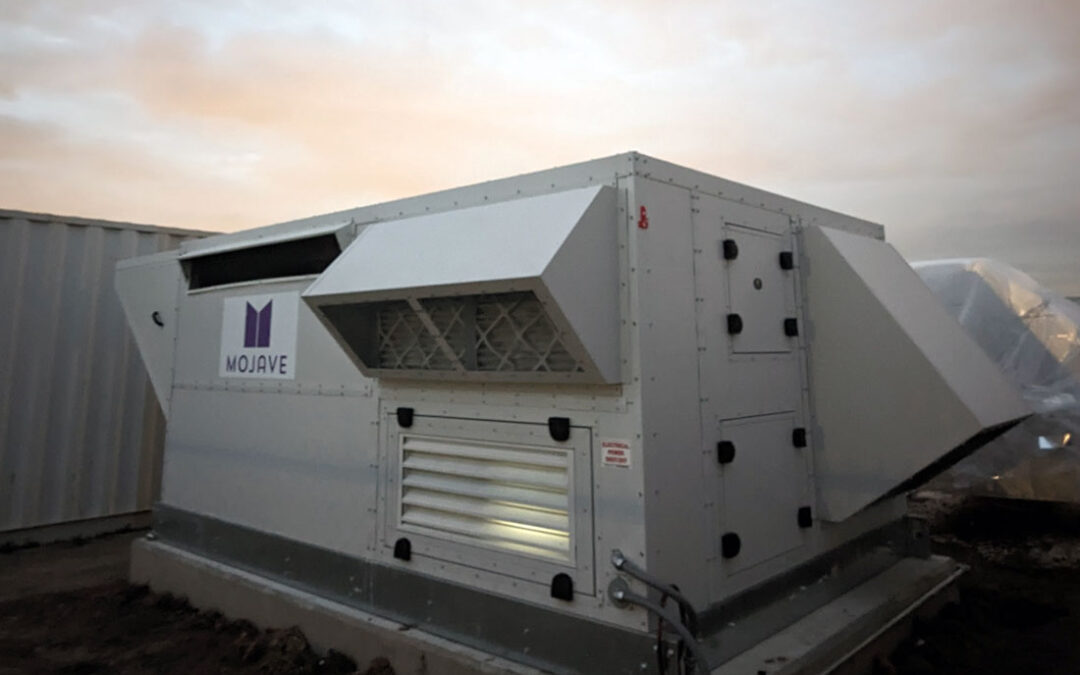
This is why the archive is more than a pleasant anecdote. Its ArctiDry ADA-025C handled 2,100 cubic feet per minute of 100% outdoor air and was specified to remove 138 pounds of moisture per hour. The precise numbers matter because a facility manager cannot buy a slogan. They have to buy a machine that meets a load.
From research project to purchase order
The trip from laboratory to rooftop required a less romantic invention: a product that contractors could actually install. Mojave designed ArctiDry DX as a packaged dedicated outdoor air system, or DOAS, that can take the place of conventional packaged equipment. The basic unit needs an electrical connection; it does not require a building's chilled-water or domestic-water line. Current configurations cover up to 8,000 cubic feet per minute, with heat-pump, gas, electric, or hot-water heating options.
The company began field pilots before its 2024 commercial launch. Its public record shows the steps of a hardware company learning to be a manufacturer: a $12.5 million seed round in 2023, a $2.6 million U.S. Department of Energy grant for scale-up and pilots, and a plan to invest more than $4 million in an Anderson, South Carolina factory. A $9.5 million Series A followed in 2024 as units started shipping. In 2025, Mojave added a reversible heat-pump version, ArctiDry HP, so the same platform could provide winter heating.
The field-hours number is an answer to a practical objection: an elegant thermodynamic idea is of little use to a hospital or grocer if the machine stops. Mojave reported more than 100,000 cumulative operating hours and 99.7% uptime for installed ArctiDry DX units by September 2025. It also listed deployments in manufacturing facilities, libraries, universities, laboratories, retail sites, hotels, grocery stores, and warehouses. Those figures are company-reported; they show a growing field record, not a guarantee for the next installation.
Two ways to buy drier air
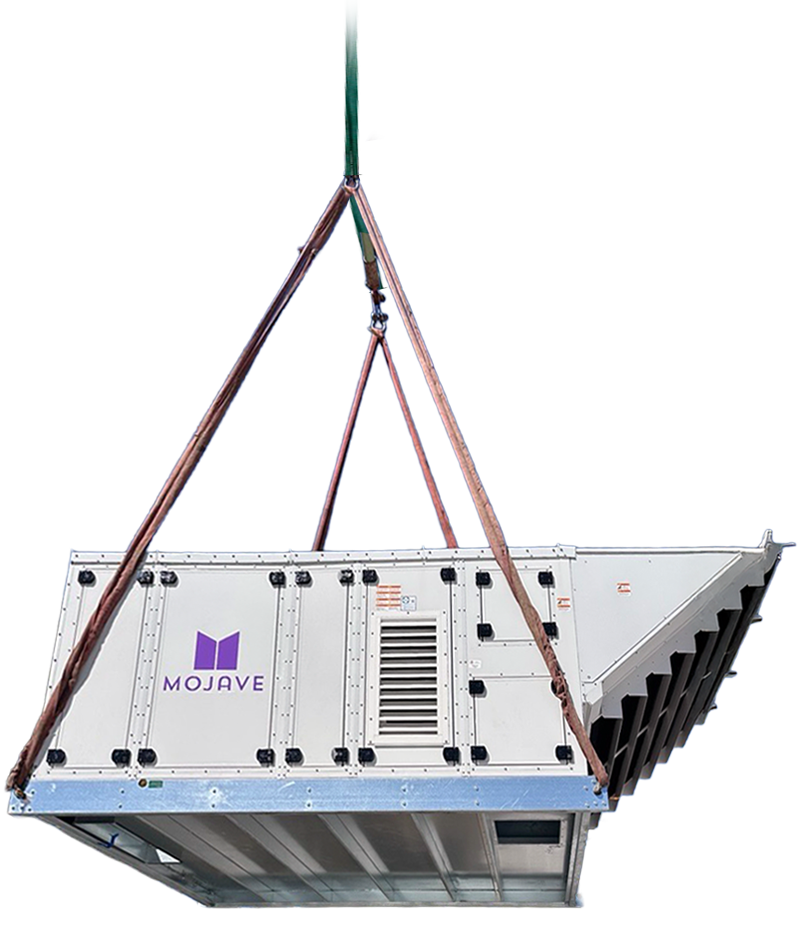
The DX product addresses buildings that use packaged rooftop equipment. ArctiDry Hydro, introduced in 2026, addresses a different buyer: a facility that already has a chilled-water plant. Hydro uses existing chilled and hot water infrastructure and is marketed for supply-air dew points as low as 25°F. Mojave says it can reduce chiller load and improve plant efficiency by up to 20%. That gives an owner another option before adding chiller capacity solely to meet a tougher humidity requirement.
Self-contained outdoor unit. Best fit when a building wants a conventional DOAS replacement without a central water plant.
Hydronic air handler. Best fit when existing chilled and hot water loops can support a deeper dew point target.
The customers are not buying the same thing in every building. A grocery operator may care about condensation on display cases and the refrigeration work caused by moist store air. A hospital may need precise conditions in operating rooms or sterile spaces. A hotel may be fighting clammy guest rooms. A university archive wants the books to survive Florida weather. In each case, Mojave's product is specified through the familiar HVAC chain of engineers, contractors, and regional representative firms.
That channel is itself part of the business. Mojave added nine representative firms across 17 U.S. states in 2024, then more than 20 partnerships across 16 states and five Latin American countries in 2025. A rep network gives a new manufacturer local access to the people who size, specify, order, and service equipment. It also explains why the company's latest $19 million Series B, announced in September 2026, is earmarked for sales capacity, manufacturing, and more products on the ArctiDry platform. The financing was led by Fairtree Elevant Ventures.
The buyer's arithmetic
Mojave says customers report 30% to 60% less energy use than standard HVAC systems and typically see payback in under 18 months. There is no single published equipment price that can be applied to every project. A facility team would need a quote, an installation scope, its own electricity tariff, and a credible comparison system before accepting the payback. The first question to copy from Mojave's approach is simpler: measure the humidity target separately from the temperature target. Then measure how much energy the existing system spends meeting each one.
The approach is most compelling where outdoor air is humid, indoor humidity limits are strict, and the current equipment overcools or reheats to keep up. Where moisture loads are modest, energy is cheap, or existing equipment already meets the specification efficiently, the economic case may be weaker. For Hydro, the building also needs suitable chilled and hot water infrastructure. These are ordinary engineering constraints, not a flaw in the idea.
What makes Mojave interesting is the refusal to treat dampness as an afterthought. A cool room with moldy books is still a failed room. By giving moisture its own control loop, Mojave has made a technical argument that an owner can test in a mechanical schedule, on a utility bill, and, in one Florida building, on the shelves.