The candle flame moved before the company existed. In the dining room of Sam Pardue's 1906 Portland Craftsman, cold air slipped through the original single-pane windows with enough confidence to make dinner flicker. Pardue wanted a warmer house. He also liked what was already there: rippled glass, careful woodwork, and old-growth timber that had lasted a century. Window replacement offered efficiency with a side order of regret.
He began where an operator often begins, with irritation sharpened into a question. Could he add a second layer inside the frame, trap insulating air, stop the draft, and leave the historic window unharmed? Pardue had no background as a contractor. He had an MBA, years in marketing at Intel, and experience turning an improbable camera lens into a real product. This window problem was physical, local, and wonderfully awkward.
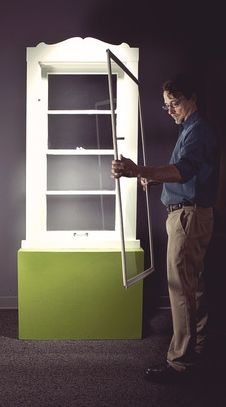
The answer became Indow: a clear acrylic panel edged with silicone tubing, cut to match a specific opening and pressed into place without screws or brackets. It is a product whose best visual trick is restraint. Installed well, it almost disappears. The view remains. The old sash remains. The draft gets the eviction notice.
The house refuses to be square
Pardue first borrowed an idea from the refrigerator. A magnet inside a compression seal could grab a metal frame around the window. The prototype had problems. It required visible hardware, complicated installation, and did little kindness to the trim. So Pardue and an early collaborator removed the magnet. The silicone's own spring force held the insert against the jamb. Subtraction had improved the invention.
“The initial prototype failed. It also didn't look great. We removed the magnet and just used the spring force of the compression seal - and it worked.”Sam Pardue, on Indow's early design
A friend, Mark Pratt, helped turn Pardue's sketch into a working prototype while involved in a backyard construction project at the house. That part of the origin story has the texture of a garage invention, but the next problem was less romantic. Old windows are not tidy rectangles. Houses settle. Frames bow. One diagonal length differs from the other. A panel cut for the ideal opening can arrive as an expensive transparent mistake.
Indow therefore had to invent a method around the object. The company developed laser-assisted measurement, software checks, and a custom manufacturing flow capable of translating an irregular opening into a matching insert. In a 2025 interview, Pardue described a system that gets the fit right on the first attempt in 99.8 percent of cases, even when homeowners do the measuring. The clear panel is the product you can hold. The dependable chain from room to factory and back is the business.
A practiced eye for odd products
Indow was not Pardue's first encounter with an object that seemed too eccentric for a market. After graduating from Carnegie Mellon's MBA program in 1998, he worked as a marketing manager at Intel. In 2004, photographer Craig Strong showed him a creative-effects lens descended from an old optic and a vacuum-cleaner hose. Strong needed someone willing to treat the experiment as a company. Pardue researched the appetite among beta users, helped launch Lensbaby, and built its branding, marketing, and global distribution.
The two products share little at first glance. One bends focus for artistic effect. The other blocks air and noise. Yet Pardue's role sits in the same productive gap: between the charming prototype and the uncharming requirements of commerce. A curious object needs a customer, a vocabulary, repeatable production, and a route through the world. Whimsy may get the first demonstration. Operations pay the freight.
Pardue left Lensbaby's chief executive role in August 2010 to focus on Indow. A year later, the young company won national Energy Efficiency and Sustainability honors at the CleanTech Open and finished second for the grand prize. A Bronze Edison Award followed in 2012. That year Indow announced a $1.3 million financing round to expand sales, marketing, and operations. By the end of 2013, its Series A fundraising totaled $2.6 million.
MBA completed at Carnegie Mellon, followed by marketing work at Intel.
Lensbaby launches, with Pardue helping turn Craig Strong's creative lens into a global product business.
Indow begins in a Portland living room after a failed magnetic prototype points toward compression fit.
CleanTech Open recognition, patent issuance, an Edison Award, and national expansion capital arrive.
Pardue is still explaining secondary glazing, commercial retrofits, and the discipline of testing business ideas.
Preservation by light touch
Pardue has called himself an “accidental historic preservationist.” The phrase is disarming, though his reasoning became deliberate. The original windows in his house contained old material and local craft. An interior insert could improve their performance while passing preservation's reversibility test: remove it, and the unmodified window is still there.
That light touch opened doors beyond the bungalow. Indow produced custom shapes for arched and unusually formed windows. Its inserts were used at Bowdoin College. For Ai Weiwei's @Large installation at Alcatraz, the company supplied panels for the gun gallery, protecting the historic environment without screws or nails. Acoustic versions found an audience in noisy cities. Pardue has said that sound reduction became a larger market than the company initially expected.
The climate case grew alongside the preservation case. Buildings lose energy through their envelopes, while wholesale replacement carries financial and material costs. Pardue's pitch is practical: secondary glazing can improve an existing window instead of sending it away. He served as a voting member of the Oregon Global Warming Commission and participated in the state's forest-carbon discussions. He has also written and spoken publicly about rural preservation, climate policy, and commercial building decarbonization.
His public language keeps returning to scale. In an interview for AIM2Flourish, Pardue described the company he imagined as a “self-perpetuating carbon mitigation machine,” growing its impact each time another customer chose efficiency. The phrase is grander than the object, which is precisely its charm. Decarbonizing buildings is usually pictured as heavy work: scaffolding, demolition, cranes, new mechanical rooms. Here, part of the proposition arrives in a shipping box and presses into a wooden frame. The climate ambition travels through a domestic annoyance, and the customer can feel the change before calculating it. A room loses its draft. A street becomes quieter. The abstract tonnage of emissions has an immediate, human accomplice.
“I sometimes refer to myself as an accidental historic preservationist.”Sam Pardue, PreserveCast
There is a mild paradox in selling an environmental product. Customers rarely wake up longing to purchase carbon mitigation. They want the dining room warmer, the bedroom quieter, or the afternoon sun less punishing. In a 2025 podcast, Pardue discussed the need to market what people immediately value while the emissions benefit accumulates behind it. Climate virtue may be part of the story. Comfort closes the window.
What founders can borrow
Indow's useful lesson is to map the entire outcome. The insert needed a seal, but the company also needed a way for non-specialists to describe crooked frames accurately. Product design continued into measuring tools, software validation, custom fabrication, shipping, instructions, and removal. The physical object is only one link in the customer's success.
The factory as another prototype
Pardue's attention to systems was visible when circumstances forced Indow to rethink its factory operations in 2020. Office employees could work remotely; manufacturing employees could not build custom inserts from their kitchens. The company used lean methods to revise movement and work practices, then shared materials through an initiative called Clean Practice. Oregon Entrepreneurs Network recognized the effort with its 2020 Give Award.
The episode fits Pardue's wider style. Colleagues describe an executive who gives people room to work, while Indow's own management page calls him “The Planter,” someone who creates stable conditions and nurtures projects. He remains active across product development, marketing, and funding. He also allows a playful streak into the sales work. Indow once used Bigfoot, shivering in a winter cabin, to explain a product category many buyers had never encountered. A sasquatch can carry quite a lot of building science.
After more than a decade, Pardue's founding problem has expanded from one old house to homes, offices, hotels, historic sites, and commercial retrofits. The company now offers inserts for heat, noise, ultraviolet light, privacy, and other needs. Recent work has explored high-performance commercial secondary glazing. Yet the original argument remains intact: precision can make restraint perform.
A window is supposed to edit the boundary between inside and outside. It admits light, frames a view, sheds weather, and occasionally lets a cold draft bully a candle. Pardue's contribution was to notice that the boundary could be improved without erasing it. The result is clear, custom cut, and easy to overlook. For once, invisibility is excellent branding.
Open another window
Explore Pardue's work, interviews, company, and demonstrations.