Sam Pardue’s business began with a candle that would not hold still. In the dining room of his 1906 Portland Craftsman, cold air slipped through the original single-pane windows hard enough to make the flame flicker. The obvious fix was replacement. It was also the fix Pardue least wanted: those sashes contained old-growth wood, architectural character and a great deal of embodied history. He wanted the draft gone, not the house edited.
So, in 2010, Pardue began experimenting in his living room. The problem looked simple: add a second transparent layer on the room side of the existing glass, trap a pocket of insulating air and stop infiltration around the edges. The difficulty was holding that layer tightly in an opening that might be bowed, racked or cheerfully non-square after a century.
His first answer borrowed from the refrigerator. A magnet sat inside compression tubing and grabbed a metal frame around the window. It failed. Worse, it looked like hardware had colonized the trim. Pardue and an early employee deleted the magnet, kept the silicone and let its spring force press directly against the jamb. The inelegant prototype had revealed the elegant product.
“The initial prototype failed. It also didn’t look great. We removed the magnet and just used the spring force of the compression seal - and it worked.”Sam Pardue, founder and CEO
A second window that does not act like construction
Today, Indow makes custom sheets of acrylic edged with a patented silicone compression tube. A customer pushes the panel into an interior frame step. No nails. No adhesive. Usually no mounting bracket. The original window remains operable once the insert is removed, and the view stays largely unchanged because the product is designed to disappear.
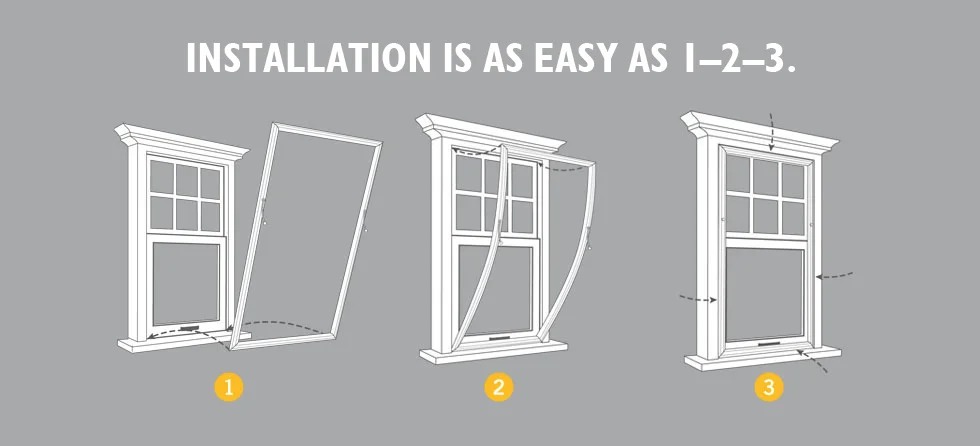
That restraint is the differentiation. Shrink film is cheap but seasonal, fragile and visibly temporary. Traditional storm windows can add frames or exterior visual weight. Full replacement can repair broken hardware and rotted sash, but it is expensive, disruptive and often unwanted in a landmark building. Indow occupies the middle: a fitted, reusable building component mailed to the customer.
The product, reduced to physics
glass
air
insert
seal
Thermal performance comes from the extra layer and reduced air leakage. Acoustic performance improves with a larger air gap and the thicker 1/4-inch panel.
The catalogue has expanded around specific annoyances. Thermal inserts use nominal 1/8-inch acrylic. Acoustic inserts double that thickness. UV-blocking versions protect art and upholstery; translucent panels trade the view for privacy; blackout panels cater to bedrooms and home theaters; heavy-duty surfaces tolerate busier commercial settings. Published pricing begins around $30 per square foot for Thermal inserts and rises to roughly $39 to $43 for specialty grades, before shipping and tax. A three-by-four-foot opening, in other words, is a several-hundred-dollar decision, not an impulse purchase.
The measurement kit is part of the product
A compression fit has no tolerance for optimistic tape-measureing. Indow screens the opening from photos and rough dimensions, then sends a laser kit for production measurements. The customer records the top, bottom, left and right edges plus both diagonals. Proprietary software translates that lopsided hexagon of data into a cut path at the Portland factory. The same remote workflow lets Indow sell custom building material like e-commerce without pretending the building is standardized.
Qualify the frame
Check photos, hardware and the continuous frame step. Most installations need at least 5/8 inch of usable depth.
Measure the oddness
Capture six laser dimensions, including diagonals. The crookedness is information, not a defect in the form.
Press, test, repeat
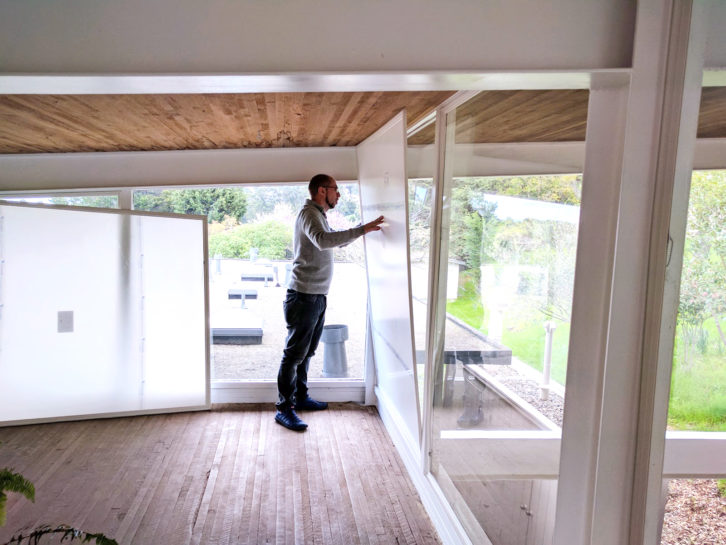
Install the labeled panel by hand. Commercial buyers can test the worst room before ordering for the whole property.
This is also where the business can wobble. A 2020 secondary-window market study described The Society Hotel in Portland sending a few units back to be recut. Pressure changes from doors opening and closing broke the seal on some larger windows, leading the owners to devise clips. The hotel still reported warmer, quieter rooms and expanded its use of the inserts. The lesson is more useful than a spotless case study: custom fit works when the opening, measurement and building pressure cooperate.
Comfort sells better than carbon arithmetic
Indow belongs to climate tech, but its customers arrive through ordinary discomfort: the bedroom facing traffic, the nursery beside an airport, the hotel suite above a nightclub, the parlor where the heater never quite wins. The company says its inserts save an average of 20 percent on heating and cooling and can reduce window-borne noise by up to 70 percent. Those are not universal promises. They are upper-level outcomes shaped by the original glazing, frame leakage, air gap, climate and the other paths sound can take.
Independent energy work gives the thermal claim some ballast. A monitored Seattle retrofit of 27 windows reported about 21 percent annualized HVAC energy savings and an 8.6 percent reduction in whole-house air leakage. The inserts cost roughly $5,600 in that study, while modeled annual electricity savings were $69 at the local rate. Utility-bill payback alone was therefore long. The missing line on a spreadsheet was comfort: a warmer interior surface can let residents lower the thermostat without feeling punished by the window.
That insight explains Indow’s market. People do not buy an acrylic panel because its U-value makes lively dinner conversation. They buy a tolerable seat beside the glass, sleep without trucks in the pillow and preserve the rippled window that makes the house theirs. Energy and avoided replacement are the financial supporting cast.
Start with the room that complains
Residential orders are mostly direct: estimate, consultation, measurement kit, fabrication, shipment. Commercial sales add a shrewd proof mechanism. Indow invites hotels, offices, apartments and government buildings to choose their worst offender and run a pilot with no large minimum. At an Embassy Suites in Orlando, management reportedly slept in the noisiest suite for 90 days before outfitting 167 windows. The broader installation took one day, and the hotel estimated noise complaints fell by 80 percent.
That is the idea another operator can steal. Do not ask a skeptical buyer to believe a building-wide model. Find the space where pain is measurable, install the smallest complete solution and let occupants notice. The same play works for lighting, acoustics, air quality and workflow software. A pilot should not be a miniature demo. It should solve one real problem end to end.
When this does not work
An insert cannot repair rot, broken locks or failed insulated glass. It needs a continuous frame step, usually at least 5/8 inch deep, with clearance from blinds and hardware. It reduces sound through the window, not through walls, doors or vents. Egress, ventilation and large-panel handling still matter. If those conditions fail, replacement, restoration or another sound-control treatment may be the honest answer.
Indow remains a small private manufacturer, with a supplied headcount of about 39 and estimated annual revenue of $9.6 million. Public financing records show a $1.3 million Series A in 2012, a $1.5 million Series B in 2015 and later debt. Its durable advantage is not acrylic, which anyone can buy. It is the stack around it: compression-seal engineering developed with Cooper Standard, remote qualification, measurement software, custom production and the accumulated judgment to say which window is a bad candidate.
A factory with a preservation habit
The Portland operation handcrafts each insert and sources its core materials in the United States, according to the company. That makes Indow look less like a software startup than a small industrial system with software in the joints. Its management describes using Certified Lean practices, while its published vision is unusually specific about who should benefit from efficiency: workers through wages, the company through reinvestment and customers through lower prices. Lower prices, in turn, are supposed to put more inserts in windows and more carbon out of the atmosphere.
The mission also explains the company’s partnerships. Cooper Standard’s industrial group helped formulate the silicone and design the extrusion die, then stayed involved as the seal evolved. Preservation groups gave Indow an audience already suspicious of replacement. Portland State researchers and a federal laboratory supplied performance testing that a clever gasket could not provide for itself. The company’s culture page adds a slightly Portland tally: its leadership team claims 10 renovated historic homes and 65 bicycle miles per week.
There is a useful boundary here. Indow is not vertically integrated all the way to molecules, nor does it need to be. It owns the product geometry, fit process, customer workflow and fabrication knowledge, while relying on a specialist for a material whose long-term compression behavior is central to the warranty. Founders often hear that they must own every critical layer. Indow’s version is more practical: know which layer is critical enough to deserve a 12-year engineering relationship.
Pardue’s original window was not asking to be replaced. It was asking for a reversible second layer. The company that grew around that distinction offers a modest but repeatable product lesson: preserve what already works, measure what does not, and remove the magnet if the magnet is only there because the first sketch looked clever.