A website owner wanted an email signup box, 600 pixels wide, with a red animated arrow pointing at it. On September 26, 2011, a representative signing herself Sofia answered the request with an offer of designers and programmers, then asked for detailed requirements before preparing a quote. It was a tiny assignment with a wonderfully unglamorous purpose: get someone to type an email address into a rectangle.
That exchange is a useful introduction to WickedInnovations. Behind the exuberant name was a web-services business pursuing the everyday work of the commercial internet. Its offering covered the visible surface of a site and the machinery underneath: design, development, ecommerce, database integration and marketing. The animated arrow was one possible job. A custom application was another.
The company's public description placed its designers, programmers and internet marketers in the Philippines. Its pitch was international and price-conscious. The interesting question was how a team selling work across a screen could earn enough confidence to start a conversation, agree a brief and get hired. The surviving sales exchanges make that process unusually tangible.
The customer who brings a friend
WickedInnovations supplied a memorable number in a case study published in the International Trade Centre's 2014 Social Marketing for Small Businesses: approximately 30% of its customers came through referrals. This was the company's historical account, rather than an audited measure or a present-day result.
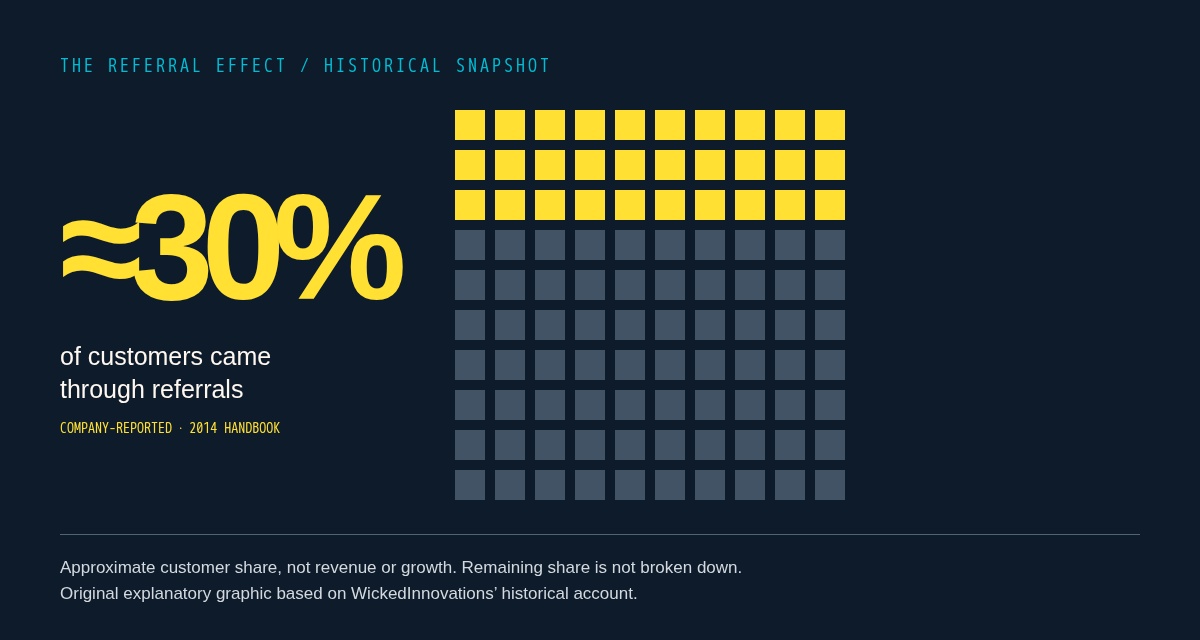
Its explanation was straightforward. Social posts kept prospects and customers aware of promotions; sharing buttons let those updates travel to friends. Interested people could then approach the sales team. The company considered advertising expensive, email potentially limited or unwelcome, and search too competitive to carry the whole effort alone.
That reasoning gives the agency an appealing wrinkle. A business selling search optimization was also explaining the limits of relying on search. It wanted people to encounter the name through relationships, too. A recommendation could give a subsequent sales conversation a more familiar starting point.
A whole website, or the awkward little bit
WickedInnovations' company profile describes an integrated service menu. For a business commissioning an online shop, that meant an advertised combination of ecommerce work, visual design and database integration. For a company establishing its identity, the menu extended to graphics and corporate identity. Multimedia presentations sat alongside the website services.
The distinction matters to a buyer. A website can look complete while still needing a working form, a usable editing system or a connection to stored information. A design brief describes appearance; a development brief must also describe behavior. An agency offering both invites the buyer to discuss those requirements together. Whether that saves time depends on how well the actual work is coordinated.
Archived requests show the smaller end of that market. In an October 2011 forum thread, a prospect wanted to change the way users replied to posts, making text and image insertion easier and expanding font choices. Sofia offered to take on the project and said she had sent details privately. The public exchange records a sales approach, not evidence that the assignment was completed.
WordPress work appeared in the same period. Representatives using WickedInnovations email addresses responded to requests for plugin development and add-ons. In another thread, they offered programmers for a social-networking script. These were buyers with particular changes in mind, a useful reminder that web development includes improving an existing property as well as launching one.
Web design, graphics, corporate identity
Custom development, ecommerce, databases
SEO and internet marketing
The price begins with the brief
The animated-arrow reply is revealing because of its sequence. The representative asked for full requirements before preparing a price. A separate September 2011 response to a WordPress add-on request followed the same pattern: specify the work, then receive a quote. The commercial unit was a discussed assignment.
For anyone comparing agencies, that sequence is worth copying. A page count leaves too much out. Five pages might contain static text and photographs, or account access, a searchable catalogue and a payment process. The work changes with those decisions. A useful brief describes what visitors must be able to do and what the owner must be able to change afterward.
The same discipline applies to something as small as the signup box. Where should the address go? What should happen after submission? Who supplies the wording? How should the result be approved? Those are proposed buying questions, not a reconstruction of this particular customer's project. They explain why even a small visual request can need a conversation before it gets a number.
WickedInnovations advertised affordability, and a 2006 promotional post explicitly framed offshore work as a way to obtain quality and productivity without spending more. That was a sales claim. A buyer should compare the agreed deliverables, revision terms and handover responsibilities before treating a lower quotation as a saving. The relevant cost is the work needed to reach an accepted result.
The portfolio had a speaking part
Sofia's forum signature invited prospects to judge expertise through the work itself. Beneath it was a link to the company's portfolio. It was an appropriate invitation for a service whose output could be inspected before the first call.
“The best way to show our expertise is to present our work...”
Sofia Arce's historical sales signature
A portfolio can answer an early question faster than a long capabilities statement. Does the work resemble the kind of thing the buyer needs? The next questions require more care: what did the team contribute, what functions did it build, and how closely does that example match the proposed assignment? Visual resemblance is a starting point for evaluation.
The sales effort also extended beyond programming. In December 2011, Marie Cruz replied to a request for affiliate banners. In a separate thread, representatives offered writers for press-release work. By October 2012, Marie was offering web experts to a prospect seeking a new site. The range supports a picture of a service business pursuing both whole projects and individual production tasks.
Those posts put WickedInnovations in a crowded, practical market. Its alternatives were other agencies, individual designers, programmers and writing providers responding to the same needs. Its advertised advantage was access to several kinds of expertise through one team, combined with a cost-conscious pitch. A broad menu is useful when the brief crosses disciplines; it still needs relevant examples to make the case.
When the pitch entered the wrong room
One early exchange shows the friction in public prospecting. A May 2006 post promoted WickedInnovations' web and multimedia services on a technical discussion forum. A respondent objected to the unsolicited promotion and questioned the professionalism of posting it there. The criticism concerned the marketing approach, not a reported customer delivery.
That distinction keeps the episode in proportion. It was a public rebuke, not proof of a failed business. But the contrast with later job-thread replies is instructive: in one setting, someone was broadcasting a services list; in the other, a potential buyer had already described work they wanted done. The surrounding conversation changed the meaning of the pitch.
A small agency can apply that observation without copying the wording or the platform. Read the request. Answer the specific problem. Offer a relevant example. Explain what information is needed next. A generic introduction makes the recipient do the work of deciding whether the provider belongs in the conversation.
Flash, banners and the business underneath
The early service vocabulary has period charm. Flash websites, animation and multimedia demonstrations appeared in a 2006 promotion, alongside HTML websites, interface design and custom applications. Another post advertised database-driven sites, banners and photo and video editing. The list captures a business willing to handle several forms of online production.
A public professional profile for Marie Cruz adds another view of that breadth, listing WordPress themes, landing pages, ecommerce, content management and PHP/MySQL among her skills. Read beside the job replies, it helps explain the agency's emphasis on designers and programmers working within the same offering. The work could move from a promotional image to a technical change.
The useful distinction for a prospective customer is therefore the task, rather than the agency label. A narrowly defined visual assignment may suit a specialist. A site that needs design, custom behavior and marketing assets may justify a broader team. An owner who wants to control every production decision may prefer direct individual hires. These are different buying situations, not a ranking of providers.
A recommendation still needs something behind it
The company's historical social-media advice put customer satisfaction first and warned that disappointed customers could also spread their experience. That is the condition beneath the referral story: distribution can carry complaints as readily as praise.
For a business studying WickedInnovations, the transferable idea is a sequence of ordinary actions. Describe the work clearly enough to price it. Show an example that makes the proposed approach credible. Deliver something the customer can recognize as meeting the brief. Keep the subsequent conversation useful. Make an introduction easy when the customer has someone to introduce.
None of that turns a referral percentage into a forecast. It does explain why the agency's small sales exchanges are worth reading. The customer with the animated arrow did not begin with a grand digital strategy. They began with a specific thing they wanted on a page. WickedInnovations answered with people who could discuss building it. That is where much of the web business starts.