Consider the conference lunch break. Hundreds of people have travelled to the same building because they care about roughly the same thing. They have badges, credentials and something to say. Yet finding someone to eat with can still feel like the hardest assignment of the day. Whova’s founding idea lives inside that small absurdity: proximity needs a little help.
- The job: connect attendees, then handle the machinery around them.
- The buyer: organizers of conferences, association meetings, trade shows and corporate events.
- The catch: attendees use it free; organizers need a custom quote.
A computer scientist walks into a conference
In 2013, UC San Diego computer science professor Yuanyuan Zhou and her colleagues began developing Whova. University reporting identifies four co-founders: Zhou, Weiwei Xiong, Soyeon Park and Tianwei Sheng. Their connections ran through research groups at UC San Diego and the University of Illinois. Networking was a problem they understood personally.
Zhou described the approach as “using geeky ways to help geeks like us to know how to socialize.” That is a refreshingly specific ambition. A conference programme tells you where to go. An attendee profile, a message or a suggested meetup can give you a reason to approach someone once you arrive.

The team did not begin charging until late 2014. By May 2016, UC San Diego reported that the app had reached more than 3,000 events in 80 countries. Today, Whova’s pricing page reports 50,000-plus events across more than 170 countries and over 15 million users. These are company-reported totals, rather than a count of annual paying customers.
The lunch button is the point
Whova’s attendee app includes personalized agendas, messaging, live polls, Q&A and a Community Board for discussions and meetups. The features sound familiar in isolation. Their usefulness becomes clearer in a small detail from the company’s Adidas Engineering Day case study: organizers added networking prompts directly to the agenda.
“Find a Lunch Mate!”
An agenda prompt at Adidas Engineering Day
There was also a dinner prompt. Whova reports 1,390 networking interactions during the training event. The interesting part is the invitation’s modest size. It asks someone to solve an immediate problem with another person. An organizer can copy that approach: make the next social action obvious, useful and easy to accept.
That still requires participation. An empty discussion board offers little reason to return. The practical implication is to introduce the app before arrival, give people a few worthwhile prompts and have someone answer questions. Software can lower the effort of starting a conversation. Attendees supply the conversation.
First, keep the agenda from disappearing
The company has expanded into the less glamorous work surrounding those introductions. Registration, ticketing, speaker information, abstract submissions, websites, badges and kiosk check-in sit alongside sponsor and exhibitor tools. Its expertise lies in connecting event operations with the attendee experience: the schedule somebody edits is the schedule somebody else follows.
DEKRA’s Safety in Action conference supplies a concrete example. In Whova’s account, organizers’ previous app sometimes lost session and speaker details and offered limited attendee interaction. The replacement needed to earn trust on basics. Whova’s Agenda Center organized 70 sessions, while its conflict checker helped identify overlapping rooms, speakers and times.
Organizers could update room assignments and give attendees personal agendas. Sponsor pages and rotating banners added visibility. This is a vendor-published customer account, but its sequence is instructive: dependable information makes participation easier. Nobody wants to network while wondering whether the workshop next door still exists.
One gathering, two ways in
Whova serves associations, universities, government teams and businesses as well as conference producers. Independent examples include the Society of American Archivists’ 2026 conference and the University of Hawai‘i Community Colleges’ HISSI event. The common requirement is a shared place for schedules, people and updates.
Hybrid events sharpen that requirement. Seedbed’s September 2021 New Room Conference brought remote and in-person participants into Whova. The company’s case study reports more than 5,500 messages over three days, around 1,000 personalized agendas and 30 meetups. The Community Board gave both audiences somewhere to join the same discussion.
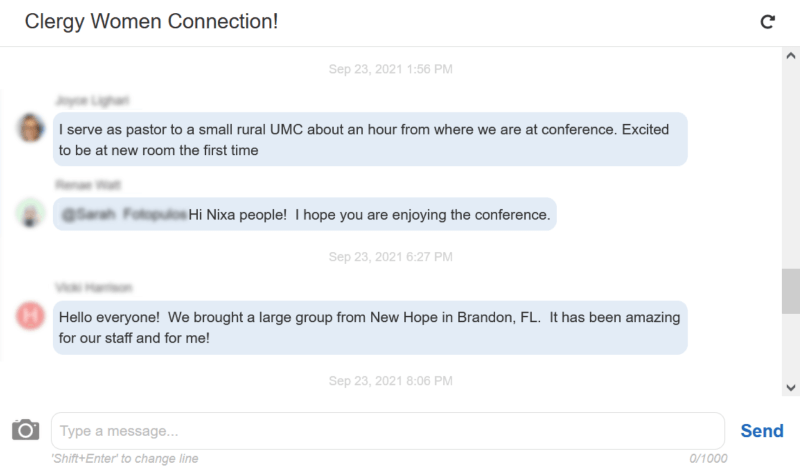
Messages measure activity, however, and activity does not establish lasting relationships or financial returns. Those require follow-up. This matters when comparing Whova with Cvent, Bizzabo, EventMobi or Swapcard: buyers should test their own agenda, networking and exhibitor workflows. A simpler ticket sale may call for a lighter tool such as Luma or Eventbrite.
The bill has several moving parts
Organizers pay; the attendee app is free. Whova quotes platform pricing according to event size and selected services. A published registration article lists a fee of 3% plus $0.99 per paid ticket. Its support documentation adds that registration and Stripe processing fees depend on country and currency. Buyers need the applicable terms.
At the published 3% + $0.99 rate. Before payment processing and any separately quoted platform costs.
Virtual delivery can add another bill. Whova’s Zoom setup guide explains that concurrent streams require appropriate Zoom accounts or licenses. The useful budgeting habit is to separate platform access, ticketing, payment processing and streaming. A per-ticket calculation alone will not tell you what the event costs.
Keep the work after everyone leaves
Recent releases extend Whova beyond conference day. February 2025 brought MicroEvents, an annual add-on to standard large-event packages for smaller gatherings, webinars and on-demand content. In 2026, Whova added a project management portal, registration-data export to MemberClicks and tools for handing templates to a successor.
October also brought sponsor branding for leaderboard contests. Together, these updates show a company pursuing more of the organizer’s working year. The original problem remains recognizable: useful connections need preparation. Sometimes that means a reliable room assignment. Sometimes it means preserving next year’s registration form. And sometimes it means giving somebody permission to ask who is free for lunch.