A delivery bicycle has an unusual talent: when it stops working, it can stop a person’s income with it. A flat tire is ordinary bad luck for a commuter. For someone carrying dinner across town, it can mean losing the evening’s orders while still owing the month’s bills. The machine is small. The consequences have an excellent appetite.
- Whizz gives couriers an e-bike without requiring a large upfront purchase.
- Repairs, battery swaps and theft recovery surround the monthly plan.
- The useful comparison is total cost and working time, not the advertised payment alone.
The customer with no spare Tuesday
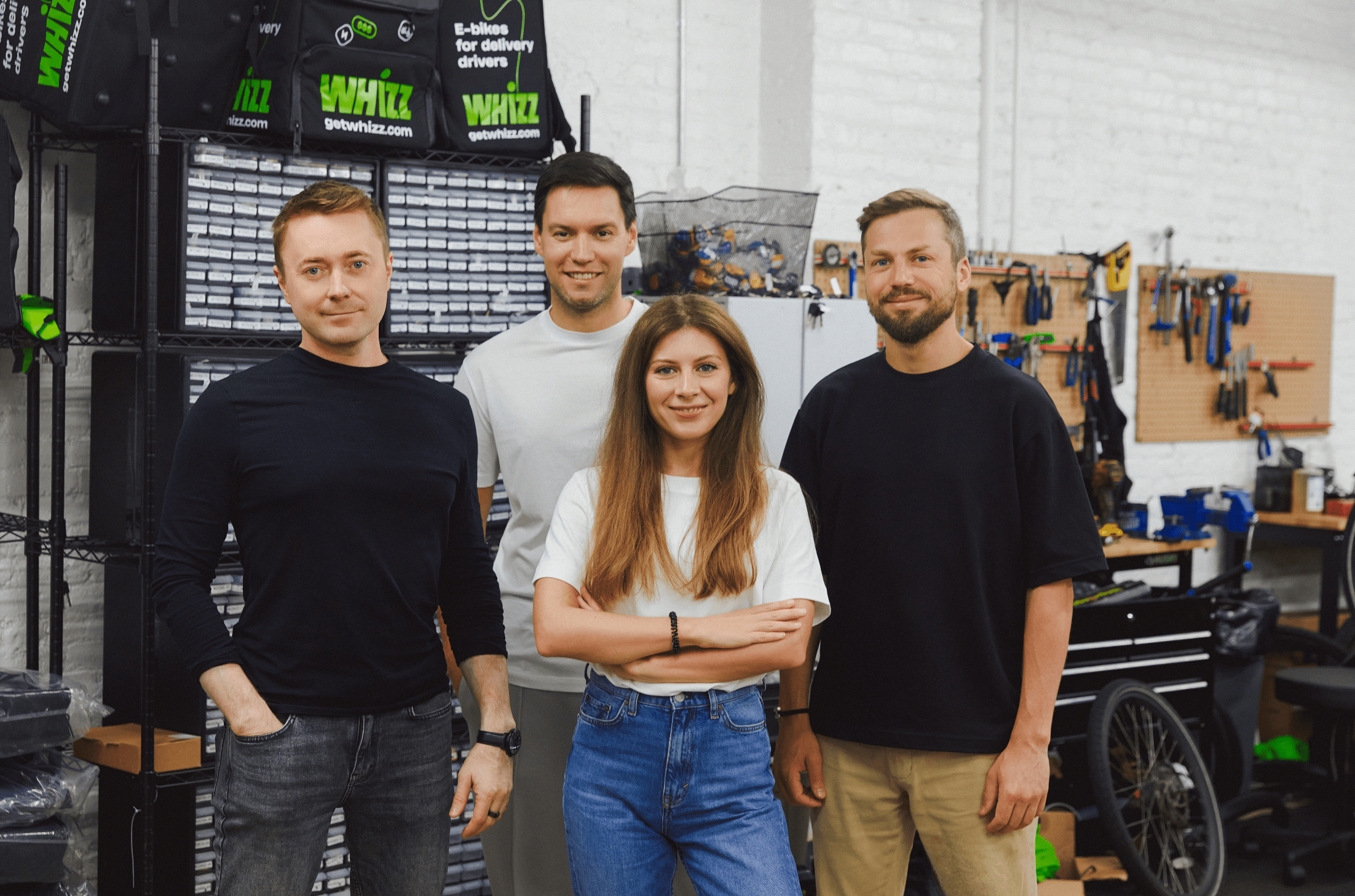
Whizz started in February 2022, according to co-founder and CEO Mike Peregudov. Alex Mironov, Ksenia Proka and Artem Serbovka were the initial founders; Peregudov first came aboard as an investor and adviser. The founders were immigrants themselves. They understood a particular predicament: a person could be ready to work and still lack the credit history or cash needed to obtain the equipment.
That observation gives the company its shape. Whizz serves independent delivery workers, including riders earning through DoorDash and Grubhub. Its website says more than 20,000 riders have joined. That is a cumulative customer claim, rather than a count of bicycles currently on the street. The distinction matters: a busy rental business can serve many people with the same machine.
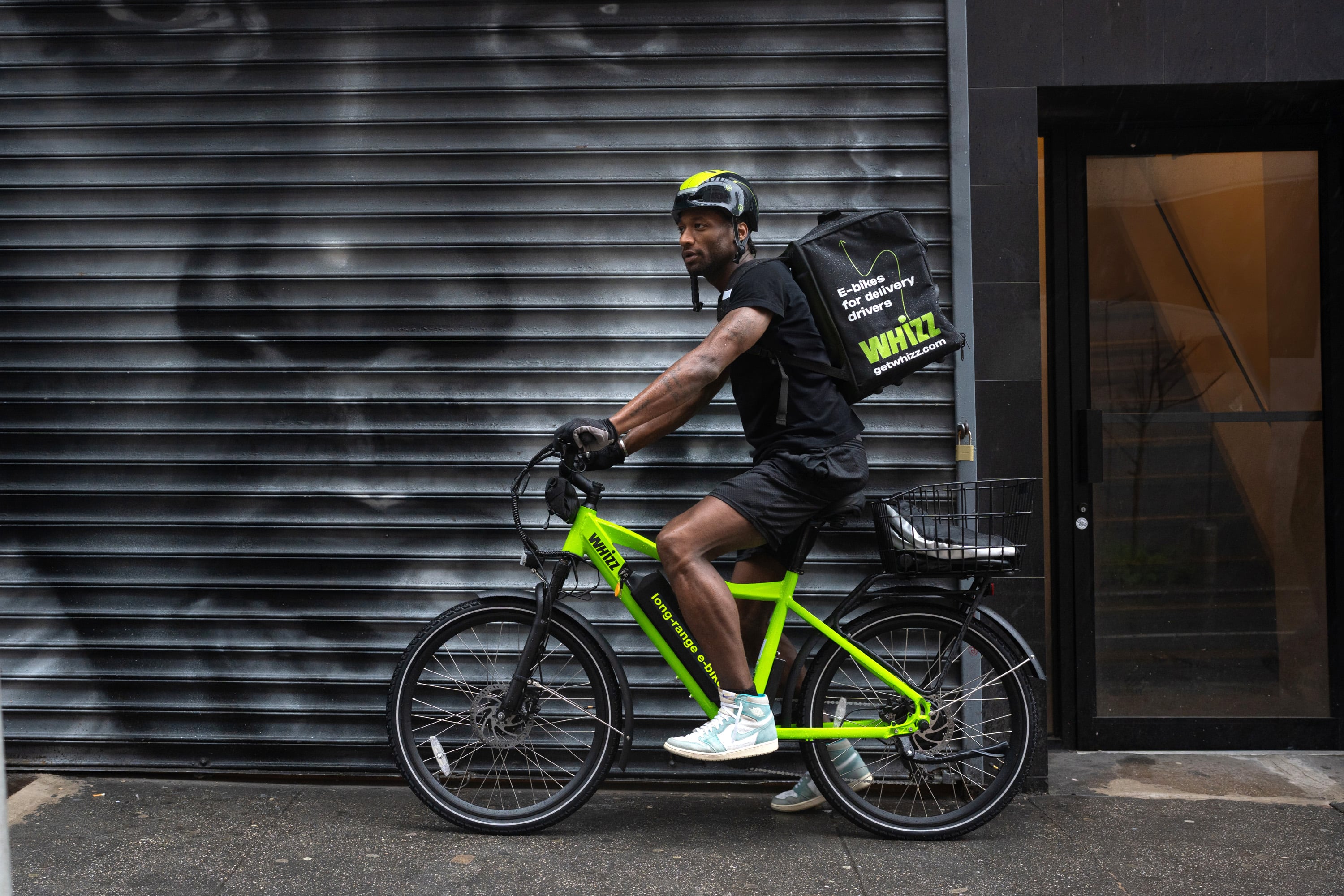
The founders brought delivery experience with them. Peregudov told Modern Delivery that he had previously built a meal-kit company, while his colleagues had operated a related rental business. Whizz applies that knowledge to the space between getting an order and completing it: vehicle access, upkeep and the small mechanical indignities that software cannot pedal away.
The monthly price has a second line
The Storm-2 illustrates the offer. Its product page advertises up to 85 miles of range, a 20 mph maximum speed and GPS tracking. Those miles are a ceiling, not a promise for every loaded shift. Terrain, weather and riding habits make their own amendments. Whizz also offers Thunder and Monster models, advertising up to 100 and 120 miles respectively.
Riders can pay weekly or monthly, buy refurbished bikes, or work toward ownership. The advertised monthly rent-to-own arrangement requires twelve payments and an optional $99 buyout. At the $179 monthly rate displayed on the dedicated Storm-2 page when checked, the base ownership arithmetic is $2,247. Prices differ across plans and promotions; this example excludes tax, additions and repair charges.
A new bike can require another $99 down payment. The optional monthly Protection Plan adds $19 plus tax. Whizz’s August 2026 repair list specifies a $9 service fee per request, alongside separate damage charges. Included maintenance therefore deserves a careful reading. The distinction between ordinary wear, chargeable parts and damage is where a tidy monthly number can become untidy.
Ownership changes the relationship, too. Someone returning the bike before buyout is paying for access. Someone completing the program acquires an asset, with future upkeep to consider. Whizz advertises a separate WhizzCare membership for owners. For the customer, the sensible question is how long the bike will be useful and how much income must support each payment.
A cabinet buys back the afternoon
Even a healthy bike eventually encounters an empty battery. In June 2025, Whizz announced battery swapping with PopWheels. The rider exchanges a depleted compatible battery for a charged one at a cabinet. Charging continues elsewhere while the courier returns to work. This is an infrastructure answer to a scheduling problem.
“There is no secret sauce”Mike Peregudov, Modern Delivery, June 2024
The division of labor is precise. PopWheels owns and operates the cabinets; Whizz owns the participating batteries. Cabinet locations and access can be checked through the rider account or app. Swapping is offered in New York, Washington, D.C. and Philadelphia, with availability tied to compatible equipment and plans. A cabinet across town is rather less helpful than one along the next delivery route.
New York’s advertised monthly swapping add-on is $49. Eligible Storm-2 and Thunder rent-to-own plans in D.C. and Philadelphia include it. Riders must compare the local offer, not borrow a price from another city. Extra range has value when it replaces a charging interruption; an occasional rider who finishes before the battery empties may have little reason to pay for more.
The city becomes part of the experiment
Whizz’s proposition has attracted customers beyond individual couriers. New York’s e-bike trade-in program specifies a certified Whizz Storm 2 and an additional certified battery for eligible participants exchanging qualifying equipment. The purchase decision becomes a public-safety decision as well: cities have an interest in what riders charge inside homes and shops.
In Washington, DDOT’s delivery pilot launched in July 2025 with thirty participants, Whizz bikes and PopWheels cabinets. LACI supplied funding and program support. A January 2026 presentation reported more than 51,000 e-bike miles through November 2025, an average of thirteen daily swaps across two cabinets, and 99% cabinet uptime. These are operating measures, not proof of a particular increase in take-home pay.
Two cabinets. Initial cohort: 30 riders. DDOT reported these figures in January 2026.
The same presentation outlined a second cohort with DoorDash subsidies. That is a revealing development: delivery platforms can help finance the equipment their contractors need without becoming the bike operator. For Whizz, partnerships bring customer access alongside the ordinary business of maintaining machines.
Copy the repair network
Expansion requires capital. The $12 million financing announced in 2024 combined $5 million of equity with $7 million of venture debt, according to Peregudov. Investor Flashpoint reported more than $8 million in annual recurring revenue at the time. Debt helped finance fleet growth; keeping that fleet useful requires shops, mechanics and disciplined operations.
Alternatives make the trade-off clearer. JOCO offers shared delivery bikes that must return to a location within its rental window. Whizz lets the rider keep an assigned bike and pursue ownership. Buying outright offers another calculation. Storage, charging access, nearby repairs and expected working hours determine which arrangement earns its place.
The lesson other businesses can borrow is concrete: map the interruption your customer cannot afford, then price the service that shortens it. Whizz’s method depends on enough nearby riders to support the physical network. Where repair trips are long, cabinets are inconvenient or delivery demand is weak, the monthly obligation remains. A bicycle can carry dinner. It cannot manufacture orders.
Keep riding, keep reading
Whizz plans · Repair prices · Battery locations · Rider blog
LinkedIn · X · Instagram · Facebook · TikTok
Storm video manual ↗ · Breeze video manual ↗ · CEO interview ↗ · D.C. pilot announcement ↗